
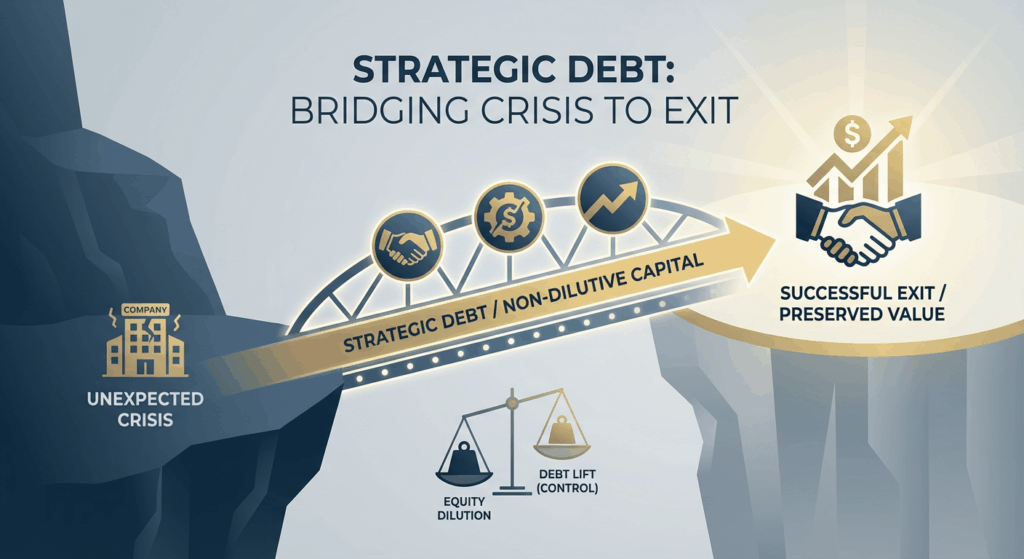
The Venture Treadmill vs. The Strategic Bridge
For many SaaS founders, the playbook is rigid: build, pitch, raise equity, repeat. It is a cycle that fuels growth but often at the cost of the very thing entrepreneurs value most, control and ownership upside. But what happens when the equity markets freeze, or term sheets dry up, right when a company needs fuel to scale?
This was the precise dilemma facing Simon Turner, co-founder of retail sales enablement platform Myagi, in early 2020. His decision to pivot from a planned equity round to a debt facility offers a masterclass in capital allocation. By choosing non-dilutive capital at a critical inflection point, Turner preserved the cap table and successfully bridged the company to a strategic acquisition, demonstrating that the “expensive” cost of interest is often far cheaper than the permanent cost of dilution.
The Story: A Pandemic Curveball
Myagi, founded by Turner to digitize the retail sales training process, had found strong product-market fit by connecting brands with frontline retail staff. By March 2020, the company was poised for a significant equity raise to fuel its next stage of growth.
Then the world shut down. The COVID-19 pandemic froze venture capital deployments and sent shockwaves through the retail sector. While physical retail paused, the demand for digital retail solutions skyrocketed. Myagi was sitting on a massive opportunity to capture market share, but the planned equity injection was no longer a certainty, or at least, not at the valuation they had expected.
The company faced a classic \”good problem\” with bad timing: they had their best six months of growth ever, but their capitalization strategy was derailed. Raising equity in a distressed market would likely mean a \”down round\” or punitive terms that would crush early shareholders and the founding team.
The Decision: Capping the Downside
Turner and his team had to choose between two paths:
- The Dilutive Path: Force an equity round in uncertain market conditions, likely giving up 20-30% of the company for the capital needed to grow, permanently reducing the founder’s share of any future exit.
- The Leveraged Path: Secure non-dilutive capital based on their recurring revenue metrics, accepting interest payments and covenants in exchange for keeping the cap table intact.
In early 2021, Myagi chose the latter. They partnered with TIMIA Capital to secure a $2.5 million investment facility. The logic was clear: the company had the recurring revenue to service debt, and the capital was needed specifically to invest in sales and product capabilities that would increase the company’s enterprise value ahead of an exit.
As Turner noted in a case study regarding the deal, \”Debt is a powerful tool for capital-efficient businesses when used under the right circumstances.\” They wagered that the cost of servicing the debt would be significantly lower than the value of the equity they would otherwise have to sell.
The Outcome: A Clean Exit
The bet paid off. The $2.5 million injection allowed Myagi to double down on its referral-based sales model and software capabilities during a critical window of industry adoption. Unlike an equity investor who might pressure for a \”swing for the fences\” outcome that could take a decade, the debt facility simply required Myagi to maintain healthy unit economics.
Roughly two years after securing the debt financing, Myagi was acquired by Rallyware in 2023. Because the founders had not diluted themselves during the 2021 growth spurt, they (and their early investors) captured a larger portion of the exit proceeds.
This strategy was not a one-off anomaly. During the same period, energy management platform WatchWire utilized a similar $2.5 million operational debt facility to bridge themselves to a strategic acquisition by Tango Analytics. In both cases, the founders used debt not as a lifeline of last resort, but as a strategic bridge to a liquidity event.
The Lessons: Calculating the True Cost of Capital
The Myagi story illustrates a vital principle for founders and CFOs: The most expensive capital is equity sold before a valuation inflection point.
When a company has predictable recurring revenue (ARR) and a clear line of sight to either profitability or a strategic exit, debt becomes a superior tool for funding growth. The math is straightforward:
- Scenario A (Equity): Raise $2.5M at a $10M pre-money valuation. You sell 20% of the company. If you exit for $50M later, that capital cost you $10M in exit proceeds.
- Scenario B (Debt): Borrow $2.5M. Pay back principal plus interest (e.g., $3.5M total repayment). If you exit for $50M, you keep that extra $6.5M difference compared to the equity scenario.
However, this approach requires discipline. Leverage works best when capital is poured into predictable growth engines, sales teams with known quotas or product features requested by existing clients. It becomes dangerous when used for speculative R&D or pivoting a business model.
For operators in today’s market, where valuations are under scrutiny and the \”growth at all costs\” mindset has faded, the Myagi playbook offers a prudent path: use leverage to bridge the gap between your current metric set and your exit valuation.


