
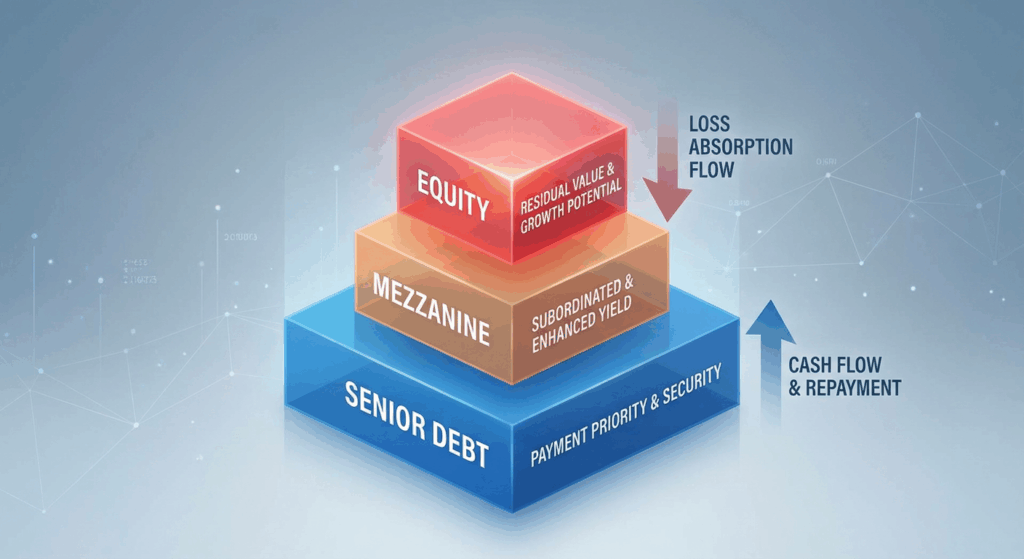
The DNA of Deal Structure: Understanding the Capital Stack
In private credit, every investment decision begins with one fundamental visualization: the capital stack. For investors, it defines safety and yield. For business owners and operators, it determines the cost of capital and ownership dilution.
The capital stack is the hierarchy of financial claims against a company. Imagine a skyscraper where the safest tenants live on the ground floor (Senior Debt) and the risk-takers live in the penthouse (Common Equity). If an earthquake hits, a financial distress event, the building collapses from the top down. The penthouse is destroyed first, while the ground floor remains the most secure.
Understanding where a loan sits in this stack is the single most important factor in assessing risk. In today’s market, where private credit has grown to approximately $1.7 trillion in assets under management, understanding these structural nuances is no longer optional; it is a prerequisite for sophisticated capital allocation.
The Concept: Seniority, Subordination, and Priority
The capital stack implies a strict order of repayment, known as absolute priority. Cash flows from operations or a liquidity event (like a sale) flow to the bottom of the stack first, but losses hit the top of the stack first.
- Senior Secured Debt: The foundation. These lenders are “first lien,” meaning they have the first claim on assets and cash flow. Because they take the least risk, they accept the lowest return (typically a floating rate over SOFR).
- Subordinated (Mezzanine) Debt: The middle layer. These lenders sit behind senior debt. They only get paid after senior lenders are satisfied. To compensate for this higher risk, they charge higher interest rates and often demand “equity kickers” (warrants).
- Equity (Preferred & Common): The top layer. Equity holders are the residual claimants. They get whatever is left after all debt is serviced. They possess unlimited upside potential but face the risk of total loss if the company’s value falls below the debt amount.
How It Works: The $100 Million Example
To see the mechanics of subordination in action, consider a hypothetical manufacturing company acquired for an Enterprise Value (EV) of $100 million. The transaction is financed using a standard capital stack:
- Senior Debt: $50 million (50% of capital structure)
- Mezzanine Debt: $20 million (20% of capital structure)
- Equity: $30 million (30% of capital structure)
Scenario A: Success (Upside)
Five years later, the company is sold for $140 million.
1. Senior Lenders get their principal back ($50M) + interest paid along the way.
2. Mezzanine Lenders get their principal back ($20M) + high interest.
3. Equity holders receive the remaining $70 million. They turned their $30M into $70M (a 2.3x return), demonstrating the power of leverage.
Scenario B: Distress (Downside Protection)
Now imagine the company struggles and is forced to liquidate assets for only $60 million (a 40% drop in value).
1. Senior Lenders are paid in full ($50M). They are “money good” despite the firm’s failure.
2. Mezzanine Lenders are owed $20M, but only $10 million remains. They suffer a 50% loss of principal.
3. Equity holders receive $0. Their investment is wiped out entirely.
This example illustrates why senior debt monitors “Loan-to-Value” (LTV) so closely. In this case, the senior debt attachment point was 0% and the detachment point was 50%. As long as the company is worth more than 50% of its initial value, senior lenders are safe.
Current Market Relevance
The structure of the capital stack is evolving rapidly in the current cycle. According to recent industry analysis, the private credit market is projected to reach roughly $2.6 trillion to $3 trillion by 2029. As the market expands, distinct trends are reshaping how these stacks are built.
1. The Rise of Unitranche
Historically, borrowers had to negotiate separately with a bank for senior debt and a private lender for mezzanine debt. Today, Unitranche facilities combine senior and junior risk into a single loan instrument. While this simplifies life for the borrower (one document, one interest rate), it often obscures the internal risk. Behind the scenes, lenders may sign an “Agreement Among Lenders” (AAL) that virtually creates a senior/junior split within that single unitranche loan.
2. Equity Cushions are under Pressure
In a higher-interest-rate environment, the cost of debt rises, putting pressure on coverage ratios. “Equity cushion”, the percentage of the capital stack below the debt, acts as the shock absorber for lenders. With valuations in private markets adjusting, lenders are increasingly focused on maintaining a thick equity cushion (often 40-50%) to ensure they are protected against valuation multiples compressing.
Decision Framework: Application
For Investors (Lenders/LPs)
When evaluating a private credit fund or direct deal, ask:
- Where is the attachment point? Are you lending against the first dollar of value (safest) or the last dollar (riskiest)?
- What is the equity cushion? If the enterprise value drops by 20%, is your principal impaired? In our example above, Senior Debt had a 50% cushion ($50M of junior capital below it). Mezzanine only had a 30% cushion.
- Is the covenants package loose or tight? Senior lenders typically have tighter control rights to force a correction if performance dips.
For Operators (Borrowers)
When structuring a buyout or growth capital:
Maximize Senior Debt when: Cash flow is stable and predictable. It is the cheapest cost of capital (often 6-8% cheaper than equity returns). However, it comes with strict covenants and amortization.
Use Mezzanine/Junior Debt when: You need to fill a funding gap but do not want to dilute your ownership further. It is more expensive than senior debt, but cheaper than selling more equity shares. It allows you to leverage your returns (as seen in Scenario A above) without giving up control.
Key Takeaways
- Seniority equals Safety: Senior secured debt is paid first and suffers losses last. It yields less but offers capital preservation.
- Equity equals Volatility: Equity holders enjoy all the upside beyond the fixed cost of debt but absorb the first dollar of losses.
- The “Cushion” Matters: The thickness of the junior capital layers protects the senior lenders. A 50% LTV implies a 50% equity cushion.
- Unitranche Simplifies Execution: Borrowers often prefer unitranche to avoid managing two lender classes, even if the “blended” cost is slightly higher for the senior portion.
- Align Risk with Position: Investors seeking income should stay at the bottom of the stack (Senior); those seeking multiples on invested capital must move to the top (Equity/Mezz).


