
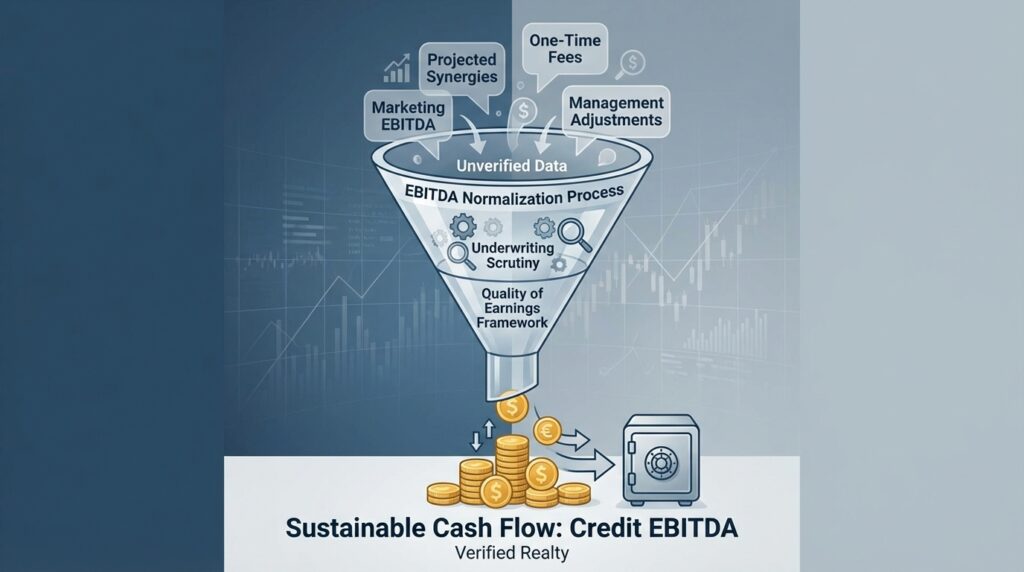
The Underwriting Challenge: Marketing vs. Credit EBITDA
In middle-market lending, few metrics are as contested as EBITDA (Earnings Before Interest, Taxes, Depreciation, and Amortization). While it serves as the primary proxy for operating cash flow and a baseline for leverage multiples, the gap between a borrower’s "Marketing EBITDA" and an underwriter’s "Credit EBITDA" can be substantial. For risk managers on the Bond Capital underwriting desk, the critical task is not just to accept the numbers presented in a Confidential Information Memorandum (CIM), but to deconstruct them to find the recurring, sustainable cash flow available to service debt.
As noted in the Basel Committee’s 2025 Principles for the Management of Credit Risk, a sound credit-granting process requires banks and lenders to clearly establish a distinct assessment of credit quality, independent of marketing materials. The risk lies in "add-backs", adjustments made to historical earnings to reflect a theoretical future state. If these adjustments fail to materialize, a leverage ratio underwritten at 3.5x can quickly balloon to 5.0x or higher, triggering covenant breaches and potential default.
The Framework: Normalization Methodology
Effective underwriting requires a rigorous Quality of Earnings (QoE) framework. The goal is to normalize earnings to reflect what the business will look like on a go-forward basis, stripping out noise and assessing the validity of proposed synergies. This process generally follows three categories of adjustments:
- Non-Recurring Items: True one-time expenses (e.g., lawsuit settlements, disaster recovery) that will not repeat.
- Pro Forma / Run-Rate Adjustments: Annualizing the earnings of a recently acquired entity or a new contract that was active for only part of the period.
- Run-Rate Cost Savings (Synergies): Theoretical reductions in expense derived from operational improvements or headcount reductions.
Underwriters must apply scrutiny to each line item. The CFA Institute’s 2026 Credit Analysis Models curriculum emphasizes that inputs to credit risk modeling, specifically the probability of default, are highly sensitive to the accuracy of these cash flow baselines.
Example: Analyzing a $12M EBITDA Manufacturer
Consider a hypothetical manufacturing borrower, "Precision Corp," seeking a $40 million term loan. The CIM presents the following:
- Reported LTM Net Income: $4.0M
- Standard Adds (Interest, Tax, D&A): +$4.5M
- Base EBITDA: $8.5M
- Proposed Adjustments: +$3.5M
- Marketing Adjusted EBITDA: $12.0M
The lender is asked to underwrite off $12.0M, implying opening leverage of 3.3x ($40M / $12M). However, if the adjustments are invalid, the true leverage is 4.7x ($40M / $8.5M), a significantly riskier proposition.
The Analysis: Stress Testing the Add-Backs
To bridge the gap between Base EBITDA ($8.5M) and Marketing EBITDA ($12.0M), the underwriter must dissect the $3.5M in proposed adjustments. Here is how a rigorous analysis proceeds:
1. Management Fees & Owner Compensation ($1.0M)
The company adds back $1.0M, claiming that after the transaction, the private equity management fee will vanish and the CEO’s salary will be normalized.
Underwriting Test: Verify the post-close employment contracts. Does the new CEO salary align with industry benchmarks? If the CEO was taking $1.5M and the market rate is $500k, the $1.0M add-back is valid. If the fee is merely being replaced by a monitoring fee to a new sponsor, the add-back should be rejected.
2. “One-Time” Professional Fees ($1.0M)
The borrower lists legal and consulting fees as non-recurring.
Underwriting Test: Review the general ledger. Are these fees truly one-off (e.g., a specific M&A transaction failed), or does the company incur $1M in legal disputes every year? If the expense is recurring in nature, it is not an add-back; it is the cost of doing business.
3. Projected Synergies ($1.5M)
The company claims $1.5M in savings from closing a warehouse and reducing headcount.
Underwriting Test: This is the highest-risk category. Have the employees already been notified? Has the lease been terminated? Institutional lenders often cap these adjustments (e.g., at 15-20% of EBITDA) or require them to be realized within 6-12 months. If the savings are purely theoretical, risk management discipline dictates excluding them or creating a "step-down" covenant structure that only gives credit as actions are taken.
Industry Standards and Red Flags
Institutional lenders and rating agencies have tightened their stance on add-backs. According to recent search data on credit performance and agency reports, aggressive add-backs are a primary driver of covenant variance post-close. When utilizing Financial Ratio Analysis, credit professionals look for the “EBITDA conversion rate”, operating cash flow divided by Adjusted EBITDA. A ratio below 60-70% suggests that the “earnings” are accounting constructs rather than cash reality.
Red Flags to Watch:
- “Poorly Defined” Restructuring Charges: Perpetual restructuring costs that appear every year.
- Lost Contract Add-Backs: Adding back lost margin from a customer who churned, claiming it was “an anomaly.”
- Inventory Adjustments: Moving from LIFO to FIFO to boost earnings without cash impact.
Underwriting Checklist: Due Diligence Requirements
Before issuing a commitment letter, the underwriting team should complete the following diligence:
- Quality of Earnings Report
- Commission a third-party accounting firm to validate the “Proof of Cash” and reconcile EBITDA to tax returns.
- Bank Statement Verification
- Ensure reported revenue matches actual cash deposits for the LTM period.
- Contract Review
- For pro forma adjustments related to new business, require signed contracts with stated pricing and volume minimums.
- Covenant Definitions
- Draft the credit agreement to strictly define “Consolidated EBITDA.” Include a hard cap (e.g., 20% of LTM EBITDA) on “Subjective Cost Savings” to limit future add-back creep.
Key Takeaways for Risk Management
- Cash is King: EBITDA is an opinion; cash flow is a fact. Always triangulate Adjusted EBITDA against Operating Cash Flow.
- Cap the Future: Limit “synergy” and “pro forma” add-backs to a percentage of the total to prevent leverage drift.
- Verify vs. Trust: Every dollar of adjustment requires documentation (invoices, contracts, termination letters).
- Monitor Drift: Track the realization of add-backs quarterly. If savings don’t materialize, re-rate the risk.
- Structure Defensive Covenants: Use “Unadjusted Leverage” as a secondary covenant test if the adjustments are aggressive.


