
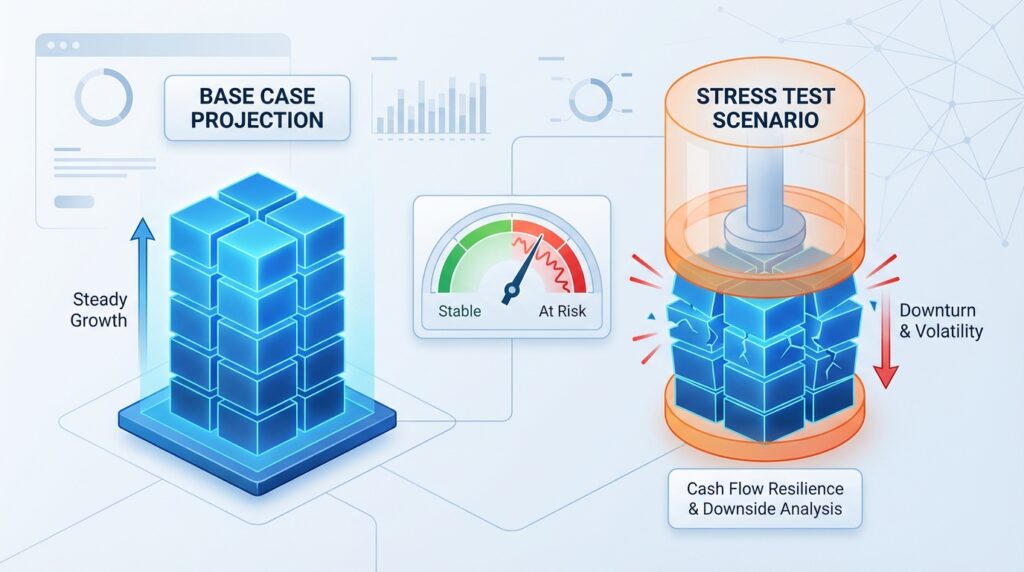
The Underwriting Challenge: Projections vs. Reality
In credit underwriting, the base case projection provided in a Confidential Information Memorandum (CIM) is rarely the scenario that tests a lender’s capital. Borrowers naturally present “sunny day” scenarios, assuming steady growth, margin expansion, and stable working capital cycles. However, the discipline of risk management lies in determining what happens when those assumptions fail.
For institutional lenders, the critical question is not whether a borrower can service debt during growth, but whether the capital structure endures during contraction. As noted in credit analysis frameworks by Overbond, assessing “Capacity”, the issuer’s ability to repay obligations when due, requires dissecting industry cyclicality and earnings volatility rather than relying solely on credit ratings or stated pro formas.
The Framework: Sensitizing the P&L
Effective stress testing requires a sensitivity matrix that isolates specific variables. Lenders often use a “multivariate” approach, adjusting two or three key value drivers simultaneously to gauge the compound effect on cash flow. The goal is to identify the “break-even” point, the level of revenue or margin deterioration at which the Debt Service Coverage Ratio (DSCR) falls below 1.0x.
A robust stress-testing framework focuses on three core variables:
- Revenue Impairment: Simulating volume declines (demand shock) vs. price erosion (competitive shock).
- Operating Leverage: Analyzing how much EBITDA falls for every dollar of lost revenue. High fixed-cost businesses suffer disproportionately during downturns.
- Free Cash Flow Conversion: Adjusting for “sticky” Capex. Differentiating between flexible Growth Capex and mandatory Maintenance Capex is essential, as defined in standard financial due diligence methodologies.
The Analysis: Stress Testing a $10M EBITDA Manufacturer
Consider a middle-market manufacturing company requesting a senior secured term loan. The “Base Case” financials suggest strong coverage, but a stress test reveals latent risks.
Base Case Scenario:
- EBITDA: $10,000,000
- Total Debt: $40,000,000 (4.0x Leverage)
- Interest Expense (8%): $3,200,000
- Maintenance Capex: $1,500,000
- Cash Flow Available for Debt Service (CFADS): $5,300,000
- Fixed Charge Coverage Ratio (FCCR): ($10M – $1.5M) / $3.2M = 2.65x (Healthy)
Stress Case Scenario (Recessionary):
We assume a comprehensive downside: Revenue drops 15%, and because the company has high fixed costs, EBITDA margins contract by 200 basis points. Simultaneously, floating interest rates rise by 2.0%.
- Stressed EBITDA: Drops to $6,500,000 (35% decline from base).
- Interest Expense (10% on $40M): Rises to $4,000,000.
- Maintenance Capex: Remains sticky at $1,500,000.
- Stressed CFADS: $1,000,000.
- Stressed FCCR: ($6.5M – $1.5M) / $4.0M = 1.25x.
The Insight: Even in a severe downside, the borrower maintains cover (greater than 1.0x). However, the cushion has collapsed from $5.3M to $1.0M. Any further deterioration, such as a working capital swing trapping cash, would trigger a liquidity crisis. This analysis signals that while the 4.0x leverage is acceptable, the covenant suite must include a strict Fixed Charge Coverage ratio to catch performance declines early.
Industry Standards and Red Flags
Institutional lenders and rating agencies typically look for resilience against “standard” shock values. For example, common stress tests involve a 10-20% revenue decline or a 25% drop in EBITDA. According to Dwellsy IQ’s guide to financial analysis, problems often arise not because a single metric is wrong, but because metrics are interpreted in isolation. A high DSCR is meaningless if it relies on zero-Capex assumptions that inevitably degrade the asset base.
Common Red Flags in Stress Testing:
- Variable Cost Fallacy: Borrowers often claim they can cut SG&A linearly with revenue falls. History shows SG&A is “stickier” than assumed.
- Working Capital Ignorance: In a downturn, inventory turnover slows, and receivables collection drags out. This traps cash exactly when the business needs liquidity.
- Cyclicality Mismatch: As noted by Overbond, cyclical industries require higher coverage cushions. A construction firm with 4.0x leverage carries significantly more risk than a healthcare software provider with the same leverage, due to earnings volatility.
Underwriting Checklist: The Downside Case
When reviewing a credit memo or building a model, underwriters should verify the following steps:
- Isolate Maintenance Capex: stripping out growth initiatives to find the true “keep-the-lights-on” cash requirement.
- Sensitize Interest Rates: Run the model with the forward SOFR curve plus a 200bps buffer.
- Scenario “Breakeven” Calculation: Solve for X: How much can EBITDA drop before DSCR hits 1.00x? If the buffer is less than 15-20%, the deal is structurally fragile.
- Review Fixed Charges: Ensure all mandatory amortizations, lease payments, and cash taxes are included in the denominator of coverage ratios.
- Liquidity Bridge: In the stress case, does the borrower have enough Revolver availability to fund operating losses for 12 months?
Key Takeaways
- Cash Flow Over Accounting: Underwriting relies on CFADS (Cash Flow Available for Debt Service), not just Accounting EBITDA.
- Severity Matters: A strong borrower implies the ability to survive a 20% EBITDA impairment without breaching having to restructure.
- Fixed Costs Kill: High operating leverage magnifies risk; these borrowers require lower financial leverage.
- Correlation Risk: Stress tests should assume bad things happen together (e.g., margins drop AND rates rise).
- Covenant Logic: Financial covenants are designed to trigger a conversation (default) before the cash runs out, not after.


