
The Architecture of Risk: Understanding the Capital Stack
In the world of private credit, the “Capital Stack” is the structural DNA of any transaction. For investors, it dictates the hierarchy of repayment and risk
exposure. For business owners and operators, it determines the weighted average cost of capital (WACC) and the degree of ownership dilution. Understanding where a loan sits in this stack is arguably the single most important factor in assessing the quality of a private credit opportunity.
While interest rates and covenants grab headlines, the priority of payment, seniority: is what actually protects capital when markets turn volatile. This article breaks down the mechanics of the capital stack, focusing on the trade-offs between position, protection, and pricing.
The Concept: Seniority and Subordination
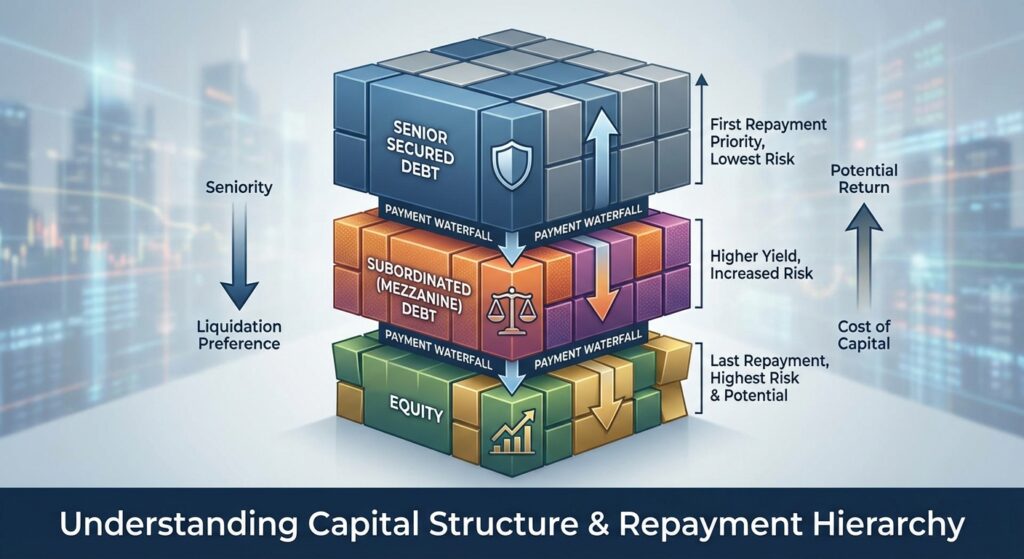
The capital stack represents the layers of financing used to fund a company, organized by priority of claim on assets and cash flow. It operates on a simple “waterfall” principle: in a liquidity event (like a sale) or a downside scenario (like a liquidation), money flows from the top down.
1. Senior Secured Debt: Sitting at the very top, this layer has the first claim on assets. It is typically secured by collateral (receivables, inventory, IP) and offers the lowest yield in exchange for the highest safety. If a company fails, these lenders are paid first.
2. Subordinated (Mezzanine) Debt: This layer sits between senior debt and equity. It is “subordinate” to senior lenders, meaning they only get paid after senior obligations are met. To compensate for this increased risk of loss, subordinated debt demands higher coupons, often including “Payment-in-Kind” (PIK) interest or equity warrants.
3. Equity: The bottom of the stack. Equity holders have the last claim on assets but unlimited upside potential. In a default scenario, they are the first to be wiped out.
How It Works: The $100 Million Scenario
To see the mechanics of subordination in action, let’s look at a hypothetical acquisition of a middle-market manufacturing firm, “Alpha Corp,” valued at $100 million.
The deal is structured as follows:
- Senior Term Loan: $50 million (50% LTV)
- Junior/Mezzanine Debt: $20 million
- Private Equity Sponsor: $30 million
Scenario A: Success (Sale for $150M)
The company grows and is sold.
1. Senior lenders receive their principal + interest.
2. Junior lenders receive their principal + high-interest coupons.
3. Equity holders receive the remaining proceeds ($80M+), realizing a massive multiple on their initial $30M investment.
Scenario B: Distress (Sale for $60M)
The company struggles and acts as a forced seller.
1. Senior lenders represent the first $50M. They are paid back in full (100% recovery).
2. Junior lenders are owed $20M, but only $10M of sale proceeds remain ($60M Sale – $50M Senior Debt). They take a 50% loss.
3. Equity holders are completely wiped out (0% recovery).
This “Attachment Point” mathematics illustrates why private credit investors focus obsessively on the Loan-to-Value (LTV) ratio through the senior portion of the stack. In this example, the senior debt has a 50% “equity cushion” beneath it, insulating it from moderate valuation shocks.
Current Market Relevance
The private credit market has evolved significantly, moving beyond traditional bank lending structures. According to recent industry data, private credit assets under management (AUM) reached approximately 1.7 trillion USD globally by the end of 2023, with projections estimating growth to nearly $3 trillion by 2028.
One major trend reshaping the capital stack is the rise of Unitranche Financing. As noted in recent industry primers regarding definitions, unitranche structures combine senior and junior debt into a single loan instrument with a blended interest rate. This simplifies the execution for borrowers by removing the need to negotiate an intercreditor agreement between two different lenders, though it creates a complex internal “Agreement Among Lenders” (AAL) behind the scenes.
Despite higher base rates, the demand for this asset class remains robust. PitchBook data (Feb 2024) highlights that private debt accounted for over 16% of total private capital AUM, underscoring its pivotal role in middle-market financing where traditional bank retraction has left a liquidity gap.
Decision Framework
For Investors: Evaluating Risk
When reviewing a private credit fund or direct deal, investors should assess the “Attach” and “Detach” points:
- Attach Point: The percentage of capitalization where your risk begins (0% for senior debt).
- Detach Point: The point where you are fully invested. If a senior loan is 40% of the capital structure, the detach point is 40%.
- Guidance: A lower detach point implies a larger equity cushion (more safety). Higher yield usually signals a higher detach point (less protection).
For Operators: Optimizing Cost of Capital
Business owners often instinctively reject debt due to the interest expense, but they must compare it against the “cost” of equity.
- Equity is expensive: Selling 10% of your company for $1M implies that $1M will cost you 10% of all future profits and exit value. If the company triples in value, that capital was incredibly costly.
- Debt is cheaper: Paying 10-12% interest on private credit preserves ownership. Senior debt is the cheapest non-dilutive capital available, while mezzanine debt bridges the gap when senior lenders cap out.
Key Takeaways
- Structure Dictates Outcomes: Return of capital relies more on seniority than on the borrower’s initial growth projections.
- The Cushion Matters: The “Equity Cushion” absorbs the first losses; senior lenders only lose money if the enterprise value falls below the loan amount.
- Unitranche Efficiency: Modern private credit often blends layers into one unitranche facility for speed and certainty, though the underlying risk separation remains relevant.
- Cost vs. Control: For operators, taking on debt lower in the stack serves as an alternative to selling equity, preserving long-term upside.
- Macro Context: With the asset class projected to approach $3T, private credit capital stacks are becoming the standard financing engine for the middle market.


