
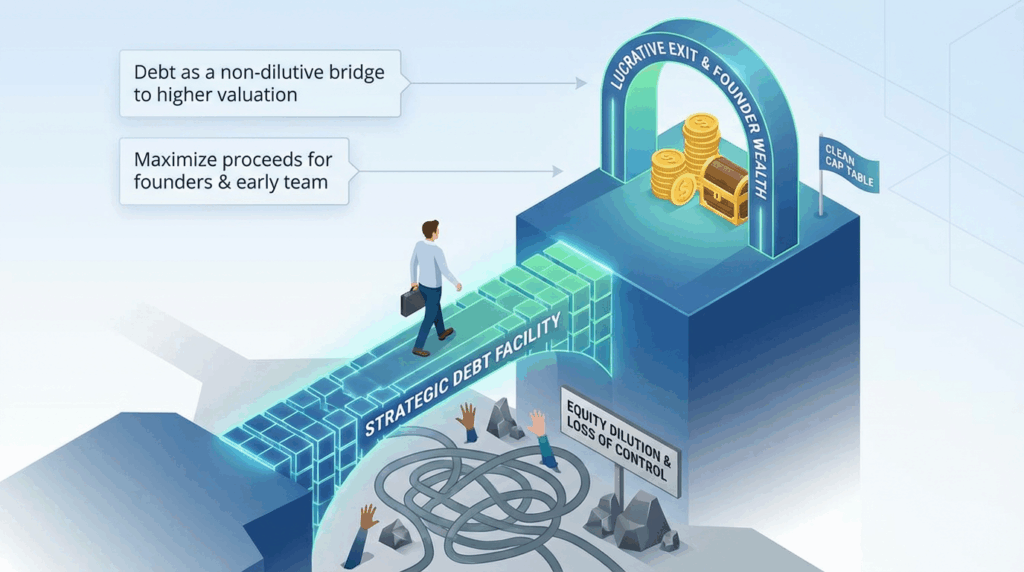
The equity check you don’t take is often the most profitable one you ever make.
For high-growth founders, the pressure to raise venture capital is relentless. The narrative is standard: hit a growth spurt, raise a Series B, dilute 20%, and keep running on the treadmill. But for Simon Turner, co-founder of retail sales enablement platform Myagi, the standard playbook didn’t make sense.
Instead of selling a chunk of his company to fuel growth, Turner utilized a $2.5 million non-dilutive debt facility. Less than two years later, Myagi was acquired by Rallyware, ensuring the exit proceeds went to the founders and early team rather than being siphoned off by late-stage investors.
This is the story of how a strategic "debt bridge" can outperform a venture round.
The Story: A Pandemic Pivot
Myagi was founded with a mission inspired by The Karate Kid: "No such thing as bad student, only bad teacher." The company provided a digital platform to ensure retail salespeople were customer-ready. By 2020, they were preparing for a significant equity round.
Then the pandemic hit. The initial shockwave disrupted the fundraising timeline, but it also created a massive tailwind. As retail rapidly digitized, demand for Myagi’s solution surged. The company posted its best six months of growth on record.
They faced a classic founder’s dilemma. They had the metrics to raise a substantial VC round, but doing so would mean locking in a valuation during a volatile market and giving up significant control. They needed cash to hire sales staff and improve the product to capture the moment, but they didn’t want to permanently dilute their ownership right before a potential harvest.
The Decision: Calculated Leverage vs. Expensive Equity
In early 2021, Turner and his team evaluated their capital structure. The choice was binary:
- Option A (Equity): Raise $3M-$5M in venture capital. This would likely cost 20-30% of the company, introduce new board members with different horizons, and add liquidation preferences that could complicate an exit.
- Option B (Debt): Secure a credit facility based on recurring revenue. This would cost interest payments but zero equity.
Turner chose Option B, securing a $2.5 million investment facility from TIMIA Capital. According to TIMIA Capital’s case study, the capital was strictly "non-dilutive," designed to fuel growth activities like sales expansion and customer success without altering the cap table.
Turner’s logic was precise: "Debt is a powerful tool for capital-efficient businesses when used under the right circumstances."
This wasn't distress financing; it was confidence financing. The team bet that the growth generated by the $2.5M would increase the company's Enterprise Value (EV) by significantly more than the cost of the debt.
The Outcome: Liquidity Without Dilution
The execution was swift. Myagi deployed the debt capital into revenue-generating engines, specifically enhancing their referral-based sales model and software capabilities. The leverage did exactly what it was supposed to do: it accelerated the timeline to a strategic exit.
Approximately two years after taking the debt, Myagi was acquired by Rallyware, a performance enablement platform. Because the company hadn’t taken that extra round of venture capital, the capital structure remained clean.
This wasn't an isolated incident. Around the same time, another SaaS company, WatchWire (energy management), executed nearly the exact same play. As reported by TIMIA Capital, WatchWire CEO Andy Anderson rejected further dilution in 2021, used debt to bridge to a higher valuation, and was successfully acquired by Tango Analytics in 2023.
In both cases, the founders successfully arbitraged the difference between the cost of debt (interest) and the cost of equity (future enterprise value).
The Lessons: The "Bridge to Exit" Framework
The Myagi and WatchWire examples illustrate a critical principle in modern corporate finance: Capital is a commodity, but control is scarce.
Here is the framework for when to choose this path:
- The Valuation Bridge: If you believe your company is 12-24 months away from a significant valuation inflection point (or exit), selling equity is the most expensive thing you can do. Debt allows you to cross that bridge and keep the upside.
- The Predictability Ratio: This strategy works best for B2B SaaS or recurring revenue models where LTV/CAC ratios are understood. You are effectively borrowing against future contract values to fund current customer acquisition.
- The Cost of Capital Reality: While headline interest rates on private credit (often 10-15%+) can seem high compared to a bank loan, they are significantly cheaper than equity that appreciates 3x or 5x in two years.
Key Insights
- Dilution is Permanent, Debt is Temporary: You can pay off a loan after an exit; you cannot buy back equity at the original price after a valuation surge.
- Clean Cap Tables Aid Exits: Acquirers prefer simple structures. Late-stage VC rounds often come with complex liquidation preferences that can block deals or hurt common shareholders.
- Use Leverage for Fuel, Not Survival: Myagi used debt to invest in growth (sales/marketing), not to keep the lights on. This is the distinction between "leverage" and "distress."
- Timing is Everything: The optimal window for venture debt is often post-product-market fit but pre-exit, where capital efficiency matters more than raw experimentation.
- Founder Alignment: Debt facilities rarely require board seats or operational control, leaving the founder in the driver’s seat during critical M&A negotiations.


