
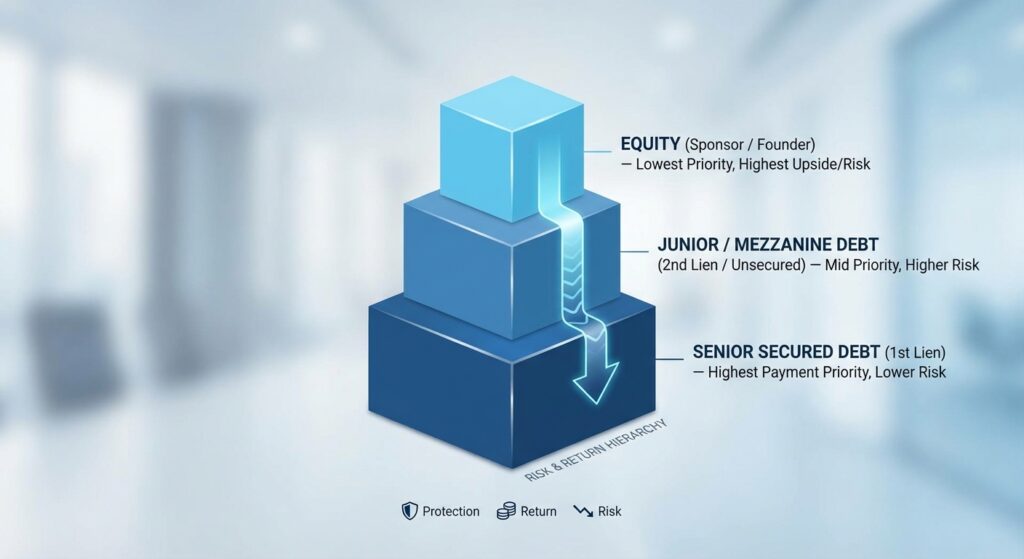
Understanding the Hierarchy of Corporate Finance
In the world of private credit, the “Capital Stack” is the foundational concept that dictates risk, return, and control. Whether you are an investor allocating capital or a business owner raising it, understanding where you sit in this stack is the single most important factor in determining your outcome during a liquidity event.
Simply put, the capital stack is the ranking of all capital provided to a company. It establishes the “waterfall” of payment priority: who gets paid first when things go well, and more importantly, who gets paid first (or at all) if they don’t.
The Concept: Priority and Subordination
The capital stack is structured like a layer cake, with the safest positions at the bottom and the riskiest at the top. This hierarchy is enforced by legal mechanisms known as subordination and intercreditor agreements.
- Senior Secured Debt: Located at the base of the stack. These lenders have the first claim on cash flows and assets. Because they take the least risk, they accept lower yields, typically floating rates (SOFR + margin). In a bankruptcy, they must be made whole before anyone else sees a cent.
- Subordinated (Mezzanine) Debt: Sits above senior debt but below equity. “Mezz” lenders take higher risk because they are unsecured or have a second lien. To compensate, they demand higher returns, often blending cash interest with “PIK” (Payment in Kind) or equity warrants.
- Equity: The top layer. Equity holders own the upside but sit in the “first loss” position. If a company dissolves, they only receive capital after every debt holder has been fully repaid.
How It Works: The $100 Million Waterfall
To visualize the mechanism of subordination, consider a manufacturing company valued at $100 million (Enterprise Value). The company structures its capital stack as follows:
- $50 Million Senior Loan (1st Lien)
- $20 Million Junior Debt (2nd Lien / Unsecured)
- $30 Million Equity (Sponsor / Founder)
Now, let’s imagine two exit scenarios to illustrate the “waterfall” of payments:
Scenario A: Growth Exit (Sale for $150 Million)
The company succeeds. The Senior Lenders get their principal back ($50M). The Junior Lenders get theirs ($20M). The Equity holders receive the remaining $80M, more than doubling their initial investment. Leverage amplified their returns.
Scenario B: Distressed Sale (Sale for $60 Million)
The company struggles and is forced to sell for assets.
1. Senior Lenders: Paid in full ($50M).
2. Junior Lenders: Receive the remaining $10M. They suffer a 50% principal loss.
3. Equity Holders: Receive $0. They are wiped out entirely.
This math highlights why senior credit is often referred to as a “defensive” asset class, while equity is “offensive.”
Current Market Relevance
In the current vintage of 2025/2026, the traditional lines between these layers are blurring. A dominant trend is the rise of Unitranche Financing, where private credit managers combine senior and junior risk into a single loan instrument.
According to Coller Capital’s 2025 findings citing Preqin, the private debt market has expanded to approximately $1.7 trillion in assets under management (AUM), with forecasts reaching $2.6 trillion by 2029. This growth is partly driven by borrowers preferring the simplicity of dealing with one lender (Unitranche) rather than syndicating separate senior and junior tranches.
Furthermore, in today’s environment of elevated interest rates, the cost of senior debt has risen. As noted in CFI’s analysis of capital structures, companies are under pressure to optimize their debt-to-equity ratios to ensure interest coverage remains sustainable. For private credit investors, this means the “equity cushion” (the value protecting the loan) is a critical metric to watch. A loan with a 50% loan-to-value (LTV) implies the enterprise value must drop by half before the senior lender loses principal.
Decision Framework
For Investors (LPs and Allocators)
When evaluating a private credit fund, ask: Where does this manager lend in the stack?
- Safety Focus: Senior Secured strategies offer capital preservation. The primary risk is credit quality, not structural subordination.
- Yield Focus: Mezzanine or Preferred Equity strategies offer higher coupons (often low double-digits) but carry “binary risk”, in a default, recovery rates can be near zero.
For Operators (Borrowers)
When raising capital, the decision is a trade-off between Cost of Capital and Dilution.
- Maximizing Debt: Raising cheap senior debt minimizes equity dilution but increases bankruptcy risk (fixed obligations).
- Raising Equity: Bringing in a partner is expensive (you give up upside) but safe (no mandatory repayment).
Key Takeaways
- Seniority is Safety: Senior lenders are paid first; equity gets paid last.
- The Waterfall Dictates Returns: In a downside scenario, losses eat through equity first, then junior debt, hitting senior debt last.
- Unitranche is the New Standard: The market is moving toward blended “one-stop” debt solutions for simplicity and speed.
- Watch the Cushion: The size of the equity layer beneath the debt is the lender’s primary margin of safety.


