
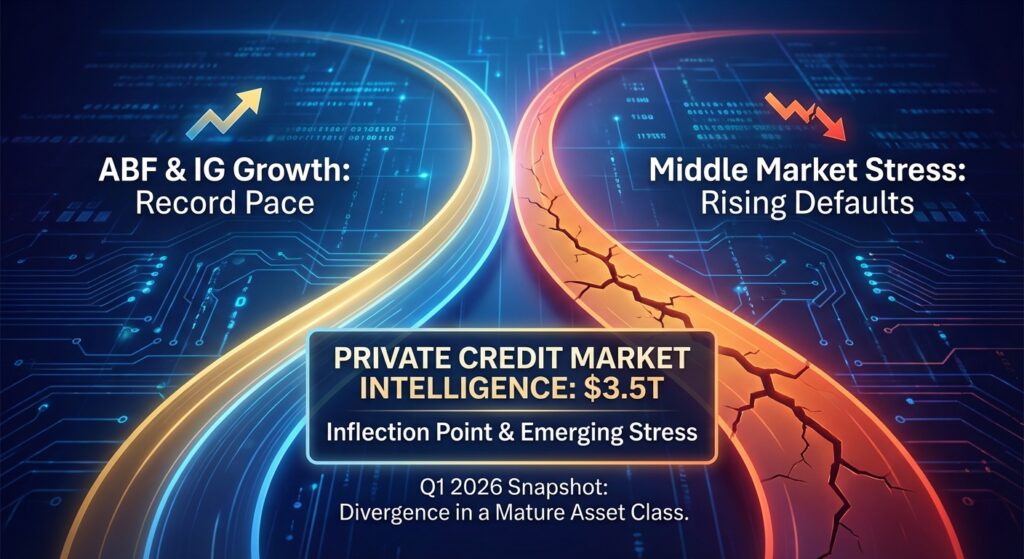
Market Headline: Private Credit Hits $3.5T Milestone Amidst First Real Stress Test
As of March 1, 2026, the global private credit market has surpassed a historic $3.5 trillion in assets under management (AUM), firmly cementing its transition from an alternative asset class to a mainstream portfolio allocation. However, this growth comes at a pivotal inflection point. While capital deployment surged nearly 80% year-over-year in 2024 to $592.8 billion, the market is facing its “first real stress test” since the 2008 financial crisis.
A divergence has emerged: while investment-grade (IG) private placements are seeing record volumes and spread compression due to voracious demand, the middle market is showing cracks. Default rates in the middle market have climbed to 5.5%, prompting a shift in lender sentiment. Apollo Global Management characterizes the current environment as a transition from a seller’s market to a buyer’s market, where underwriting discipline and selectivity will define performance in 2026. With $96 billion in bank loan commitments now fueling private credit vehicles, the lines between traditional banking and private credit continue to blur.
Quantitative Snapshot: Q1 2026
The following metrics highlight the current bifurcation between liquidity-flush demand and deteriorating credit fundamentals in specific segments.
| Metric | Current Value | Comparison / Trend | Source |
|---|---|---|---|
| Global Private Credit AUM | $3.5 Trillion | Record High | Private Markets Insights |
| 1st Lien Direct Loan Yields | 8.0% – 8.5% | Down from 10%+ peaks | Private Markets Insights |
| Middle Market Default Rate | 5.5% | Rising trends | Private Markets Insights |
| IG Private Placement Vol | >$170 Billion | Record pace (surpassing 2024) | SLC Management |
| LBO Deal Volume | +40% YoY | Significant revival in late 2025 | Private Markets Insights |
| IG Spread Movement | -5 bps (Tightening) | Compressed in Q4 2025 | SLC Management |
Sector Analysis: Hot Zones and Warning Signs
Asset-Based Finance (ABF)
Status: Hot
Asset-based finance has emerged as the highest growth potential sector, with 65% of managers identifying it as a primary target. Major players like Apollo project the total addressable market for ABF at $40 trillion. As traditional direct lending faces margin compression, capital is rotating toward ABF strategies that offer collateralized protection.
Investment Grade Private Placements
Status: Hot / Competitive
The IG private credit market remains robust, driven by a supply-demand imbalance favoring issuers. Deals in late 2025 were frequently 5-10x oversubscribed, leading to spread tightening of approximately 5 basis points. Business Development Companies (BDCs) have also seen strong activity, with issuances pricing roughly 10 bps tighter than initial guidance.
Middle Market Corporate Credit
Status: Caution / Mixed
While LBO volume revived with a 40% year-over-year increase, credit quality concerns are mounting. The middle market default rate has hit 5.5%, and the rising use of payment-in-kind (PIK) toggles suggests underlying cash flow stress. A new cohort of distressed and opportunistic funds raised over $100 billion in the last two years, anticipating opportunities arising from this volatility.
Implications for Market Participants
For Borrowers
The current landscape favors high-quality issuers. The “supply-demand imbalance” in investment-grade credit and the revival of M&A activity mean that capital is available, often at tighter spreads than seen in previous years. However, with the shift to a “buyer’s market,” lenders are likely to be more prescriptive regarding covenants and structures for non-IG credits.
For Lenders & Investors
The “rising tide lifts all boats” era is over. With 65% of managers expecting loss rates to increase, manager selection is critical. The gap between top-tier performers and average funds is expected to widen significantly. Furthermore, the 8.0-8.5% yield environment, while attractive compared to public fixed income, requires disciplined underwriting to avoid the mounting default risks in the middle market portfolios.
Forward-Looking View (Next 3-6 Months)
Expect continued spread compression in the highest quality tiers as record fundraising capital chases deals. Conversely, lower-middle market borrowers may face tighter liquidity as lenders scrutinize portfolios for late-cycle weakness. The “stress test” of 2026 will likely drive consolidation among managers and an uptick in secondary market volume, which already reached ~$5 billion annually by late 2025.
Key Market Insights
- Default Divergence: Middle market defaults (5.5%) are rising despite healthy macro growth, signaling idiosyncratic risks are being exposed.
- Capital Overhang: With $3.5T in AUM and $96B in new bank partnerships, liquidity remains abundant, preventing a full credit crunch but compressing spreads.
- Sector Rotation: Asset-Based Finance (ABF) is overtaking plain-vanilla direct lending as the preferred growth engine for large managers.
- Retail Impact: Wealth management is the fastest-growing client segment, comprising 75% of managers’ growth channels, sustaining inflow momentum.
- Deal Revival: A 40% jump in LBO volume signals a robust pipeline for 2026, helping deploy the record dry powder accumulated in 2024-2025.


