
The Architecture of a Deal
In the world of private credit, every investment decision begins with a biological imperative: survival. For investors, this means the return of capital is just as important as the return on capital. For business owners, it means funding growth without losing control. The mechanism that balances these competing needs is the Capital Stack.
The capital stack is the hierarchical structure of all capital invested in a company. It defines who gets paid first when things go right, and more importantly, who loses money first if things go wrong. Understanding where a specific loan sits in this stack is the single most critical factor in assessing risk for investors and cost for operators.
The Concept: Seniority and Subordination
Think of the capital stack as a tower of blocks. The blocks at the bottom must stay in place for the blocks on top to remain stable. In finance, this stability is built on seniority.
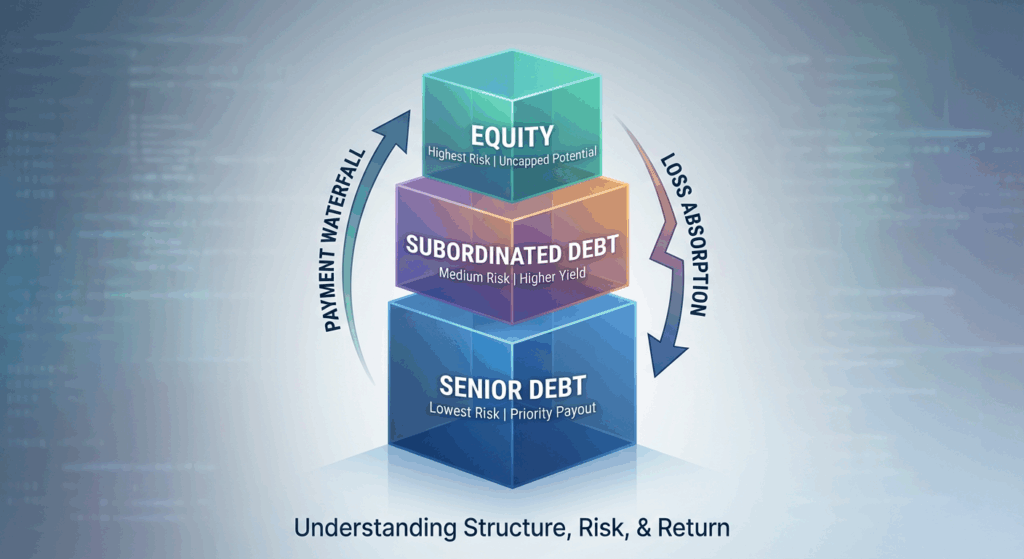
The stack is generally divided into three primary layers:
- Senior Secured Debt: Sitting at the very top of the payout order (though often visualized as the base foundation of safety), this capital has the first claim on cash flows and assets. It typically carries the lowest interest rate because it has the lowest risk.
- Subordinated Debt (Mezzanine / Junior): This layer sits below senior debt. It only gets paid after senior lenders are satisfied. To compensate for this increased risk, it commands higher interest rates and often includes "equity kickers" (warrants).
- Equity: This is the ownership layer relative to the residual value. Equity holders take the most risk, they get paid last, but enjoy uncapped potential upside.
The term structural subordination refers to the legal mechanics ensuring that senior lenders are made whole before junior lenders or equity holders receive a penny during a liquidation or bankruptcy event.
How It Works: The Waterfall Example
To see the mechanics in action, let’s look at a hypothetical manufacturing company, "TechSteel Inc.," with an Enterprise Value (EV) of $100 million.
The Structure:
- $50 Million Senior Loan: First lien on assets. Interest rate: 10%.
- $50 Million Equity: Ownership stake held by a private equity sponsor.
In this scenario, the Loan-to-Value (LTV) ratio is 50%. The $50 million in equity acts as a "cushion" regarding the debt. The company’s value would have to drop by more than 50% (losing all $50M of equity) before the senior lender loses a single dollar of principal.
The Downside Scenario:
Now, imagine a recession hits. TechSteel is forced to liquidate, and its assets are sold for only $60 million (a 40% decline in value).
The Payout Waterfall:
- Senior Lender: Receives $50 million (100% principal recovery).
- Equity Holders: Receive the remaining $10 million (an 80% loss on their initial $50M investment).
If the company had used a riskier structure with $80 million in debt and only $20 million in equity, that same $60 million liquidation would have wiped out the equity entirely and resulted in a loss for the lenders. This illustrates why the position in the stack and the size of the equity cushion are paramount.
Current Market Relevance
As of early 2026, the distinctions within the capital stack have evolved. The private credit market has ballooned, with assets under management reaching approximately $1.7 trillion recently, according to Umbrex’s 2025 Industry Primer.
Two key trends are reshaping capital stacks today:
- The Rise of Unitranche: Historically, companies had to negotiate separate senior and mezzanine loans. Today, Unitranche facilities invoke a hybrid structure blending senior and junior risk into a single instrument. As noted by Umbrex, this Simplifies the capital stack for borrowers while offering lenders a blended return.
- Equity Cushion Discipline: Despite competitive pressures, credit managers remain disciplined. The "denominater effect" of high valuations has meant that while absolute debt levels are high, significant equity checks (often 40-50% of the stack) remain common to protect lenders.
Furthermore, the cost differential is stark. As Swingbridge notes, the further down the stack you go (toward equity), the more expensive the capital becomes to compensate for the loss of control and seniority.
Decision Framework
For Investors: Calculating the Attachment Point
When evaluating a private credit opportunity, investors should calculate the attachment point (where their risk begins) and the detachment point (where their risk ends).
- Metric to Watch: Look for the Loan-to-Value (LTV) ratio. A Senior Secured loan with a 40% LTV implies there is 60% equity value protecting your principal.
- Red Flag: Be wary of "covenant-lite" structures in the lower middle market where the definition of EBITDA is too loose, artificially inflating the perceived equity cushion.
For Operators: Dilution vs. Interest
For business owners, the capital stack represents a trade-off between cash flow and ownership.
- Senior Debt: Cheapest capital (lower interest rate) but comes with strict covenants and amortization requirements. It preserves ownership but taxes cash flow.
- Equity: Most expensive capital (selling shares means selling future value forever). It has no mandatory monthly payments, but it permanently dilutes the founder’s stake.
- Optimization: Operators should maximize the senior debt portion of the stack up to the point where covenants restrict operational flexibility, using it as a non-dilutive tool to fuel growth.
Key Takeaways
- Seniority equals Safety: Senior secured creditors are paid first; they only lose money if the entire equity cushion is eroded.
- Structure Matters: The "equity cushion" is the lender’s primary defense against principal loss.
- Unitranche Efficiency: Modern private credit often combines senior and junior debt into one facility for speed and certainty.
- Cost of Capital: Debt is cheaper than equity because it is capped upside and senior in priority.
- Risk Assessment: Investors must focus not just on the yield, but on where they sit in the liquidation line.


