
In 2021, the venture capital markets were historically frothy. Valuations for SaaS companies (particularly those in the burgeoning ESG and Cleantech sectors) were reaching dizzying heights. For founders like Andy Anderson of WatchWire (formerly EnergyWatch), the environment presented a seductive paradox: cash was everywhere, but taking it meant selling a piece of the future just as the business was hitting its stride.
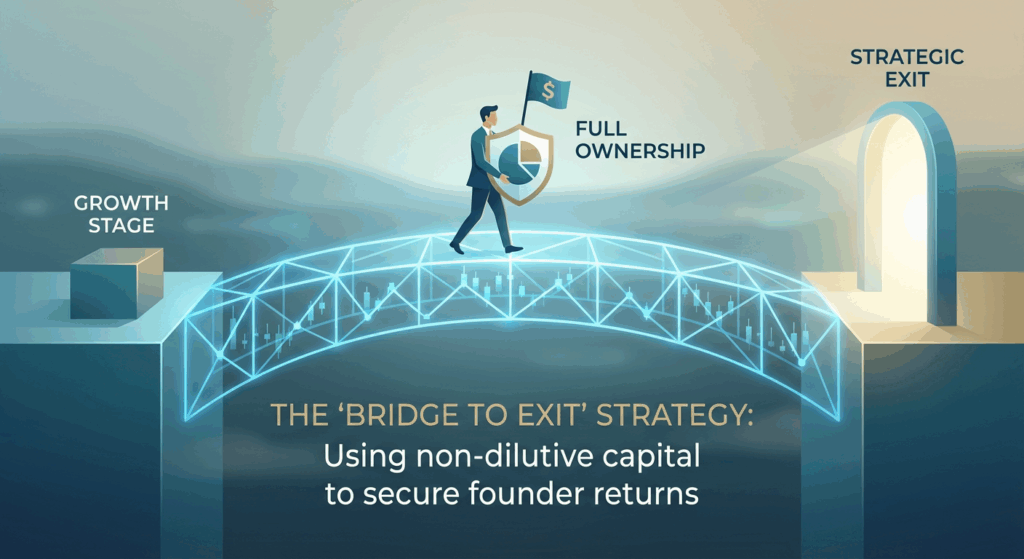
While many peers loaded up on venture equity to fuel “growth at all costs,” Anderson and his team executed a contrarian playbook. They identified that their recurring revenue was an asset that could finance itself. Instead of diluting their ownership on the eve of a liquidity event, they used private debt to bridge the gap to a strategic exit.
This is the story of how WatchWire utilized the “Bridge to Exit” strategy to maximize founder outcomes.
The Story: From Consulting to Platform
WatchWire arguably did things the hard way. Established in 2000 in the chaotic deregulated energy market of New York, the company spent years as a consulting and procurement advisory firm. It wasn’t born as a high-margin SaaS rocket ship; it evolved into one.
As environmental regulations tightened and the demand for carbon accounting grew, the team identified a gap. They pivoted from pure consulting to platform development, building a robust software solution to normalize chaotic energy data. For years, they bootstrapped, focusing on product-market fit rather than pitch decks. By 2021, they had solidified themselves as a leader in sustainability management, boasting the kind of sticky, recurring revenue that private equity firms covet.
They were ready to scale their sales pipeline, but they needed capital to do it.
The Decision: The Cost of Capital
In the tech boom of 2021, the standard playbook was to raise a Series B or C round. WatchWire had options. Investors were eager to deploy capital into Cleantech.
However, Anderson viewed capital through a strict cost-benefit lens. Equity capital is “patient,” but it is arguably the most expensive money a founder will ever take, especially if a successful exit is on the near-term horizon. Selling 20% of the company to raise $5-10 million might solve immediate cash flow needs, but it permanently reduces the founder’s share of the final pie.
WatchWire chose a different route. They engaged TIMIA Capital for a debt facility significantly smaller than a typical VC round but non-dilutive.
“Non-dilutive capital was key for us. It’s simply much cheaper capital,” Anderson noted in a retrospective on the deal. “Even if it’s just a bridge to something bigger like a larger VC round, TIMIA’s investment will help us get to the next stage without giving up more of our company.”
The strategy was precise: use debt to fund specific, high-ROI activities (specifically sales and marketing pipeline growth) that would directly increase valuation in the short term.
The Outcome: Liquidity Without Loss
The execution validated the strategy. With the capital injection, WatchWire expanded its pipeline and finalized its transition into a pure-play SaaS asset. They didn’t need the capital to survive; they used it to polish the asset for sale.
In 2023, just two years after securing the debt facility, WatchWire was acquired by Tango Analytics, a cloud-based real estate management company backed by Berkshire Partners.
Because WatchWire had avoided a late-stage equity round, the capitalization table remained tight. The founders and early shareholders didn’t have to split the exit proceeds with a fresh layer of preferred equity investors. The debt was repaid from the proceeds, and the “surplus” equity value, which would have otherwise gone to VCs, flowed to the operators who built the business.
A similar success story played out with Myagi, a retail sales enablement platform. Facing a potential down-round or high-dilution event during the pandemic, Myagi used a $2.5 million debt facility to bridge themselves to an eventual acquisition by Rallyware, preserving significant founder equity.
The Lessons: The “Bridge to Exit” Framework
The WatchWire case illustrates a critical framework for founders approaching the $10M-$30M ARR range.
If a company has high recurring revenue and a clear path to a strategic exit within 12-24 months, equity is often the wrong tool for financing growth. The math (illustrated in the hypothetical scenario below) is compelling.
Hypothetical Scenario: Debt vs. Equity at the Finish Line
Consider a founder owning 80% of a company valued at $40M, looking to exit in two years at $100M. They need $5M to get there.
- Option A (Equity): Raise $5M for 11% of the company (post-money). Founder stake drops to ~71%. At the $100M exit, that 9% dilution costs the founder $9 million.
- Option B (Debt): Borrow $5M at a high 15% interest rate. Over two years, interest costs ~$1.5M. Founder retains 80%. total cost is $1.5 million.
In this scenario, choosing debt saves the founder $7.5 million. This is the “arbitrage” that WatchWire tapped into.
This strategy requires discipline. It only works if the underlying unit economics are sound (LTV:CAC > 3:1) and the churn is low, allowing the company to service the debt without stressing operations. For companies like WatchWire, with robust retention and statutory tailwinds (ESG regulation), the risk was calculated and the reward was substantial.
Key Insights
- Cost of Capital is Dynamic: In the early stages, equity is necessary risk capital. In later stages, especially pre-exit, it becomes arguably the most expensive form of financing.
- The Bridge Strategy: Debt is most effective when used as a specific bridge to a valuation step-up or liquidity event, rather than a permanent runway extender.
- Control Premium: Beyond the financial math, debt allowed WatchWire’s leadership to retain operational control without managing new board members with misaligned time horizons.
- Recurring Revenue as Collateral: Modern credit lenders view ARR (Annual Recurring Revenue) as an asset class, allowing asset-light software companies to access leverage previously reserved for industrial firms.
- Fit for Purpose: WatchWire didn’t use debt to “find” product-market fit; they used it to pour fuel on a fire that was already burning.


