
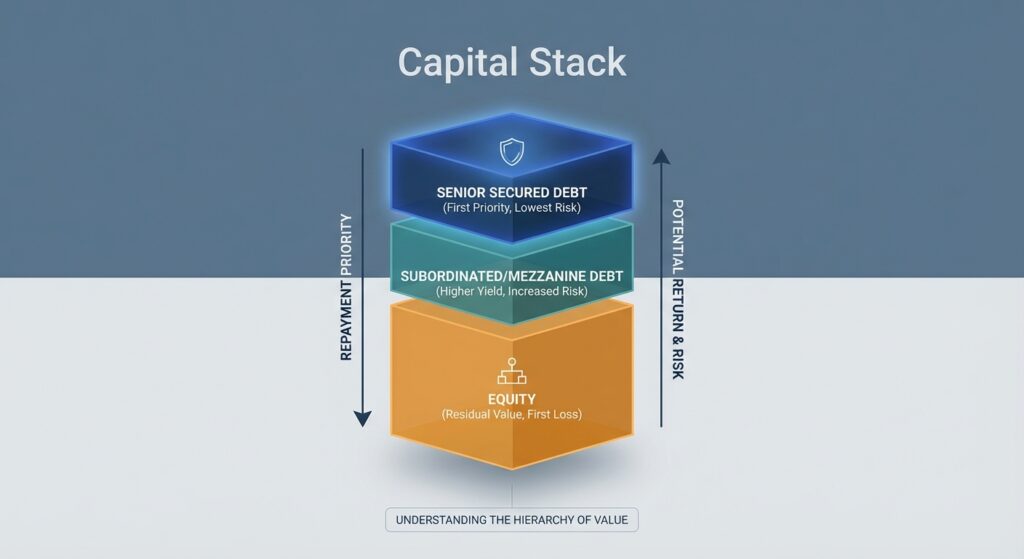
Understanding the Hierarchy of Value
In the world of private credit, the “Capital Stack” is the bedrock concept determining risk, return, and ultimate survival. For investors, it dictates the probability of repayment in a downturn. For business owners (operators), it determines the cost of capital and how much ownership they must dilute to fund growth. Put simply, the capital stack represents the hierarchy of financial claims on a company’s assets and cash flows.
While public markets often focus on stock prices (equity), private credit professionals focus on priority. Where does a specific dollars sit in the line? Whether you are allocating institutional capital or structuring a acquisition, understanding this hierarchy is the single most important factor in assessing the safety and efficiency of an investment.
The Concept: Seniority and Subordination
The capital stack is organized by seniority. Claims at the “top” of the stack have the highest priority for repayment and typically the lowest risk. Claims at the “bottom” have the lowest priority, absorbing losses first, but essentially capturing the unlimited upside of growth.
In a Private Credit context, the stack is generally divided into three primary layers:
- Senior Secured Debt: This is the top layer. It has the “first lien” on assets. In a liquidation event, these lenders are paid first. Because of this security, it carries the lowest cost of capital (interest rate) for the borrower and the lowest yield for the investor. According to Adams Street Partners, senior secured direct lending remains the predominant form of private credit explicitly because of this safety profile.
- Subordinated (Junior/Mezzanine) Debt: This layer sits between senior debt and equity. It is “subordinate” to the senior lenders, meaning they cannot be paid until the senior lenders are satisfied, but it ranks above equity. To compensate for this increased risk, these instruments often carry higher cash interest rates or “PIK” (Payment in Kind) features, and sometimes equity warrants.
- Equity (Common and Preferred): The bottom layer. Equity holders own the residual value of the business. They take the most risk (first loss) but enjoy the excess profits once all debt obligations are met.
How It Works: The $100 Million Example
To see the mechanics of attachment points and loss absorption, let’s value a hypothetical middle-market company at $100 million (Enterprise Value). A typical leveraged buyout (LBO) or recapitalization might structure the capital stack as follows:
- Senior Secured Loan: $50 million (0% to 50% LTV)
- Mezzanine Debt: $20 million (50% to 70% LTV)
- Equity Contribution: $30 million (70% to 100% LTV)
Scenario A: The Upside Case
The company is sold five years later for $150 million.
The Senior Lenders get their principal back (+ interest paid over time).
The Mezzanine Lenders get their principal back (+ higher interest).
The Equity holders receive the remaining proceeds. Their initial $30 million is now worth roughly $80 million (minus debt repayment), generating a massive return.
Scenario B: The Downside Case (The Protection Mechanism)
The company struggles and is forced to liquidate assets for only $60 million.
Senior Lenders: They are owed $50 million. They receive 100% of their principal. They are “money good.”
Mezzanine Lenders: They are owed $20 million. There is only $10 million remaining after paying the senior lenders. They recover 50% of their capital, taking a loss.
Equity Holders: They are owed nothing until debts are paid. They receive $0. Their capital is wiped out.
This example illustrates why private credit investors, particularly those in senior secured direct lending, focus intensely on the equity cushion (the 30% buffer in this case) and asset coverage. As defined by Umbrex, senior debt is the “most secure layer,” designed to weather valuation drops that would wipe out junior stakeholders.
Current Market Relevance
In the current vintage of 2025-2026, the capital stack has become a critical focal point due to shifting interest rate environments and valuation resets.
1. Industry Scale & Stability: Private credit has grown to match this structural importance. According to Mayer Brown data, the asset class ended 2023 with over $1.7 trillion in AUM and is projected to reach nearly $3 trillion by 2028. This growth is driven by investors seeking the safety of the “top of the stack” position combined with yields that surpass public bond markets.
2. The Unitranche Shift: A major trend is the blurring of the line between Senior and Mezzanine into “Unitranche” facilities. As noted in the Umbrex Private Credit Industry Primer, unitranche loans combine senior and junior tranches into a single instrument with a blended interest rate. For operators, this simplifies the stack (one lender to deal with); for lenders, it often provides better protection against creditor-on-creditor violence during restructuring.
3. Market Share: Private debt now represents substantial market depth, accounting for roughly 16.6% of total private market assets under management according to PitchBook. This indicates that more companies are utilizing private capital stacks rather than traditional bank financing to fuel growth.
Decision Framework
For Investors: Evaluating Risk
When reviewing a private credit opportunity, the primary question is: Where do I sit in the stack?
- Senior Allocations: Best for capital preservation and steady income (Coupons equal to Base Rate + Spread). Ideal for conservative parts of a portfolio.
- Junior/Mezz Allocations: Best for yield enhancement. Investors must fundamentally believe in the enterprise value stability, as the “equity cushion” beneath them is thinner.
For Operators: Optimizing Cost of Capital
Business owners often view debt purely as risk, but structurally, it is cheaper than equity.
If a business generates a 20% return on equity (ROE), raising capital via Senior Debt at 10% is accretive: it boosts the returns for existing shareholders without dilution.
However, “over-stacking” debt increases default risk. The decision framework requires balancing the Weighted Average Cost of Capital (WACC) against the volatility of cash flows.
Key Takeaways
- Seniority is Safety: Senior secured debt is paid first. In a downside scenario, losses eat through equity and junior debt before touching senior capital.
- Equity Cushion Matters: The thickness of the equity layer below the debt acts as a “shock absorber” for lenders.
- Trade-off Principle: Moving down the stack (from Senior to Mezzanine to Equity) increases potential return but disproportionately increases the risk of total principal loss.
- Unitranche Efficiency: Modern private credit often combines layers into single “Unitranche” facilities to streamline execution for borrowers.
- Asset Class Growth: With AUM approaching $3 trillion, the private capital stack effectively replaces the traditional banking model for many middle-market firms.


