
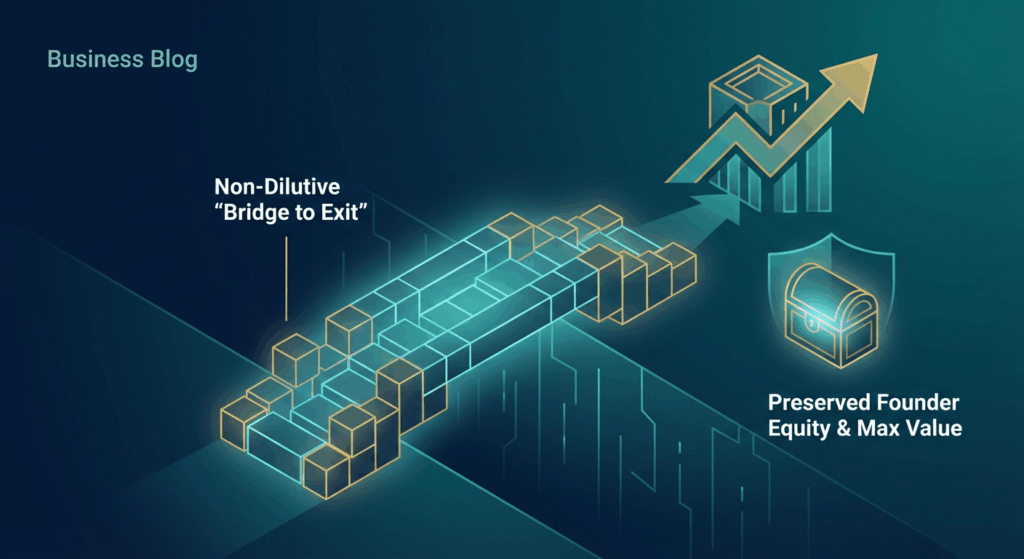
In the high-stakes world of venture-backed technology, the default playbook often dictates a linear path: Seed, Series A, Series B, and onwards until a massive exit or IPO. However, a quieter, often more lucrative strategy exists for founders who see an exit on the horizon but need one final push: the "Bridge to Exit" using non-dilutive debt.
For founders Simon Turner of Myagi and Andy Anderson of WatchWire, the decision to bypass a final equity round in favor of debt financing wasn't just about cash flow; it was about preserving millions of dollars in personal wealth during their liquidity events.
This week, we analyze how two SaaS founders utilized leverage to fuel their "last mile" of growth, avoiding the heavy cost of late-stage dilution.
The Setup: Growth Without the Handcuffs
By 2020, Myagi, a retail sales enablement platform, was at an inflection point. The company had initially planned a significant equity round in March 2020, but the pandemic disrupted global markets. Paradoxically, the remote work shift surged demand for digital retail solutions, handing Myagi its best six months of growth. Founder Simon Turner knew the company had the potential for a significant valuation uplift and subsequent exit, but he needed capital to bridge the gap between his current trajectory and the target acquisition profile.
Similarly, WatchWire (formerly EnergyWatch) had transitioned from energy consulting to a SaaS-based sustainability platform. Having bootstrapped for years, CEO Andy Anderson had built a robust culture and product without the pressure of external VC timelines. By 2021, with Cleantech heating up, Anderson had term sheets available from equity investors. But he recognized a critical mathematical reality: selling equity now, right before a potential strategic sale, would be the most expensive capital he ever took.
The Decision: Debt vs. Late-Stage Equity
Both founders faced a classic capital structure dilemma:
- Option A (Equity): Raise $2M–$5M in venture capital. This would provide cash but likely cost 15-20% ownership dilution, introduce new board members with aggressive return horizons, and potentially complicate a near-term exit with liquidation preferences.
- Option B (Debt): Utilize revenue-based or term debt. This would cost interest payments and require discipline in unit economics, but it would leave the cap table untouched.
Both founders chose debt. Myagi secured a $2.5 million facility from TIMIA Capital to invest in sales and customer success without giving up shares. Simon Turner noted, "Debt is a powerful tool for capital-efficient businesses when used under the right circumstances."
WatchWire followed a similar path, securing financing to double down on pipeline growth and partner channel development. Anderson’s rationale was blunt and effective: "Non-dilutive capital was key for us. It’s simply much cheaper capital… TIMIA’s investment will help us get to the next stage without giving up more of our company."
The Outcome: Maximizing the Exit
The strategic bet on leverage paid off for both companies by allowing them to dictate the terms of their exits.
Myagi was acquired by Rallyware just over two years after securing the debt facility. The capital allowed them to boost revenue metrics, making them a more attractive target, while the founders retained the equity upside that would have otherwise gone to a Series B investor. See the full case study at timiacapital.com.
WatchWire achieved a successful exit in 2023, acquired by Tango Analytics (backed by Berkshire Partners). Because Anderson had avoided late-stage dilution, the proceeds from the sale flowed more efficiently to the founders and early employees rather than being siphoned off by a late-stage VC's liquidation preference. See the WatchWire analysis at timiacapital.com.
The Math of the "Bridge to Exit" (Hypothetical Framework)
To understand the magnitude of this decision, consider a hypothetical scenario based on these principles:
- Scenario: A SaaS company with $5M ARR is valued at $30M. They need $3M to reach $8M ARR and sell for $60M.
- Equity Path: Raising $3M at $30M pre-money means selling ~9% of the company. At a $60M exit, that 9% is worth $5.4M. The cost of capital is effectively $5.4M.
- Debt Path: Borrowing $3M at a 15% cost of capital implies roughly $450k-$1M in interest/fees over the term.
- Result: The founder saves roughly $4.4M in value by choosing debt.
The Lessons: When Leverage Works Best
The stories of Myagi and WatchWire illustrate that debt is not merely a tool for distress or massive buyouts; it is a precision instrument for equity preservation.
- The "Last Mile" Value Capture: As a company approaches an exit window, equity becomes exponentially more expensive. Using debt to bridge the final 12-24 months prior to a sale is often the highest-ROI decision a founder can make.
- Control Premiums: Non-dilutive capital generally does not come with board seats or blocking rights. This allowed Turner and Anderson to negotiate their exits on their timelines, not on a VC fund's 10-year expiration schedule.
- Discipline as a Feature: Unlike equity, which can sometimes encourage "growth at all costs," debt service requirements force management to maintain focus on unit economics and cash efficiency, traits that make the company more attractive to strategic acquirers.
Key Insights
- Dilution is Permanent, Interest is Temporary: Once equity is sold, it is gone forever. Debt is a temporary obligation that disappears upon repayment or exit.
- Preserve Optionality: Debt bridges allow founders to delay valuation events until they are in a stronger negotiating position.
- Alignment of Interest: Lenders primarily care about repayment, whereas VCs care about "fund-returning" exits. For founders looking for realistic strategic exits ($50M-$100M range), lenders effectively align better than swing-for-the-fences VCs.
- The "Clean" Cap Table: Acquirers prefer simple cap tables. Avoiding a complex late-stage round with heavy liquidation preferences simplifies the M&A negotiation process.
- Timing is Everything: This strategy works best for companies with predictable recurring revenue and a clear line of sight to an exit or profitability; it is ill-suited for early-stage exploration.


