
The March 2020 Pivot
In early 2020, Simon Turner, the co-founder of Myagi, was preparing for a traditional milestone in the life of a SaaS startup: a significant equity fundraising round. Myagi, a platform designed to connect brands and retailers for improved sales enablement, had finding product-market fit and was ready to scale. Then, the COVID-19 pandemic hit.
For a company focused on the retail sector, the global lockdown could have been a death knell. Retail stores shuttered, and the traditional “field sales” model evaporated overnight. However, the constraints of the pandemic created an inverse opportunity. With physical sales calls impossible, brands desperately needed a digital way to train and inform frontline retail staff. The demand for Myagi’s solution didn’t drop; it surged.
Turner and his team faced a classic founder’s dilemma, albeit in a volatile environment. They needed capital to capture this sudden spike in demand. The default path for a high-growth tech company is almost always venture capital. But raising equity during global economic uncertainty often means accepting suboptimal valuations or onerous terms. Furthermore, selling a permanent stake in the business to solve a temporary cash flow constraint is the most expensive money a founder can buy.
The Decision: Debt as a Bridge, Not an Anchor
The Myagi team realized they were sitting on a valuable asset: recurring revenue and a clear path to growth. Selling equity would have diluted their ownership right as the company was proving its resilience. As Turner noted in a case study on the transaction, “Debt is a powerful tool for capital-efficient businesses when used under the right circumstances.”
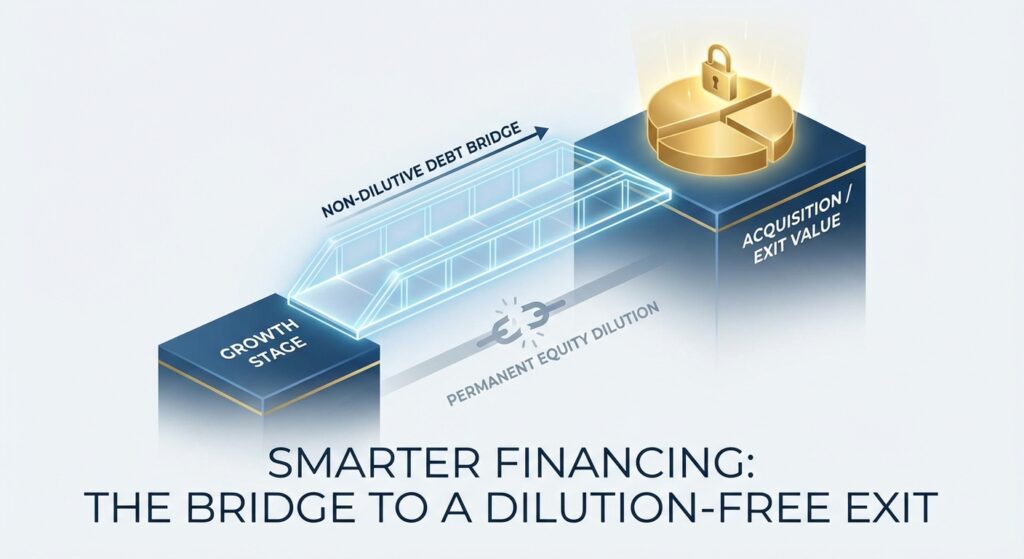
Instead of the dilution of a priced round, Myagi turned to TIMIA Capital in 2021 for a $2.5 million investment facility. This was structured as non-dilutive debt financing, capital that is repaid over time (often tied to revenue) rather than in perpetuity through shares.
The mechanics of the choice were clear:
- The Equity Option: Raise $2M–$3M from a VC. Likely cost: 15–20% of the company, plus board control dynamics and the pressure to hit “unicorn” returns.
- The Debt Option: Raise $2.5M from a revenue-based lender. Cost: A predictable interest rate/return cap. Equity surrendered: Zero.
Myagi chose the debt. They used the capital to double down on the referral-based sales model and improve software capabilities, betting that they could grow enterprise value faster than the cost of the interest.
The Outcome: Liquidity Without Loss
The bet paid off. The capital injection fueled a period of aggressive growth without altering the cap table. Approximately two years after securing the debt facility, Myagi was acquired by Rallyware, a performance enablement platform.
While the specific financial terms of the exit remain private, the structural victory for the founders is mathematically evident. By using debt to bridge the gap between their 2021 growth spurt and their 2023 exit, the founders and early shareholders didn’t have to split the exit proceeds with a new class of Series B or C investors. The debt was repaid from the company’s cash flows or the exit proceeds, and the remaining upside stayed with the operators.
This narrative isn’t unique to Myagi. WatchWire, a sustainability and energy management software, executed a nearly identical play. In 2021, facing plenty of VC interest in the hot cleantech sector, WatchWire’s leadership explicitly sought to avoid dilution. They utilized a similar debt facility to bridge themselves to a 2023 acquisition by Tango Analytics (backed by Berkshire Partners). As former WatchWire CEO Andy Anderson put it, “Even if it’s just a bridge to something bigger… [debt] will help us get to the next stage without giving up more of our company.”
The Lessons: When to Leverage
For founders and CFOs, the Myagi and WatchWire examples illustrate a critical framework for avoiding the “Equity Illusion”, the false belief that equity is ‘free’ money because it lacks monthly payments.
1. The “Bridge to Exit” Strategy
If an exit is visible on the horizon (12–36 months), equity is punitive. Raising equity sets a new valuation floor and brings in partners who need a 3x–10x return to be satisfied. Debt only requires its principal plus interest. If you sell the company, the debt holder gets paid off and leaves; the equity holder stays forever.
2. Cost of Capital Calculation
Founders should calculate the “cost of equity” at the exit. If you sell 20% of your company for $3M today, and sell the company for $50M in three years, that capital cost you $10M. A $3M debt facility might cost $1M–$1.5M in interest/fees over the same period. The savings ($8.5M in this example) go directly to the founders and common stock.
3. Control Premium
In the Myagi case, retaining control allowed the founders to navigate the post-pandemic market on their terms. Debt covenants are strict, but they rarely dictate product strategy or hiring decisions in the way a new VC board member might.
Key Insights
- Dilution is permanent; debt is temporary. Once equity is sold, it is nearly impossible to buy back. Debt can be extinguished.
- Align capital type with use of funds. Use equity for high-risk R&D (moonshots). Use debt for predictable growth (sales & marketing) where ROI is calculable.
- The “Bridge” application. Debt is most effective when bridging to a specific valuation event (a larger round or an exit), preventing unnecessary dilution right before enterprise value jumps.
- Crisis can broaden options. Myagi’s pivot during COVID-19 made them a better candidate for debt because their revenue quality improved (digital stickiness), even as the macro environment worsened.
- Preserve optionality. By taking debt, Myagi kept the acquisition window open. Venture investors often block early exits that don’t return the full fund; debt lenders generally welcome any liquidity event that repays the loan.


