
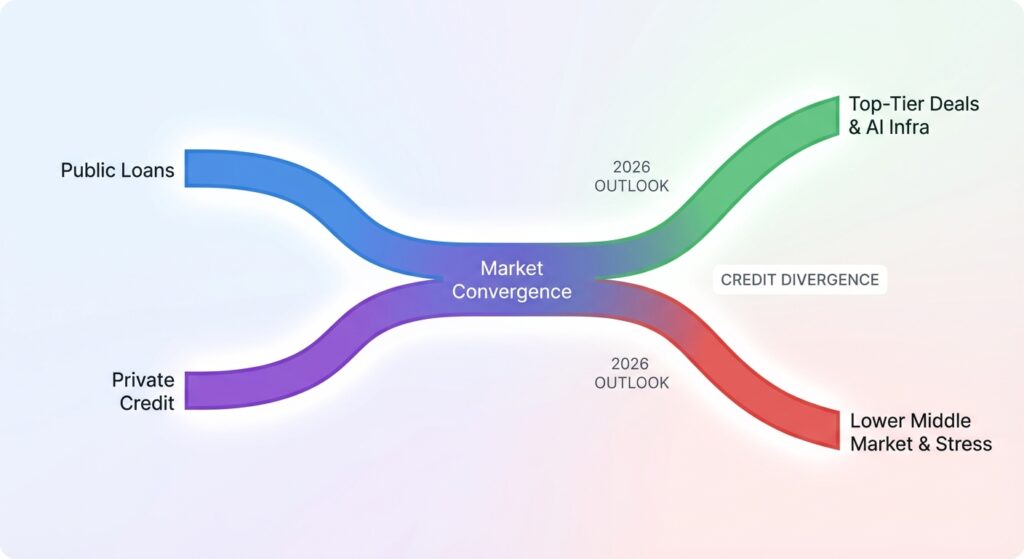
Market Headline: The Great Convergence Meets Credit Divergence
As we move through the first quarter of 2026, the private credit market is defined by a sharp dichotomy: aggressive capital inflows are compressing spreads at the top of the market, while credit deterioration accelerates at the bottom. The “Great Convergence” between private and public markets is no longer a forecast; it is the operational reality. According to recent data, the spread differential between private credit and broadly syndicated loans (BSL) has compressed to just 100-150 basis points, effectively tearing down the traditional liquidity premium walls.
However, this liquidity abundance masks growing fundamental stress. While deal oversubscription rates remain high, often 5-10x for investment-grade placements, underlying borrower health in the middle market is fraying. Downgrades are significantly outpacing upgrades, signaling that while the “funding machine” is robust, the “repayment machine” for legacy vintage deals is sputtering under the weight of sustained high rates and margin compression. For investors and lenders, the beta trade is over; 2026 is the year of manager selection and aggressive credit tiering.
Quantitative Snapshot: Q1 2026
The following metrics highlight the current bifurcation between liquidity conditions and credit performance.
| Metric | Current Value | Trend / Comparison | Source |
|---|---|---|---|
| Private vs. BSL Spread | 100-150 bps | Significantly Compressed | Private Markets Insights |
| Downgrade/Upgrade Ratio | 3.3x | Worsening (Up from 3.3x in Q4 ’25) | Morningstar DBRS |
| IG Private Placement Vol. | >$170 Billion | Record High (2025 Total) | SLC Management |
| Manager Dispersion | 400-600 bps | Widening Gap (Top vs. Bottom Quartile) | Private Markets Insights |
| Bank Partnership Origination | ~25% | Up from ~5% in 2020 | Private Markets Insights |
Sector Analysis: Rotation to Real Assets
Hot Sectors: AI Infrastructure & Asset-Based Finance
Capital is rotating out of crowded corporate cash-flow lending into asset-heavy verticals. The “growth story” has shifted toward Asset-Based Finance (ABF), now viewed as a $5 trillion opportunity, and AI infrastructure. With data center demand estimated at over $2 trillion, lenders are pivoting to finance physical infrastructure where collateral is tangible, moving away from pure enterprise-value lending which dominated the 2020-2024 cycles.
Cold Sectors: Lower Middle Market Corporates
Traditional middle-market borrowers are facing the brunt of the credit cycle. Morningstar reports that the weakest 10% of rated borrowers are heavily dependent on external capital support and PIK (payment-in-kind) deferrals. Sectors sensitive to margin compression are seeing a spike in “selective defaults” (SD), where distressed exchanges are used to avoid hard bankruptcy. The downgrade activity is particularly focused on borrowers moving toward the B (low) ratings, with no material momentum of recovery from CCC categories.
Structural Shift: The Bank-Nonbank Hybrid
The adversarial relationship between banks and private credit has evolved into a symbiotic one. Bank partnerships (e.g., Citigroup/Apollo, Wells Fargo/Centerbridge) now account for an estimated 25% of origination volume in 2026. This allows banks to maintain client relationships while offloading the asset risk to private capital, further fueling the supply of credit to larger borrowers.
Implications for Market Participants
For Borrowers:
The supply-demand imbalance clearly favors issuers, particularly those with clean balance sheets. With BDCs pricing issuances 10 bps tighter than initial guidance and deals massively oversubscribed, borrowers have leverage to negotiate looser covenants and tighter pricing. The “December premium” of 2025 has faded, and early 2026 execution is highly efficient for high-quality credits.
For Lenders & Investors:
The environment demands caution. The widening dispersion of 400-600 bps between top and bottom-quartile managers indicates that “rising tides” are no longer lifting all boats. Lenders must scrutinize portfolios for “masked” defaults, specifically PIK toggles and aggressive EBITDA add-backs that hide deteriorating coverage ratios. The convergence of terms means private credit lenders are importing aggressive documentation practices from the syndicated market, including “lender-on-lender violence” tactics, increasing recovery risk.
Forward Outlook (3-6 Months):
Expect continued compression in spreads as retail capital ($350B entered via BDCs/interval funds) chases yield. However, we anticipate a decoupling event where the “haves” (infrastructure, ABF, upper-middle market) separate further from the “have-nots” (leveraged lower-middle market). Default intensity will likely continue to rise through Q2 2026 as hedges roll off and the full impact of sustained leverage takes hold.
Key Market Insights
- Credit Quality Erosion: Downgrades are outpacing upgrades by 3.3x; focus on manager selection is critical as performance dispersion hits 600 bps.
- Spread Convergence: The premium for illiquidity has largely evaporated (100-150 bps spread vs. BSL), forcing investors to seek alpha in deal structuring rather than just holding risk.
- Sector Rotation: CapEx-heavy sectors (AI, Infrastructure) are absorbing the new liquidity, while traditional corporate cash-flow lending faces saturation and credit headwinds.
- The Hybrid Era: Banks are back, but as originators for private capital. This structural change is permanent, stabilizing deal flow but homogenizing underwriting standards.
- Retail “Tourist” Capital: The influx of semi-liquid retail capital is suppressing volatility and spreads, potentially mispricing risk in the event of a liquidity shock.


