
The Story: A Retail Empire Built on Spreadsheets
For a few years, Franchise Group (FRG) appeared to have cracked the code of modern retail. Led by Brian Kahn, the company executed an aggressive roll-up strategy, acquiring nationally recognized brands like The Vitamin Shoppe, Pet Supplies Plus, and Buddy’s Home Furnishings. The thesis was seductive in its simplicity: acquire reputable (but perhaps sleepy) retail chains, separate their operations into a "franchisor" model to generate high-margin royalty streams, and use those predictable cash flows to service the debt used to buy them.
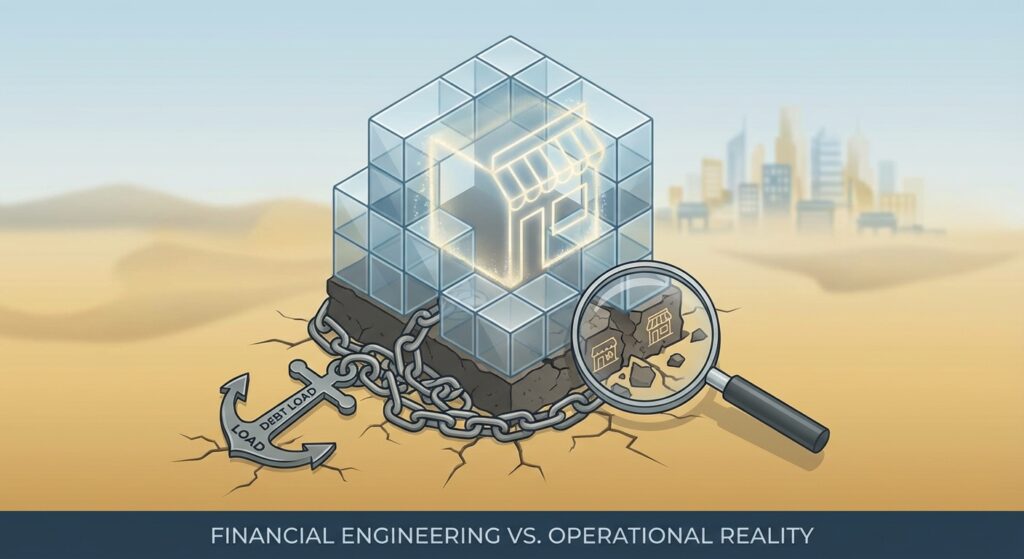
On paper, it was a classic financial arbitrage play. By stripping out costs and purportedly converting volatile retail earnings into stable franchise royalties, FRG hoped to command a higher valuation multiple while maintaining a massive debt load. However, the reality described in recent retrospectives was far stickier. As Pari Passu Newsletter notes, the "franchise model that appeared asset-light on paper masked the company’s significant exposure to struggling brick-and-mortar categories."
The company wasn’t just collecting checks from independent franchisees; it still owned and operated a massive fleet of corporate stores. It was a levered retailer dressed up as a fintech platform.
The Decision: Doubling Down with Complexity
The critical turning point came fundamentally in 2023. Facing headwinds in the public markets and rising interest rates, the management team, backed by financial partners like B. Riley, opted for a take-private transaction. Rather than de-leveraging or pausing to digest its acquisitions, the group doubled down.
The capital structure chosen for this pivot was extraordinarily complex. It created a bifurcated stack of HoldCo (Holding Company) and OpCo (Operating Company) debt. This structure allowed them to raise more total leverage than a traditional senior secured loan might permit, but it introduced a ticking time bomb: structural subordination.
In this arrangement, the lenders at the top, those funding the HoldCo, were effectively betting on the equity value of the operating companies. If the underlying retail businesses (the OpCos) struggled to send cash upstream, the HoldCo debt wouldn’t just be stressed; it would be stranded. The decision to prioritize financial engineering over operational resilience set the stage for a conflict that would tear the company apart.
The Outcome: Bankruptcy and the "Fusion" Rebirth
The thesis unraveled quickly. High inflation squeezed consumer discretionary spending, hitting brands like The Vitamin Shoppe and Buddy’s. With interest rates remaining elevated, the debt service burden became untenable. The "stable royalties" proved to be a mirage as the underlying corporate-owned stores faced the same brutal economics as any other retailer.
By late 2025, Franchise Group collapsed into Chapter 11 bankruptcy. It became one of the "messiest and most litigious bankruptcies of 2025," according to industry analysis. The complexity of the capital structure, specifically the HoldCo vs. OpCo dynamic, turned creditors against one another. HoldCo lenders, realizing they were deeply out of the money, wielded aggressive litigation tactics to extract value.
The outcome was a total wipeout for the common equity and a bruised exit for many creditors. In early 2026, the company emerged from the ashes re-branded as "Fusion," shedding its old skin but carrying the scars of a failed financial experiment. The lenders effectively "took the keys," swapping their debt for equity in a restructuring that proved that no amount of financial formatting can fix broken unit economics.
The Lessons: Principles for the Leveraged Founder
The fall of Franchise Group provides a stark curriculum for founders and CFOs considering leverage. While private credit and debt financing are powerful tools for non-dilutive growth, they punish complexity and opacity.
1. You Cannot Financial-Engineer Fundamental Risk
FRG tried to arbitrage the difference between retail trading multiples and franchise trading multiples. But debt is serviced by cash flow, not multiples. If the underlying asset is a volatile retail store, the debt must be sized for that volatility, regardless of what you call the corporate parent.
2. Complexity is a Liability in Distress
Founders often accept complex structures (like HoldCo/OpCo splits or PIK toggles) to squeeze out an extra turn of leverage. In good times, this looks like efficient capital. In bad times, it creates a prisoner’s dilemma. Simple capital structures allow for rational renegotiation; complex ones lead to litigation and total loss of control.
3. The Danger of "Adjusted" EBITDA
Roll-up strategies rely heavily on "pro forma" adjustments, assuming cost savings that haven’t happened yet. FRG’s leverage looked manageable based on future synergies but was suffocating based on actual trailing cash flows. When macro headwinds hit, the phantom EBITDA vanished, but the very real interest payments remained.
4. Asset-Light vs. Asset-Right
There is a difference between being truly asset-light (software, pure IP licensing) and simply moving assets off the primary balance sheet. Lenders will eventually look through to the quality of the ultimate revenue source. If that source is capital-intensive and cyclical, the debt capacity should reflect that reality.


