
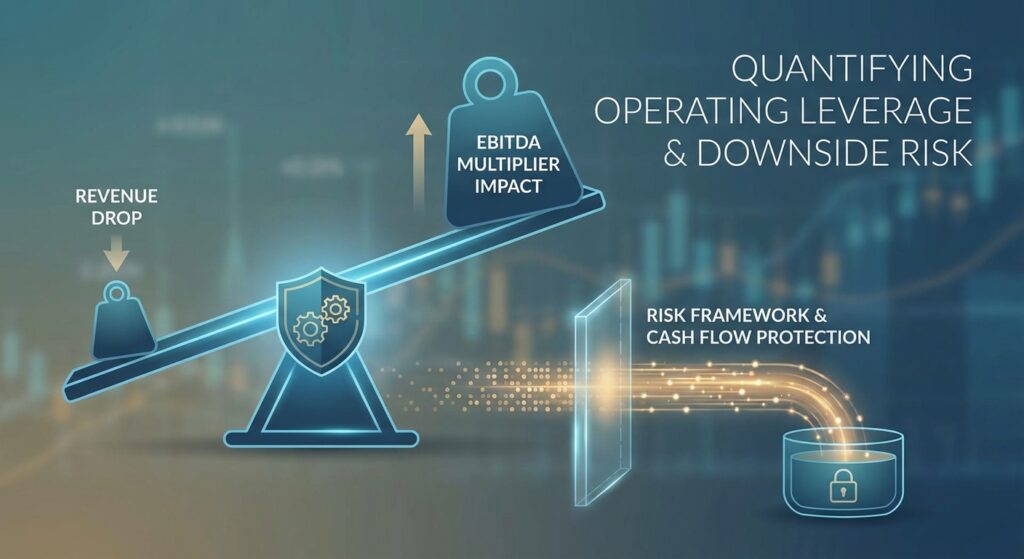
The Underwriting Challenge: Beyond the Base Case
In the current lending environment of early 2026, the primary differentiator between a performing portfolio and a distressed one is often the rigor applied during the stress-testing phase of underwriting. While base-case models typically show a borrower comfortably servicing debt with modest growth assumptions, credit losses rarely stem from the base case. They stem, almost exclusively, from the inability of a capital structure to absorb unexpected volatility.
Effective underwriting requires moving beyond simple coverage ratios to understand the operating leverage of a business, specifically, how changes in revenue volume translate to EBITDA deterioration. As highlighted in recent Fitch Ratings criteria, assessing a corporate borrower’s financial profile requires a granular look at profitability and financial flexibility under pressure [assets.fitchratings.com]. The objective is not to predict the future, but to quantify the “margin of safety” before a payment default or covenant breach occurs.
The Framework: Quantifying Operating Leverage
A robust stress-testing framework isolates the borrower’s fixed versus variable cost structure. A company with high fixed costs (high operating leverage) will experience a disproportionate drop in EBITDA for every dollar of lost revenue. The core methodology involves three steps:
- Cost Segregation: Audit the General Ledger to categorize COGS and SG&A into fixed (rent, salaries, insurance) and variable (materials, shipping, commissions) buckets.
- Sensitivity Analysis: Apply specific stress variables to volume, price, and margins independently.
- Breakeven Calculation: Solve for the exact revenue decline required to break the Fixed Charge Coverage Ratio (FCCR) of 1.0x.
This is aligned with the Basel Committee on Banking Supervision’s 2025 principles, which emphasize a sound credit-granting process that accounts for potential risks in evolving economic conditions [bis.org].
The Analysis: A $10M EBITDA Case Study
To illustrate the impact of operating leverage, consider a manufacturing borrower with $50 million in Revenue and $10 million in EBITDA (20% margin). The proposed loan is $40 million (4.0x leverage) with a 10% annual debt service ($4 million).
Base Case Structure:
– Revenue: $50,000,000
– Expenses: $40,000,000
– EBITDA: $10,000,000
– DSCR: 2.50x ($10M / $4M)
Step 1: Determine Cost Structure
Upon diligence, we find that the $40 million in expenses is split 50/50 between fixed and variable costs.
– Fixed Costs: $20,000,000
– Variable Costs: $20,000,000 (40% of Revenue)
Step 2: Apply the Stress (15% Revenue Decline)
If revenue drops 15% to $42.5 million, variable costs also drop by 15%, but fixed costs remain static.
– New Revenue: $42,500,000
– New Variable Costs: $17,000,000
– Fixed Costs: $20,000,000
– New EBITDA: $5,500,000
The Result:
A 15% decline in revenue caused a 45% decline in EBITDA ($10M to $5.5M). The DSCR compresses from 2.50x to 1.37x. While the borrower can still service debt, the leverage ratio has ballooned from 4.0x to 7.3x, likely triggering a covenant default. This “multiplier effect” is the single greatest risk in middle-market credit underwriting.
Industry Standards & Data Validation
Institutional lenders and regulators increasingly require this level of granularity. The Federal Reserve Bank of Atlanta notes that sound underwriting standards must describe enhanced monitoring practices, including stress testing for systemic dependencies [atlantafed.org]. Furthermore, Thornburg Investment Management suggests that in the private credit space, building smarter portfolios requires looking “beyond the hype” to the fundamentals of borrower cash flow stability [thornburg.com].
When evaluating credit performance, lenders should benchmark against the “Breakeven Revenue Decline.” For B-rated equivalent credits, standards often require that a borrower can withstand a 15-20% revenue contraction without breaching a 1.0x FCCR. If the model breaks at a 5% decline, the credit has insufficient structural protection regardless of the starting leverage point.
Underwriting Checklist for Stress Testing
To ensure a comprehensive risk assessment, underwriters should utilize the following checklist prior to investment committee approval:
- Variable Cost Validation: Have you verified which costs are truly variable? (e.g., Direct labor is often semi-fixed in the short term).
- Maintenance CapEx: Have you distinguished between growth CapEx (which can be cut) and maintenance CapEx (required to keep the lights on)?
- Working Capital Intensity: In a downside scenario, does the release of working capital (collecting AR, selling inventory) provide a cash cushion, or is the business cash-negative during contraction?
- Customer Concentration: Stress test the loss of the top 3 customers. Does the EBITDA remain positive?
- Covenant Buffer: set financial covenants (Total Leverage, FCCR) with enough cushion (typically 20-25% headroom) to allow for moderate volatility without triggering an immediate technical default.
Key Takeaways
- Leverage is Relative: Low starting leverage is irrelevant if high fixed costs exist; always solve for the operating leverage multiplier.
- Cash is King: Stress tests should focus on cash flow available for debt service (CAFDS), not just EBITDA accounting.
- Volatility Matters: A 15% revenue drop can lead to a 45% EBITDA drop in manufacturing/industrial sectors.
- Structure Defensively: Use the “Breakeven Analysis” to set covenant levels that trigger varying degrees of lender intervention.
- Monitor Continuously: Stress testing is not a one-time closing event; update models quarterly with actual financial data.


