
The Convergence of Speed and Scale: Why Unitranche Dominates Middle-Market Buyouts
In the high-velocity environment of middle-market leverage buyouts (LBOs), financing certainty often outweighs the marginal benefit of optimizing every basis point of interest. This preference has cemented unitranche financing as the dominant structure for sponsor-backed acquisitions in 2026. By blending senior and subordinated risk into a single instrument, the unitranche structure solves a critical friction point: the complexity of managing multiple lender classes during a time-sensitive close.
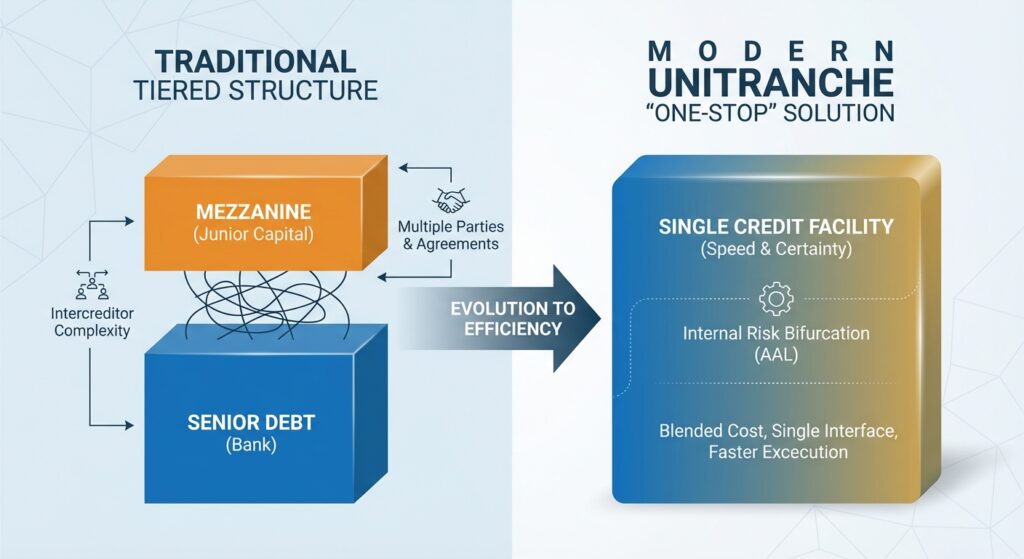
While traditional bank senior debt paired with mezzanine notes historically offered a lower weighted average cost of capital (WACC), the operational drag of negotiating intercreditor agreements and managing two sets of covenants has pushed sponsors toward the “one-stop” unitranche solution. Today, with private credit assets under management exceeding $2.1 trillion, unitranche facilities are no longer just for small deals; they are powering multi-billion dollar transactions with terms that increasingly rival the syndicated market.
Structure Breakdown: Components and Mechanics
A unitranche facility is functionally a hybrid loan structure that combines senior secured debt and junior capital (subordinated debt) into a single lien credit facility. To the borrower, it appears as one loan with one interest rate, one set of covenants, and one agent.
However, the internal engineering is where the complexity lies. Lenders typically bifurcate the risk behind the scenes using an Agreement Among Lenders (AAL). This agreement creates a synthetic “First-Out” and “Last-Out” waterfall:
- First-Out Tranche: Often held by a bank or low-cost capital provider, this tranche gets paid first and bears lower risk.
- Last-Out Tranche: Held by the direct lender or credit fund, this tranche absorbs higher risk for a high yield, effectively acting as the mezzanine layer without a separate document.
Deal Example: $100M Enterprise Value Software Buyout
Consider a private equity sponsor acquiring a B2B software company with $10M EBITDA at a 10x multiple ($100M EV). The sponsor needs $55M in debt financing (5.5x leverage).
The Unitranche Term Sheet:
- Facility Size: $55 million single term loan
- Pricing: SOFR + 575 bps (approx. 10.75% all-in assumed at current base rates)
- OID (Original Issue Discount): 98.0 (2% upfront fee)
- Amortization: 1% per annum
- Covenants: Single financial maintenance covenant (e.g., Total Net Leverage not to exceed 6.5x)
- Call Protection: 102, 101, par (3-year hard call profile)
In this scenario, the borrower navigates a single credit agreement. If the company needs to raise an incremental $10M for an add-on acquisition six months later, they negotiate with one relationship lender rather than obtaining consents from a senior bank syndicate and a separate mezzanine provider.
How It Compares: Unitranche vs. Senior-Mezz
The strategic choice between unitranche and a traditional tiered structure (“Senior-Mezz”) comes down to a trade-off between cost and execution efficiency.
Recent market data highlights the stark difference in timelines. Median unitranche deals move from specific terms to funding in approximately 45 days, compared to 70 days for senior-mezz structures. This 25-day delta can be the difference between winning and losing a competitive auction.
| Feature | Unitranche | Traditional Senior + Mezzanine |
|---|---|---|
| Documentation | Single Credit Agreement | Two Agreements + Intercreditor Deed |
| Lender Interfacing | Single Agent (One relationship) | Multiple parties (Bank + Credit Fund) |
| Pricing (Spread) | Higher Blended Rate (e.g., S+575) | Senior (S+350) mixed with Mezz (12%+) |
| Dilution | Rarely includes warrants | Mezzanine often requires equity kickers (warrants) |
While the Senior-Mezz stack might save 50-100 basis points in interest expense, it introduces “intercreditor risk”, conflicts between senior and junior lenders during workouts or amendments. Additionally, mezzanine debt often carries equity warrants (ranging from 1% to 3% ownership), which represents real dilution to the sponsor that often offsets the interest savings.
Current Market Terms (2026 Outlook)
As of early 2026, the unitranche market has standardized around borrower-friendly terms due to intense competition among direct lenders.
- Pricing: Spreads for middle-market issuers have tightened to SOFR + 475–575 bps. This reflects a compression from the 600+ spreads seen in previous volatility cycles.
- Leverage: Total leverage multiples for software and healthcare deals are holding steady at 5.0x to 6.0x EBITDA, with lenders placing greater emphasis on recurring revenue stability and loan-to-value (LTV) ratios of 50-60%.
- Portability: A growing trend in 2025/2026 term sheets is the inclusion of “portability” clauses, allowing the debt to remain in place if the sponsor sells the company, provided certain leverage and credit criteria are met.
According to market analysis from October 2025, unitranche financing now accounts for roughly 80% of North American buyout financing by deal count, underscoring its role as the default utility for middle-market M&A.
Structuring Guidance
For Operators and Sponsors
When negotiating a unitranche facility, focus on scalability. Ensure the term sheet includes a committed “delayed draw term loan” (DDTL) or an accordion feature. This allows you to tap additional capital for acquisitions without re-opening the full credit agreement or paying new closing fees on the whole facility. Furthermore, scrutinize the “definition of EBITDA” heavily; the ability to add back synergies and one-time costs will directly determine your covenant compliance headroom.
For Lenders and Investors
In a unitranche participation, the risk is often binary. Unlike a bank that can exit first, the unitranche lender is in the deal until the end. Therefore, strict maintenance covenants are non-negotiable for preserving capital. Investors should also pay close attention to the “incremental facility” language (“Mfn” or Most Favored Nation clauses) to ensure that if the borrower raises new debt at a higher yield, the existing lenders get re-priced upwards to match.
Key Takeaways
- Speed Premium: Borrowers pay ~50-100 bps more for unitranche to close 30 days faster and avoid syndication risk.
- Invisible Bifurcation: Risk is split via a private Agreement Among Lenders (AAL), appearing seamless to the borrower.
- Dilution Defense: Unitranche avoids the equity warrants typical of mezzanine styling, preserving cap table ownership.
- Scalability: The structure excels for “buy-and-build” strategies due to easier access to incremental debt (DDTLs).
- Single Counterparty: In distress, dealing with one lender group is significantly more efficient than mediating between conflicting senior and junior classes.


