
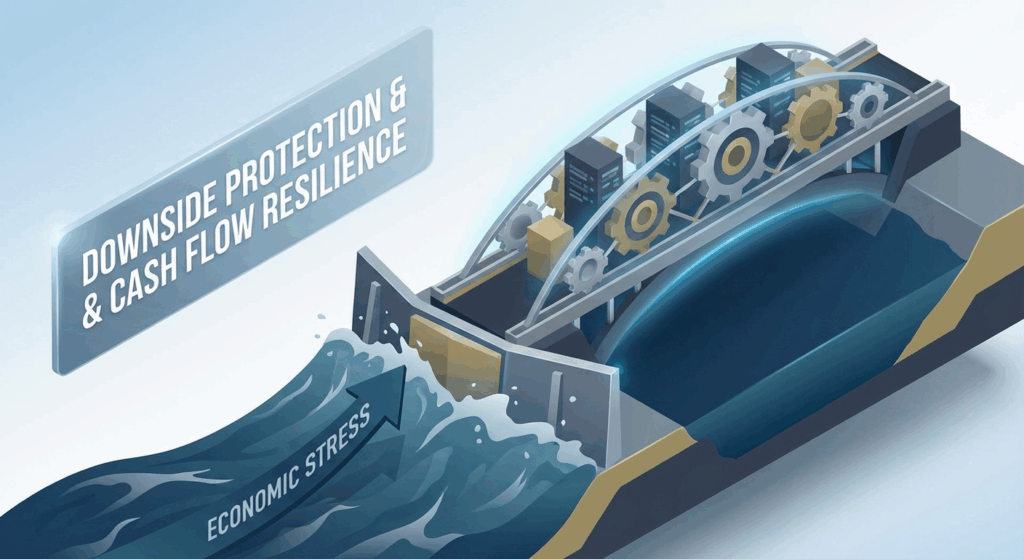
The Asymmetric Reality of Credit Risk
In credit underwriting, the risk-return profile is fundamentally asymmetric. Unlike equity investors, who participate in unlimited upside, a lender’s best-case scenario is simply the return of principal plus interest. The downside, however, is a total loss of capital. Therefore, the primary objective of rigorous underwriting is not to predict success, but to ensure survivability during failure.
Effective risk management requires moving beyond the borrower’s “Management Case” (often an optimistic projection of growth and margin expansion) to construct a rigorous “Downside Case.” This process, known as stress testing cash flows, determines the borrower’s ability to service debt when economic conditions deteriorate. As outlined in the 2025 Principles for the management of credit risk by the Basel Committee on Banking Supervision, sound credit granting requires a forward-looking perspective that anticipates adverse market developments rather than relying solely on historical performance.
The Framework: Constructing the Downside
A robust stress testing framework isolates key variables to understand their individual and aggregate impact on cash flow. Institutional lenders typically evaluate creditworthiness over a three- to five-year time horizon, a standard reinforced by Fitch Ratings’ Corporate Rating Criteria, to capture a full economic cycle.
We categorize stress tests into three primary tiers:
- Sensitivity Analysis: Changing one variable at a time (e.g., a 10% rise in raw material costs) to measure elasticity.
- Scenario Analysis: Changing multiple linked variables to simulate a specific event (e.g., a recession causing both a 15% revenue decline and a 5-day extension in receivables).
- Breakeven Analysis: Solving for the maximum deterioration the company can absorb before the Fixed Charge Coverage Ratio (FCCR) breaches 1.0x.
The Analysis: Stress Testing a $10M EBITDA Manufacturer
Consider a hypothetical manufacturing borrower, “Alpha Corp,” seeking a term loan.
Base Scenario: Alpha generates $10 million in EBITDA with $40 million in senior debt (4.0x leverage). Debt service (principal + interest) is $5 million annually. The base FCCR is 2.0x ($10M / $5M), implying a healthy cushion.
The Downside Stress: To test resilience, we apply a “recession scenario”:
- Revenue Haircut: We assume a 15% drop in revenue due to demand contraction.
- Operating Leverage Impact: Because manufacturing has high fixed costs, a 15% revenue drop often leads to a disproportionate drop in EBITDA. If Alpha has 40% fixed costs, a 15% revenue decline might result in a 30% EBITDA contraction.
- EBITDA Adjustment: EBITDA falls from $10 million to $7 million.
- Cash Flow Conversion: We assume customers pay slower, increasing Days Sales Outstanding (DSO) by 10 days, trapping an additional $1 million in working capital.
The Result: The effective cash flow available for debt service drops to $6 million ($7M EBITDA – $1M working capital drag). With $5 million in debt service, the stress FCCR tightens to 1.2x. While still positive, this leaves little margin for error. If the stress scenario pushes FCCR below 1.0x, the capital structure is considered too aggressive for the risk profile.
Industry Standards and Red Flags
Regulatory frameworks, such as the ECB’s Credit Risk SREP Methodology, emphasize that lenders must assess the “nature of the credit portfolio… including from a forward-looking perspective.” Merely accepting a borrower’s historical averages ignores the cyclicality of credit markets.
Red flags in stress testing include:
- Unrealistic Cost Flexibility: Borrowers often claim they can cut SG&A expenses immediately during a downturn. Institutional lenders typically discount these savings by 50% to reflect the lag in implementation.
- Ignoring Maintenance CapEx: In a downside model, lenders must differentiate between “growth CapEx” (which can be cut) and “maintenance CapEx” (required to keep the lights on). Underestimating maintenance CapEx artificially inflates free cash flow.
- Covenant Tightness: A loan is risky if a 10% deviation in EBITDA triggers a covenant default. Lenders generally look for a 20-25% “cushion” in the base case to prevent technical defaults during minor volatility.
Underwriting Checklist: Stress Testing Protocol
When conducting due diligence, the following steps ensure a rigorous assessment of cash flow durability:
- Variable Isolation: Identify the single most volatile driver of margins (e.g., commodity prices, labor rates) and shock it by 2 standard deviations.
- Working Capital Cycle: Analyze the “Cash Conversion Cycle” during the last downturn. Did the company consume or release cash? (e.g., inventory gluts consume cash).
- Fixed vs. Variable Cost Audit: Verify the true fixed nature of operating expenses. Do not rely on management adjustments without general ledger verification.
- Customer Concentration: Run a “Client Loss” scenario where the top 2 customers zero out. Can the remaining cash flow service the debt?
- Liquidity Bridge: Ensure the borrower has sufficient revolver availability to cover the trough of the stress period.
Key Takeaways
- Cash Flow Over Collateral: While collateral provides recovery, cash flow prevents default. Prioritize cash flow stability in analysis.
- The Multiplier Effect: Revenue declines trigger disproportionate EBITDA declines due to operating leverage.
- Working Capital is a Use of Cash: In many stress scenarios, slowing collections consume cash exactly when it is needed most.
- Forward-Looking Compliance: Align stress testing horizons with regulatory standards (3-5 years) to capture cyclical risks.
- Breakequals Safety: The “Breakeven” point, where cash flow equals debt service, is the truest measure of margin for error.


