
The Financing Challenge: Speed vs. Cost
In the competitive lower-middle market (LMM) landscape of early 2026, private equity sponsors and corporate acquirers face a persistent structural trade-off: the speed and certainty of a single lender versus the lower blended cost of a complex capital stack. While broadly syndicated markets have reopened, the unitranche facility remains the dominant tool for sub-$500M enterprise value transactions, primarily because it solves the "intercreditor friction" problem that kills deals in volatile windows.
For operators and CFOs, understanding the mechanics of unitranche debt, beyond just the headline interest rate, is critical for optimizing capital structures without diluting equity.
Structure Breakdown: Mechanics and Economics
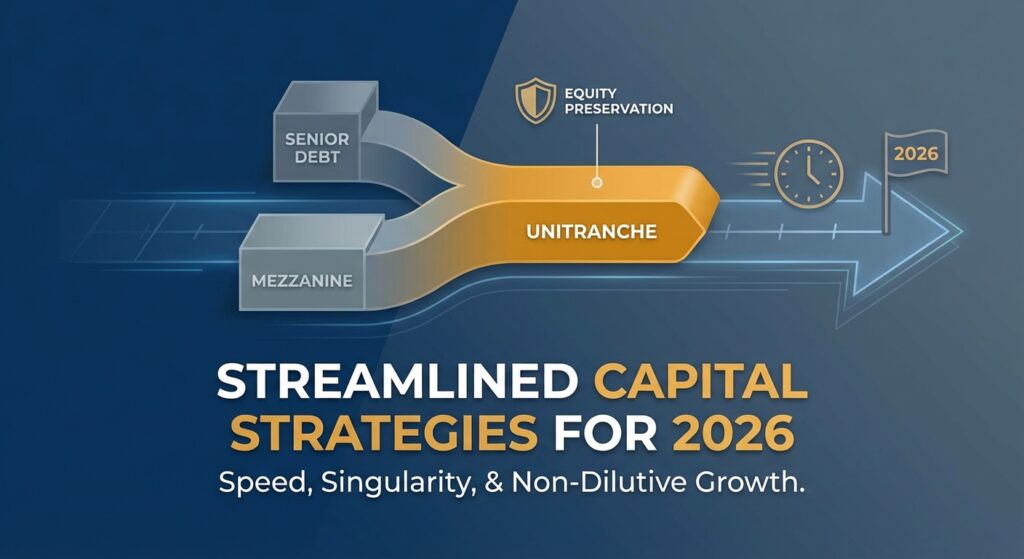
A unitranche facility combines senior debt (first lien) and subordinated debt (unsecured or second lien) into a single loan instrument with a blended interest rate and one set of governing documents. Unlike a traditional structure where a commercial bank holds the senior piece and a credit fund holds the junior piece, a unitranche lender provides the entire check.
Detailed Deal Example:
Consider a software company with $10M EBITDA acquiring a competitor for a total Enterprise Value of $100M (10x multiple). The financing requirement is $55M (5.5x leverage).
- Facility Size: $55 million single tranche term loan.
- Pricing: SOFR + 550 basis points (floor of 1.0%).
- Structure: First lien security on all assets.
- Amortization: 1.0% per annum (minimal required principal paydown).
- Covenants: Single financial maintenance covenant (typically Leverage Ratio < 6.0x or Fixed Charge Coverage > 1.1x).
- Call Protection: 103/102/101 (typical soft call prepayment penalties for years 1-3).
Behind the scenes, the lender may bifurcate the risk using an Agreement Among Lenders (AAL) to create a "first-out" and "last-out" waterfall, but the borrower never sees this complexity. They sign one credit agreement and manage one relationship.
Comparative Analysis: Unitranche vs. Senior-Mezzanine
The primary alternative to unitranche in the LMM is a Senior-Mezzanine stack. Choosing between them requires weighing execution risk against cost efficiency and equity preservation.
1. Execution Speed & Complexity
Data from 2025 indicates a significant speed advantage for unitranche. The median "sign-to-fund" timeline for unitranche deals is approximately 45 days, compared to 70 days for Senior-Mezzanine structures. This 25-day delta is often the difference between winning and losing a competitive auction. Senior-Mezz requires negotiating an intercreditor deed, which defines how the two lenders interact during a default, a process that often stalls documentation.
2. Dilution & Warrants
While a senior bank loan is cheaper (e.g., SOFR + 350 bps), the required mezzanine slice is expensive (12-14% total return) and often demands equity warrants (commonly 3-5% of fully diluted ownership) to juice returns. Unitranche lenders, targeting a blended return of ~10-12%, rarely require warrants. For a founder or sponsor confident in a high exit multiple, paying a higher cash interest rate (unitranche) is often preferable to giving up permanent equity upside (mezzanine).
Current Market Terms (2025-2026 Data)
Following the stabilization of interest rates, 2026 terms have tightened slightly favoring borrowers, though leverage remains disciplined. According to recent private credit market data:
- Spreads: Typical unitranche spreads are currently running SOFR + 475–575 bps depending on the credit quality and sector.
- Leverage: Total leverage on these deals hovers around 4.5x – 5.5x EBITDA, with lenders remaining sensitive to free cash flow coverage.
- Loan-to-Value (LTV): Lenders are advancing 55–65% LTV, requiring significant equity cushions (35-45%) from sponsors.
- Upfront Fees: 1.5% – 2.0% original issue discount (OID) or closing fees remains standard.
Structuring Guidance: Negotiation & Strategy
For Operators & Borrowers:
When negotiating a unitranche sheet, focus on "scalability." Since you are paying a premium for a monolithic facility, ensure it allows for Incremental Facilities (Accordions). This permits you to borrow additional funds for future acquisitions at pre-agreed terms without restriking the entire credit agreement. Additionally, push for "covenant holidays" offering a 1-2 quarter relaxation of leverage ratios immediately following a material acquisition.
For Investors:
The risk in unitranche lies in the "last-out" exposure. If the facility is internally leveraged or syndicated, understanding the AAL is paramount. Ensure you have voting rights on material amendments (e.g., releasing collateral or increasing the facility size) even if you are in the minority position.
Key Takeaways
- Speed Premium: Unitranche closes ~35% faster than bifurcated structures, crucial for tight M&A timelines.
- Equity Preservation: Higher cash interest costs are often offset by the absence of equity warrants/kickers found in mezzanine debt.
- Simplicity: One credit agreement and one agent eliminate intercreditor disputes during workarounds.
- Pricing Band: Current market pricing settles around SOFR + 475-575 bps for healthy mid-market credits.
- Flexibility: Negotiate for committed delayed draw term loans (DDTL) to fund post-close buy-and-build strategies.


