
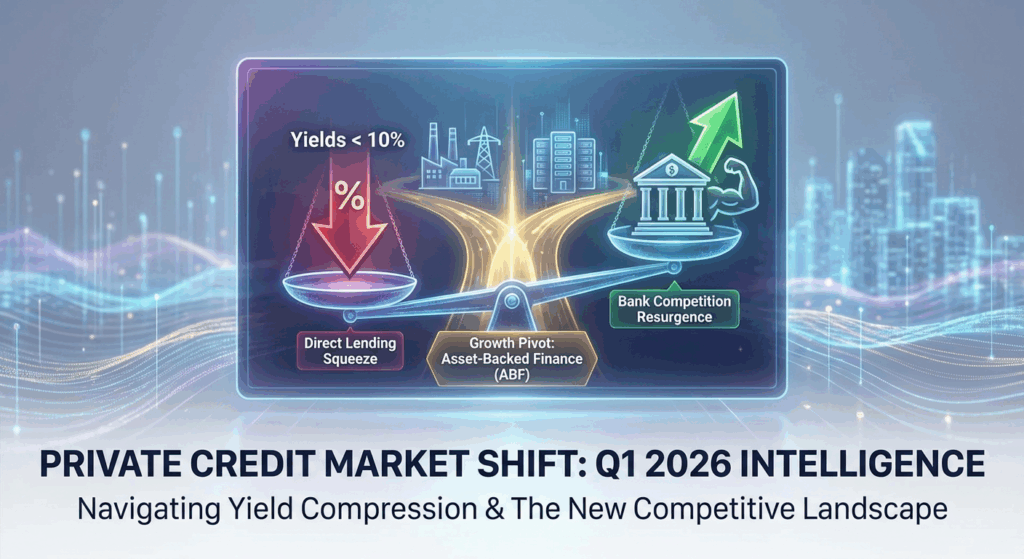
Market Overview: The Yield Squeeze and the Return of Bank Aggression
As we move through Q1 2026, the distinguishing feature of the private credit market is the rapidly intensifying competition between direct lenders and traditional banks. Following the critical regulatory shift in December 2025, where leveraged lending guidelines were effectively withdrawn, banks have re-entered the leveraged finance arena with renewed appetite for higher leverage levels, directly challenging private credit’s dominance.
For the first time in three years, direct lending yields have compressed below 10%, driven by a combination of Federal Reserve rate cuts (bringing the top rate to 3.75%) and a supply-demand imbalance where lender capital outweighs high-quality issuance. While the “Golden Age” of double-digit risk-free-comparable returns may be tapering, the asset class is evolving toward greater complexity, with Asset-Backed Finance (ABF) and Investment Grade private placements driving the next leg of growth toward a forecast $3 trillion market by 2028.
Quantitative Snapshot: Q1 2026
| Metric | Current Level (Q1 2026) | Trend / Comparison | Source |
|---|---|---|---|
| Direct Lending Yields | < 10.0% | First time below 10% in 3 years | CreditSights |
| OID (Original Issue Discount) | 98.75 – 99.25 | Tightened from 98.50 (Sep ’25) | VRC |
| Fed Policy Rate | 3.75% (Top End) | Cut in Oct & Dec ’25 | McDermott Will & Emery |
| Market Volume (2025) | ~$140 Billion | Resilient despite $48B BSL recaptures | CreditSights |
| Default/Risk Signals | Rising PIK Usage | Systemic risk monitor | CreditSights |
Sector Analysis: The Rotation to Asset-Based Finance
While corporate direct lending faces margin compression, capital is rotating toward complex, asset-heavy sectors where premium returns still exist.
- Asset-Backed Finance (ABF) & Infrastructure: This segment is identified as the primary growth engine for 2026. With the BSL market recapturing traditional corporate LBOs, private lenders are pivoting to ABF, particularly in data infrastructure and consumer loans. Deals involving major players like Intel and Rogers Communications underscore how private credit is winning large-cap digital infrastructure mandates via joint-venture structures. Cleary M&A Watch
- Digital Infrastructure & Tech: Despite high valuations, lender appetite remains robust for data centers and AI-adjacent infrastructure. However, concentration risk in technology and healthcare is now being flagged as a key systemic vulnerability, with some lenders pulling back on “story” credits in these sectors. CreditSights
- Cyclical & Tariff-Exposed Sectors: A bifurcation has emerged. While high-quality assets see spread compression, lower-quality credits (specifically those exposed to potential new tariffs or heavy cyclicality) are seeing widening risk premiums or exclusion from the tightest pricing bands. VRC
Implications for Market Participants
For Borrowers (Corporates & Sponsors):
The current environment is decidedly borrower-friendly. The resurgence of the Broadly Syndicated Loan (BSL) market has forced private lenders to concede on terms. We are seeing a proliferation of pricing grids with “step-downs” (e.g., spreads dropping from S+475 to S+450 based on leverage metrics) embedded at origination. Furthermore, the withdrawal of bank leverage guidelines means borrowers may soon see banks matching private credit on leverage multiples, increasing negotiation leverage. VRC
For Lenders & Investors:
The “easy beta” of soaring base rates is over. With yields compressing and OIDs tightening toward par (99.25), managers must rely on origination alpha (specifically in ABF and hybrid capital solutions) to maintain return targets. There is also a rising “interconnectivity risk” as insurance-PE partnerships and bank exposures to NDFIs (Non-Bank Financial Intermediaries) deepen, creating potential contagion channels if credit fundamentals deteriorate. Moody’s
Key Market Insights
- Regulatory competitive release: The withdrawal of leveraged lending guidelines (Dec 2025) removes the leverage cap handicap for banks, predicting a fiercer battle for LBO market share in 2026.
- Spread compression reality: Direct lending yields dropping below 10% signals a return to a “search for yield” environment, likely pushing capital further out the risk curve or into structured products.
- Documentation convergence: Expect private credit covenants to weaken further, converging with BSL standards, as managers compete to deploy significant dry powder.
- The ABF Pivot: Asset-Backed Finance is no longer a niche; it is becoming the core allocation for lenders seeking differentiation from the commoditized corporate lending market.
- Systemic Watch: Rising Payment-in-Kind (PIK) usage is the critical metric to watch for hidden stress in lender portfolios.


