
The Financing Challenge: Speed vs. Cost Efficiency
In the current middle-market landscape, sponsors and operators often face a critical decision during an acquisition or refinancing: optimize for the lowest weighted average cost of capital (WACC) using a complex multi-tranche structure, or pay a premium for speed, certainty, and simplicity. The Unitranche facility has emerged as the dominant solution for the latter, effectively displacing the traditional senior-subordinated debt structures in many private equity buyouts.
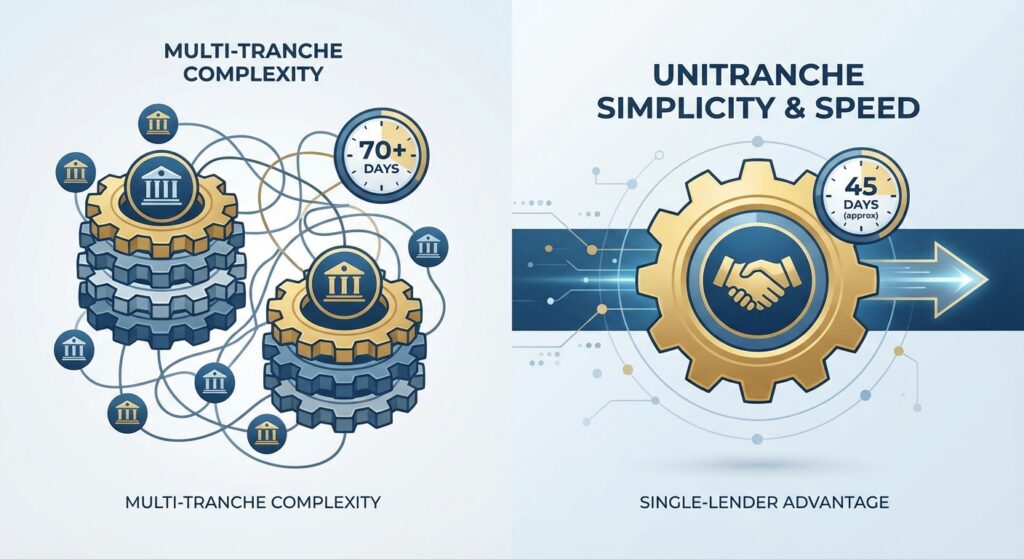
For a borrower with $100M in enterprise value looking to fund a buyout, securing separate senior bank debt and mezzanine capital can take upwards of 70 days, involving inter-creditor negotiations and distinct covenants. The unitranche collapses this timeline to roughly 45 days by blending senior and junior risk into a single instrument with one lender and one loan agreement.
Structure Breakdown: Mechanics and Components
A unitranche facility combines senior secured debt and junior capital into a single lien term loan. While it appears as a single facility to the borrower, behind the scenes, it may be structured with a “first-out/last-out” (FOLO) agreement between lenders to allocate risk and return.
Detailed Example: The $55M Unitranche
Consider a software company with $10M EBITDA valued at $100M (10x EV) seeking leverage for a buyout.
- Facility Size: $55M (5.5x Total Leverage)
- Structure: Single Credit Agreement
- Pricing: SOFR + 550 basis points (bps)
- Amortization: 1.0% per annum
- Tenor: 5-6 years
- Covenants: Single maintenance covenant (Total Net Leverage Ratio), typically set with 25-30% headroom.
In this scenario, the “blended” rate of SOFR + 550 bps replaces a theoretical stack of Senior Bank Debt (SOFR + 350 bps) and Mezzanine Debt (12% Cash + 2% PIK + Warrants). The borrower avoids the dilution of warrants often attached to mezzanine debt and eliminates the friction of managing two lender groups.
How It Compares: Unitranche vs. Senior-Mezz
The choice between unitranche and a traditional stratified capital stack comes down to execution risk and dilution.
- Speed & Certainty: Recent data indicates the median sign-to-fund timeline for unitranche deals is approximately 45 days, compared to 70 days for senior-mezzanine structures. In competitive auction processes, this speed can be the deciding factor in winning a bid.
- Leverage & LTV: Unitranche providers frequently offer higher loan-to-value (LTV) ratios, averaging 55–65% on live deals, whereas senior lenders typically cap out at 40–50%, requiring a separate mezzanine tranche to bridge the gap.
- Cost Trade-off: While the headline rate on a unitranche (e.g., S+575) appears higher than a senior bank loan (e.g., S+350), it is often cost-neutral or cheaper when weighted against the expensive junior capital required to achieve the same leverage point, without the potential equity dilution from warrants.
Current Market Terms (2025-2026)
The unitranche market has matured significantly, moving up-market to fund large-cap transactions that were previously the domain of the syndicated loan market.
- Pricing Spreads: Current market pricing for middle-market unitranche facilities hovers between SOFR + 475 bps and SOFR + 575 bps depending on credit quality and sector.
- Upfront Fees: Borrowers often see Original Issue Discount (OID) or upfront fees in the 1.5% – 2.0% range.
- Scale: The market is no longer limited to small deals. For example, large private credit players recently led a $2.11 billion unitranche facility for Aptean, refinancing existing first and second lien syndicated loans. This demonstrates the depth of liquidity available in private credit for “mega-unitranche” executions.
Structuring Guidance & Negotiation
For Operators and Sponsors:
- Accordion Features: Negotiate a robust “incremental facility” or “delayed draw term loan” (DDTL) upfront. This allows you to fund add-on acquisitions under the same documentation without restriking terms.
- Covenant Holidays: While unitranche deals typically feature a maintenance covenant (leverage ratio), try to negotiate “step-downs” that are generous in the first 12-18 months to account for integration costs or J-curve effects.
- Call Protection: Pay attention to prepayment penalties (NC/103/102/101). If you anticipate a quick exit or refinancing, negotiate for softer call protection (e.g., 101 soft call for 6 months) to avoid expensive breakage costs.
For Investors:
- Documentation Risk: In a single-lender structure, the documentation is often “club-style” rather than broadly syndicated. Ensure the credit agreement includes strict limitations on “leakage” (restricted payments, unbounded subsidiaries) that could dilute collateral coverage.
Key Takeaways
- Speed Premium: Unitranche closes ~25 days faster than multi-tranche alternatives, reducing execution risk in M&A.
- Simplicity: One credit agreement and one agent eliminate inter-creditor disputes and streamline post-close administration.
- Higher Leverage: Offers deeper LTV (up to 65%) compared to standalone senior facilities.
- Scalability: “Mega-unitranche” deals now rival the syndicated market, supporting multi-billion dollar capital structures.
- Non-Dilutive: Avoids the equity warrants often required by mezzanine lenders to achieve similar leverage profiles.


