
Market Headline: The Great Convergence and the Return of the Buyer’s Market
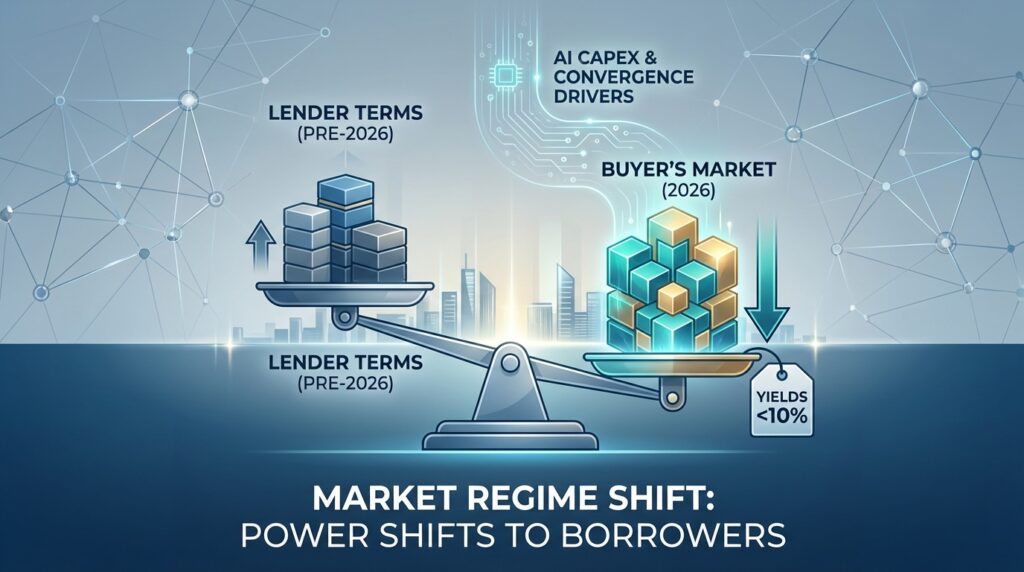
As of February 2026, the private credit market is undergoing a fundamental regime shift. After years defined by capital scarcity and lender-friendly terms, the balance of power has decisively tipped creating a “buyer’s market” for credit. This transition is driven by the aggressive re-entry of traditional banks following the withdrawal of leveraged lending guidelines in late 2025, alongside a resurgence in M&A activity.
For the first time in three years, all-in yields for direct lending have compressed below 10%, accelerated by Federal Reserve rate cuts and intense competition from the Broadly Syndicated Loan (BSL) market. The BSL market recaptured nearly $48 billion in refinancings from private credit in 2025, forcing private lenders to defend their turf through competitive pricing and looser documentation. While deal volumes remain robust, holding near $140 billion annually, the easy alpha of the post-2022 era has evaporated. The market is now defined by “dispersion, not distress,” where capital is abundant but increasingly selective, gravitating toward high-quality borrowers and asset-backed structure.
Quantitative Snapshot: February 2026
| Key Metric | Current Level / Trend | Comparison / Context | Source |
|---|---|---|---|
| Direct Lending Yields | < 10% | First time below double-digits in 3 years (Spread compression acceleration) | CreditSights |
| Market Volume (Annual) | ~$140 Billion | Stable despite $48B lost to BSL takeouts; BSL recouping market share | CreditSights |
| AI Capital Expenditure | $2.7 Trillion | Forecast 2025-2029; Primary driver of new credit supply | Apollo Academy |
| Private Credit AUM | > $2 Trillion | On track to approach $4T by 2030; Matching BSL market size | Moody’s |
Sector Analysis: The AI Capex Supercycle & Asset-Backed Finance
Infrastructure & AI (Overweight): The dominant narrative for 2026 is the “AI arms race,” which has evolved from a self-funded equity story into a massive debt financing event. With hyperscaler investment projected to exceed $2.7 trillion through 2029, internal cash flows are no longer sufficient. This has opened a direct pipeline for private credit into investment-grade adjacent opportunities, specifically in data centers and energy infrastructure. Large-cap issuers like Intel and Meta have already tapped private markets for joint-venture financing, signaling a structural shift where private credit supports large-scale industrial policy.
Asset-Backed Finance (ABF) (Rising): As corporate direct lending spreads tighten, lenders are rotating into Asset-Backed Finance (ABF) to maintain yield. ABF is becoming the growth engine of the private market, forecast to lead AUM expansion through 2030. This shift is partly a response to “plain vanilla” corporate lending becoming commoditized. Managers are increasingly partnering with banks to originate consumer loans and data infrastructure credit, moving beyond the traditional sponsor-backed middle market.
Tech & Healthcare (Watchlist): While still active, these sectors face heightened scrutiny due to concentration risk. Systemic vulnerabilities are emerging from the deepening interconnectedness between private credit funds and insurance backers, particularly in leveraged tech portfolios where “payment-in-kind” (PIK) usage remains elevated.
Implications: The Convergence of Documents and Terms
For Borrowers: Conditions are the most favorable they have been since 2021. The withdrawal of bank leveraged lending guidelines in December 2025 has emboldened syndicated desks to underwrite higher leverage multiples, forcing private lenders to match terms. Borrowers can now demand BSL-style covenant-lite structures even in private executions. The convergence of documentation standards means the “privacy premium” is shrinking; borrowers are effectively renting the speed and certainty of private credit without paying the historical spread premium.
For Lenders & Investors: The “set it and forget it” yield environment is over. With yields compressing and correlations rising (driven by broad AI exposure), manager selection is paramount. The risk of specific credit impairments is rising as dispersion widens between high-quality AI-adjacent assets and legacy borrowers facing margin pressure. Lenders must look to hybrid strategies (such as junior debt with equity upside or NAV lending) to manufacture returns that justify illiquidity.
Key Market Insights
- Bank Competition Restored: Regulatory rollback (Nov/Dec ’25) has unleashed banks to compete aggressively on leverage, ending the private credit monopoly on LBO financing.
- Yield Compression: Sub-10% yields in direct lending are the new baseline; expect funds to increase leverage or pivot to ABF to boost net returns.
- BSL Convergence: Documentation terms are converging; expect “liability management transactions” (LMTs) to become more common in private deals as covenants loosen.
- The AI Macro Bet: Portfolio diversification is illusory if underlying issuers are all correlated to AI capex; true diversification requires looking at non-tech geographically distinct assets (e.g., European private credit).
- Liquidity Innovation: Growth in evergreen funds and secondary trading is transforming private credit from a “buy-to-hold” to a “buy-to-manage” asset class.


