
The DNA of Risk and Return: Mastering the Capital Stack
For both investors and business operators, the “capital stack” is the single most important concept in private credit. It is the roadmap that determines who gets paid first, who holds the control, and who bears the brunt of losses when things go wrong.
While interest rates and spreads grab the headlines, the structural position of a loan within this hierarchy often matters more for ultimate recovery. In private credit, where assets are illiquid and marked-to-market less frequently than public bonds, understanding where a specific investment sits in the repayment waterfall is not just a technical detail; it is the primary shield against permanent capital loss.
This article dissects the mechanics of the capital stack, focusing on the distinction between senior secured debt and subordinated tranches, and provides a framework for evaluating these structures in the current market.
The Concept: The Absolute Priority Rule
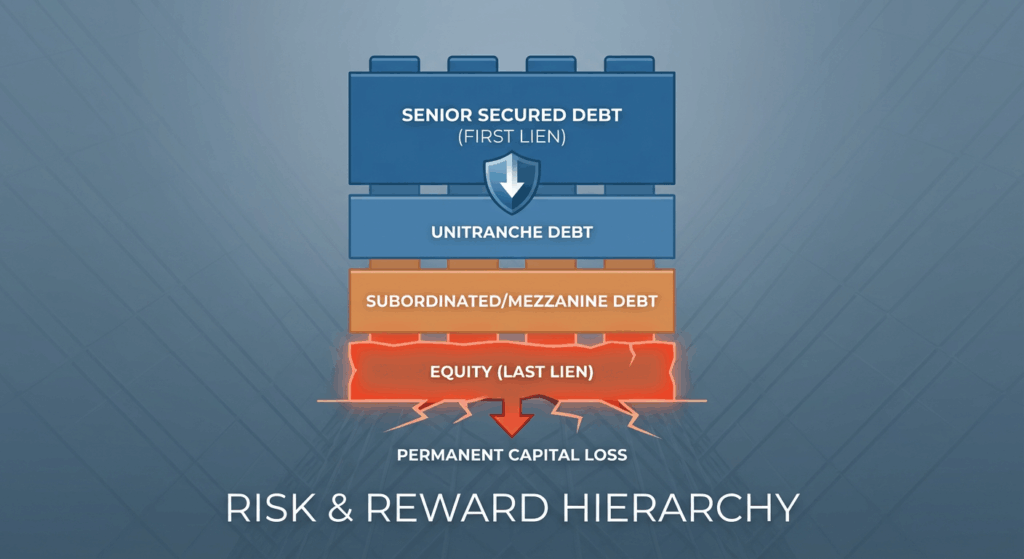
The capital stack represents the hierarchy of rights to a company’s cash flow and assets. It is governed by the Absolute Priority Rule, a legal principle ensuring that senior claims must be satisfied in full before junior claims receive a single cent.
In a typical private credit transaction, the stack is stratified as follows:
- Senior Secured Debt: Sits at the very top. It has the first claim on assets (collateral) and cash flow. It typically carries the lowest cost of capital but the strictest covenants.
- Unitranche Debt: A hybrid structure that combines senior and junior debt into a single instrument. It simplifies the relationship for borrowers but requires careful analysis of the “attachment point” for investors.
- Subordinated (Mezzanine) Debt: Junior to senior debt. It is unsecured or has a second lien on assets. Investors demand higher yields here to compensate for the higher risk of being wiped out in a default.
- Equity: The bottom of the stack. Equity holders enjoy the unlimited upside of growth but are the first to be wiped out if the company’s value falls.
How It Works: The Liquidation Waterfall
To understand the gravity of the capital stack, let’s look at a concrete repayment scenario. Imagine a middle-market manufacturing company, “FabriCorp,” with an Enterprise Value (EV) of $100 million.
FabriCorp is capitalized with the following structure:
- $50 Million Senior Secured Loan (First Lien)
- $20 Million Mezzanine Debt (Unsecured)
- $30 Million Equity (Sponsor/Owner Money)
Scenario A: Successful Exit ($120M Sale)
The company sells for $120 million.
1. Senior Lenders get their $50M + interest.
2. Mezzanine Lenders get their $20M + interest.
3. Equity holders receive the remaining $50M (a significant profit on their $30M initial stake).
Scenario B: Distress Sale ($60M Sale)
The market turns, and FabriCorp is forced to liquidate for only $60 million.
1. Senior Lenders are paid $50 million (100% recovery).
2. Mezzanine Lenders receive the remaining $10 million (50% recovery/loss).
3. Equity holders receive $0 (100% loss).
This math illustrates why “equity cushion” matters. The $30 million in equity and $20 million in mezzanine debt acted as a buffer for the senior lenders, absorbing the valuation shock before the senior principal was touched.
Current Market Relevance
The private credit market has evolved significantly, with data from 2024 and 2025 highlighting a shift toward safety and simplicity in these structures.
- Dominance of Direct Lending: According to NAIC research (2024), direct lending now accounts for approximately 40% of the U.S. private credit market. This surge is partly driven by borrowers preferring the certainty of a single private lender over a syndicate.
- Flight to Quality: Blackstone (2024) notes that senior secured loans have become increasingly attractive for defensive income. Because these loans sit at the top of the capital structure, they offer principal preservation in volatile markets.
- Yield Protection: As noted by T. Rowe Price (2024), private credit assets typically feature floating rate coupons. In a rate environment that remains higher than the pre-2022 era, this structure protects the real yield of the senior debt, whereas fixed-rate junior bonds might see price deterioration.
- Banks Retreating: The capital stack opportunity for private lenders has widened as traditional banks retreat. Gridline (2024) reports that regulations like Basel III have forced banks to be more conservative, leaving a gap for private funds to provide senior debt that was previously the domain of commercial banks.
Decision Framework
For Investors: Evaluating Attachment Points
When reviewing a private credit opportunity, the yield is secondary to the attachment point.
Ask: “What is the Loan-to-Value (LTV) through my tranche?”
If a fund invests in Senior Secured debt with a 40% LTV, the underlying enterprise value must drop by 60% before your principal is impaired. If a fund invests in Unitranche debt up to 60% LTV, the cushion is smaller. In uncertain economic times, a lower attachment point (being higher in the stack) is often worth sacrificing 100-200 basis points of yield.
For Operators: Cost vs. Dilution
For business owners, the capital stack represents a trade-off between the cost of capital and flexibility.
Ask: “How much equity dilution am I preventing by taking on debt?”
Senior debt is the cheapest capital (e.g., SOFR + 5-7%) but comes with strict financial maintenance covenants. Mezzanine debt is more expensive (e.g., 12-14% + PIK) but is often “patient capital” with fewer restrictions. Operators confident in their cash flow growth often prefer maximizing senior debt to minimize equity dilution (selling shares), which is logically the most expensive capital in the stack.
Key Takeaways
- Seniority is Safety: In a liquidation scenario, the top of the stack is paid first. Junior lenders and equity holders absorb losses from the bottom up.
- The Equity Cushion: Senior lenders rely on the thickness of the equity and junior debt layers beneath them to absorb validation shocks.
- Floating Rate Benefit: Most private senior debt uses floating rates, aligning operator costs and investor returns with the current cost of money, mitigating interest rate risk.
- The Trade-off: Moving down the stack (Junior/Mezzanine) increases potential yield for investors but drastically increases the probability of total loss.
- Structural Shift: The retreat of banks has allowed private credit mangers to occupy the “safer” senior secured portion of the stack, not just the risky distressed segments.


