
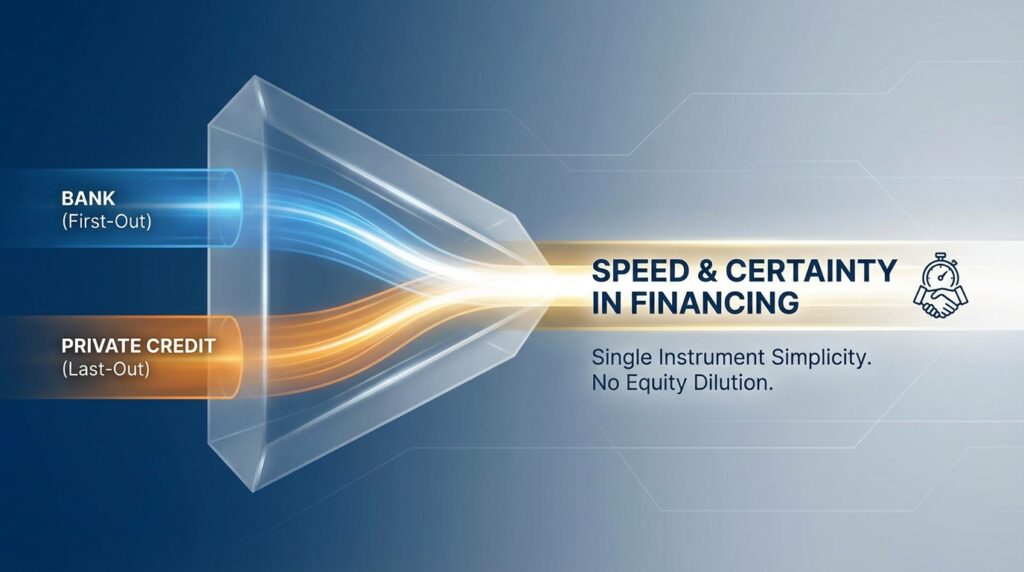
The Financing Challenge: Certainty in a Fragile Market
In the high-stakes environment of middle-market M&A, the cost of capital is often secondary to the certainty of closing. For sponsors and operators in 2026, the structural debate frequently boils down to a single question: Do we optimize for the lowest blended interest rate using a complex multi-lender stack, or do we pay a premium for speed and simplicity?
As private credit assets under management swell to over $2.1 trillion, the unitranche facility has cemented itself as the dominant instrument for sponsor-backed buyouts. Unlike traditional financing that layers senior bank debt with junior mezzanine capital, a unitranche facility combines these risk profiles into a single instrument with one interest rate and one set of documents. This structure has evolved from a niche product to a market standard, capable of funding everything from lower-middle-market buyouts to multi-billion-dollar “mega-unitranche” deals.
Structure Breakdown: The “Invisible” Tranche
The defining feature of a unitranche loan is its simplicity for the borrower masked by complexity for the lenders. To the borrower, it appears as a single senior secured term loan. Behind the scenes, however, lenders often bifurcate the risk using an Agreement Among Lenders (AAL).
The Mechanics
The AAL creates a “first-out” and “last-out” waterfall structure without the borrower needing to negotiate an intercreditor agreement. The “first-out” lender (often a bank) takes the lower-risk, lower-yield portion, while the “last-out” lender (often a private credit fund) takes the higher-risk attachment point for a higher return.
Hypothetical Deal Structure: Project Velocity
Consider a software company with $10 million in EBITDA seeking a $60 million financing package (6.0x leverage) for a buyout. A typical 2026 unitranche term sheet would look like this:
- Facility Size: $60 million single-tranche term loan
- Pricing: SOFR + 550 bps (floating)
- Upfront Fee: 2.0% ($1.2 million)
- Amortization: 1.0% per annum
- Tenor: 5-6 years
- Covenants: Single financial maintenance covenant (e.g., Net Leverage Ratio < 6.5x) or a liquidity sweep.
In this scenario, the borrower signs one credit agreement. They pay one blended coupon (SOFR + 550). They deal with one administrative agent. However, the lenders might privately split the deal: a bank takes the first $30 million at SOFR + 300, and a private credit fund takes the remaining $30 million at SOFR + 800. The borrower pays the weighted average, paying for the convenience of a single counterparty.
How It Compares: Unitranche vs. Senior-Mezz
The primary alternative to unitranche is the traditional Senior + Mezzanine stack. Understanding the trade-offs is crucial for CFOs and Investment Committees.
1. Speed and Execution
Recent market data highlights a significant “speed premium.” Unitranche deals typically move from term sheet to funding in roughly 45 days, compared to a median of 70 days for senior-mezz structures. The senior-mezz route requires negotiating two separate credit agreements and a complex intercreditor deed, doubling the legal friction.
2. Cost vs. Dilution
While a senior loan might price at SOFR + 350 bps, the mezzanine layer sitting beneath it is expensive. Mezzanine debt often carries cash interest of 10-12% plus Payment-In-Kind (PIK) interest, and frequently necessitates equity warrants (often 5-15% coverage). While the headline rate of a unitranche (SOFR + 550 bps) appears higher than senior debt, it is often cheaper than the blended cost of a senior-mezz stack when factoring in the mezzanine’s effective yield and the non-dilutive nature of unitranche debt.
3. Governance
Unitranche offers a single point of contact for amendments, waivers, and add-on acquisitions. In a senior-mezz scenario, a borrower may need consent from both the conservative senior bank and the aggressive mezzanine fund to execute a bolt-on acquisition, increasing execution risk.
Current Market Terms (2026)
The private credit market has stabilized following the rate volatility of previous years. According to recent private credit surveys and deal reports, the following terms define the current landscape for middle-market sponsored deals:
- Spreads: High-quality credits are pricing between SOFR + 475 bps and SOFR + 575 bps.
- Leverage: Total leverage ratios are hovering around 5.0x to 5.5x on a net basis, with Loan-to-Value (LTV) ratios typically between 55% and 65%.
- Documentation: “Document-lite” approaches are standard, typically featuring significantly fewer maintenance covenants than bank deals. Incurrence-based covenants (testing metrics only when taking an action like raising debt or paying dividends) are becoming more common in the upper middle market, mimicking the Broadly Syndicated Loan (BSL) market.
Structuring Guidance & Negotiation
For Operators and Borrowers:
The “scalability” of the facility is a key negotiation point. Ensure your unitranche facility includes a committed Delayed Draw Term Loan (DDTL) to fund future acquisitions. This locks in your pricing and terms today for capital you might need tomorrow, without paying interest on the cash until it is drawn (aside from a small ticking fee).
For Investors:
When evaluating unitranche exposure, clarify the “last-out” risk. If you are participating in a fund that provides unitranche, understand if the fund is holding the entire position or if they are leveraging the “first-out” portion to a bank to juice returns. This “fund-level leverage” increases the risk profile significantly in a default scenario.
Key Takeaways
- Speed Premium: Borrowers pay ~50-100 bps more in spread to close 25-30 days faster than multi-lender solutions.
- Dilution Defense: Unitranche avoids the equity warrants common in mezzanine financing, preserving cap table value.
- Bilateral Control: A single lender relationship simplifies post-close waivers and M&A activity compared to syndicated groups.
- Hidden Leverage: An “Agreement Among Lenders” often splits risk internally; borrowers should understand who actually holds the voting rights.
- Market Depth: With mega-unitranches now exceeding $2 billion, size is rarely a constraint for this structure anymore.


