
Understanding the Capital Stack: The First Line of Defense
In the world of private credit, the “Capital Stack” is the architectural blueprint of a deal. It determines who gets paid first, who holds the most control, and who absorbs the risk if a business faces headwinds. For both investors seeking yield and business owners optimizing their cost of capital, understanding where a specific instrument sits in this stack is the single most critical factor in risk assessment.
While interest rates and spreads dominate headlines, the structural protections built into the concept of seniority and the equity cushion are what fundamentally differentiate private credit from public equities or distressed debt.
The Concept: Seniority and The Waterfall
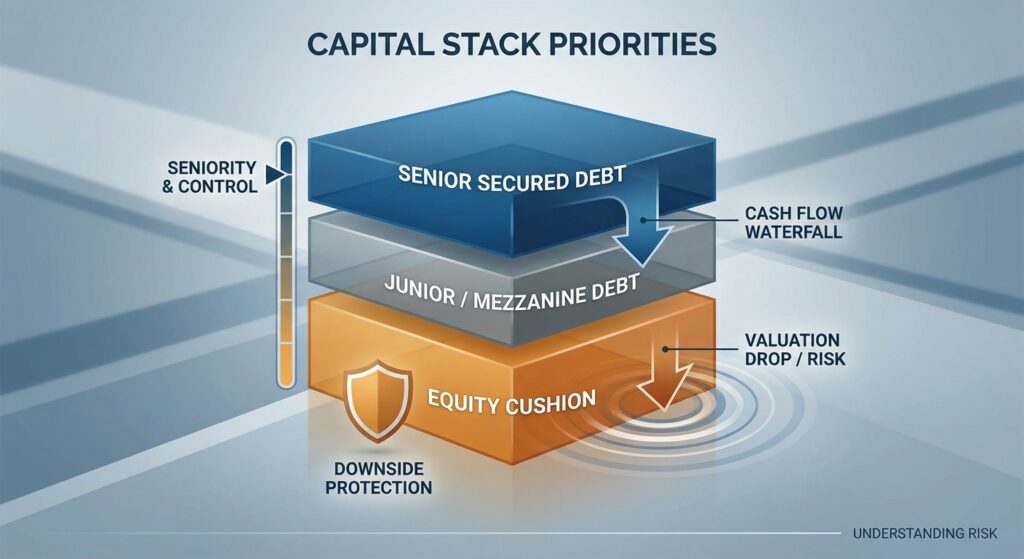
The capital stack is hierarchically arranged based on priority of repayment. This concept is often visualized as a waterfall: cash flows cascade from the top down.
- Senior Secured Debt: This sits at the very top. It is “senior” because it has the first claim on cash flows and assets. It is “secured” because it is backed by collateral (assets, receivables, or enterprise value).
- Junior/Mezzanine Debt: This sits in the middle. It takes a higher risk for a higher return, only getting paid after senior lenders are satisfied.
- Equity: This sits at the bottom. Equity holders enjoy the unlimited upside of growth but occupy the “first loss” position.
According to T. Rowe Price (2024), senior loans provide significant cushions against losses precisely because they must be repaid in full before junior debt or equity holders receive a cent in a liquidation event.
How It Works: The Equity Cushion Math
To understand the mechanics of risk, we measure the Equity Cushion: the percentage of total enterprise value that is subordinate to the debt. Let’s look at a concrete example of a standard “Unitranche” or Senior Secured facility.
The Scenario:
An operator is acquiring a manufacturing business with an Enterprise Value (EV) of $100 million.
The Structure:
- Senior Loan: $45 million (45% Loan-to-Value)
- Sponsor/Owner Equity: $55 million (55% Equity Cushion)
This structure implies a 55% equity cushion. This is the “shield” protecting the lender.
The Stress Test:
Imagine a recession hits, and the company’s valuation drops by 40%. The business is now worth only $60 million.
The Outcome:
- Equity Holders: Their value drops from $55M to $15M. They have lost ~72% of their investment fundamental value.
- Private Credit Lenders: The loan balance is $45M. The company is worth $60M. The lender is still 100% money-good (covered).
This illustrates why Blackstone (2024) highlights that private loans typically sit senior with a “meaningful cushion” below them. The equity layer acts as a shock absorber, protecting the debt from valuation volatility.
Current Market Relevance
As we navigate the 2026 investment landscape, the fundamentals regarding capital stack positioning remain robust, driven by the continued shift from public to private markets.
Key Market Metrics:
- Market Dominance: Direct lending has solidified its position, accounting for approximately 40% of the U.S. private credit market, according to NAIC analysis (2024).
- Growth Trajectory: The asset class has grown from a niche middle-market solution to a massive funding source estimated between $1.3 trillion and $1.7 trillion (NAIC).
- Income Stability: In a fluctuating rate environment, Lord Abbett (Aug 2025) notes that private credit prices are not marked daily, creating less interpretation “noise” and offering higher yields relative to public equivalents.
- Defensive Nature: T. Rowe Price data indicates that historically, the combination of seniority and floating-rate coupons has allowed private credit to generate attractive risk-adjusted returns with lower volatility than traditional equity portfolios.
Decision Framework
For Investors: Evaluating Attachment Points
When reviewing a private credit opportunity, the primary question is not just “What is the yield?” but “Where is the attachment point?”
- Conservatism: Look for Loan-to-Value (LTV) ratios below 50-60%. A lower LTV means a thicker equity cushion.
- Covenant Quality: Ensure the seniority is documented with strong covenants that allow the lender to intervene early if performance degrades, preserving that cushion.
For Operators: Optimizing Cost of Capital
For business owners to utilize this structure effectively, they must weigh dilution against interest costs.
- Why accept Senior Debt? While it requires regular interest payments, it is cheaper than equity. Raising $45M in debt to buy the $100M company (in the example above) allows the owner to retain more ownership upside than if they raised the full $100M in equity.
- The Trade-off: The cost of this cheaper capital is the priority claim. You must pay the lender before you can take distributions.
Key Takeaways
- Priority Matters: Senior secured debt sits at the top of the waterfall, getting paid before junior debt or equity.
- The Cushion is Key: The “Equity Cushion” is the percentage of value that must potentially be wiped out before the lender takes a principal loss.
- Downside Protection: In a 45% LTV scenario, the enterprise value can drop by half, and the senior lender is still structurally protected.
- Market Context: Direct lending now comprises ~40% of the market, validating the senior secured model as a primary financing tool.
- Investor Lens: Smart credit investing is about protecting the downside; let the structure do the heavy lifting.


