
The Financing Challenge: Speed vs. Cost
In the current middle-market buyout landscape, sponsors and operators often face a critical friction point: the trade-off between execution speed and the cost of capital. Historically, maximizing leverage required a complex capital stack, pairing a senior bank loan with mezzanine debt or seller notes. While effective for juicing returns, this multi-tranche approach introduces intercreditor friction, dual diligence processes, and execution risk.
Today, the unitranche facility has emerged as the structural standard for sponsor-backed middle-market transactions. By blending senior and subordinated risk into a single instrument, borrowers gain certainty and speed, albeit at a premium. Understanding the mechanics of this structure, specifically the hidden “Agreement Among Lenders” (AAL), is essential for navigating modern acquisition financing.
Structure Breakdown: The Unitranche Mechanic
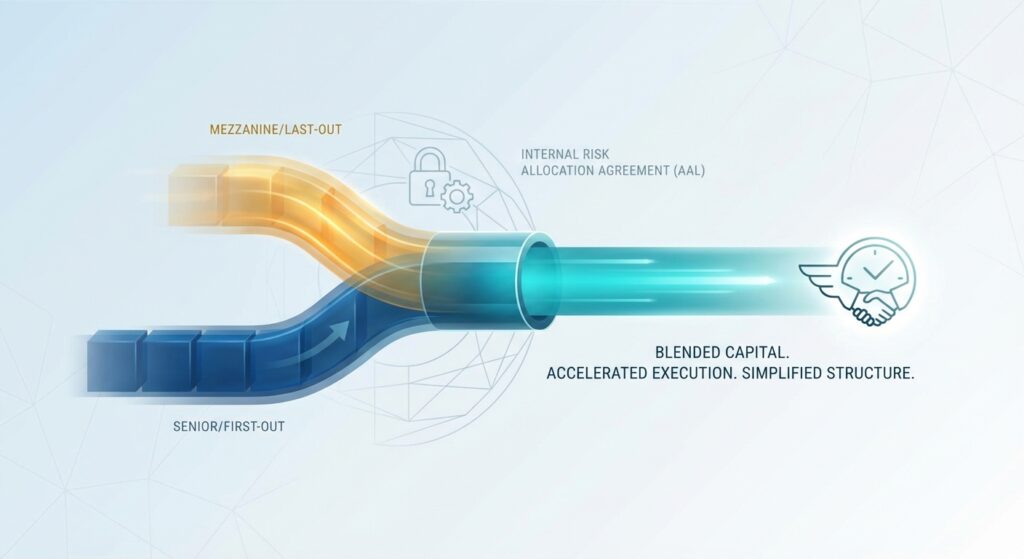
At its core, a unitranche facility acts as a hybrid loan. To the borrower, it appears as a single senior secured term loan with one interest rate, one amortization schedule, and one set of covenants. However, behind the scenes, the risk is often bifurcated.
The “First-Out / Last-Out” Split
While the borrower signs a single credit agreement, the lenders often execute a separate Agreement Among Lenders (AAL) to manufacture synthetic leverage. This agreement splits the loan into:
- First-Out Tranche: Often held by a bank or low-cost capital provider. It has priority on repayment and carries a lower yield (e.g., SOFR + 300 bps).
- Last-Out Tranche: Held by a private credit fund or BDC. It absorbs the first loss after equity and carries a higher yield (e.g., SOFR + 800 bps).
The borrower pays a single “blended” rate, unaware of the internal economics, simplifying administration.
Deal Example: Leveraged Buyout of “TechCo”
Consider a $100M Enterprise Value (EV) software company with $10M EBITDA. The sponsor seeks 6.0x leverage ($60M total debt).
- Facility Size: $60M Unitranche Term Loan
- Pricing: SOFR + 575 bps (Blended)
- OID (Original Issue Discount): 2.0% ($1.2M upfront fee)
- Amortization: 1% per annum
- Call Protection: 102, 101, Par over 3 years
In a traditional structure, this might have been a $40M Senior Loan (SOFR + 350) and a $20M Mezzanine Note (12% Cash + 2% PIK). The unitranche simplifies this into one $60M check, closing the funding gap instantly.
Comparison: Unitranche vs. Senior-Mezz vs. Syndicated
Choosing the right structure requires weighing execution certainty against expense.
1. Speed and Certainty
According to recent market data, the median time to close a unitranche facility is approximately 45 days, compared to 70 days for a senior-mezzanine stack [financely-group.com]. In competitive auctions, this 3-4 week advantage is often the deciding factor in winning a bid, justifying the higher cost of capital.
2. Dilution and Economics
Standard mezzanine debt frequently includes an equity kicker, such as warrants providing 5-15% IRR upside. Unitranche facilities typically feature a higher cash coupon but zero warrant coverage. For sponsors confident in significant equity appreciation, paying a higher interest rate (e.g., SOFR + 575 bps vs 450 bps blended) is cheaper than surrendering 3-5% of the backend equity value [financely-group.com].
3. Documentation Efficiency
A unitranche structure involves a single credit agreement. A Senior-Mezz stack requires two credit agreements and a complex Intercreditor Agreement that dictates standstill periods and payment blocks. The unitranche structure reduces legal fees and administrative burden post-closing.
Current Market Terms (2025-2026)
As of late 2025 and entering 2026, the private credit market has stabilized with the following standard terms for middle-market issuers:
- Spreads: High-quality borrowers are seeing pricing compress to SOFR + 475-575 bps [financely-group.com].
- Leverage: Total leverage ratios for sponsored deals are hovering around 5.0x EBITDA, with lenders focusing heavily on interest coverage and free cash flow rather than just enterprise value [privateequitybro.com].
- Loan-to-Value (LTV): Typical unitranche lenders are underwriting to 55-65% LTV, leaving a substantial equity cushion [financely-group.com].
- Covenants: The trend remains toward “covenant-loose” structures, often featuring a single maintenance covenant (typically Total Net Leverage) with generous equity cure rights (usually 2 permitted over the life of the loan) [privateequitybro.com].
Structuring Guidance & Negotiation
For Operators and Sponsors:
When negotiating a unitranche, focus on scalability. Ensure the term sheet includes a committed “Delayed Draw Term Loan” (DDTL) to fund future acquisitions at the same pricing. Additionally, negotiate “portability” clauses, allowing the debt to remain in place if the business is sold, which can increase the asset’s attractiveness to future buyers.
For Investors and Lenders:
Scrutinize the Agreement Among Lenders (AAL). Unlike public intercreditor agreements, AALs are private contracts. In a bankruptcy scenario, the enforceability of “silent seconds” and voting rights within the AAL is critical. Ensure clarity on who controls the enforcement process if the borrower defaults.
Key Takeaways
- Speed Premium: Borrowers pay ~50-100 bps more for unitranche to close 30 days faster than syndicated or multi-tranche options.
- Dilution Defense: Unitranche generally avoids warrants, preserving equity upside for sponsors compared to traditional mezzanine debt.
- Simplified Ops: Single credit agreement and agent reduce administrative drag and legal costs.
- Hidden Mechanics: The risk allocation happens behind the scenes in the AAL; borrowers see one blended rate.
- Market Standard: With spreads at SOFR + 475-575 and 5.0x leverage, unitranche remains the dominant tool for sub-$500M buyouts.


