
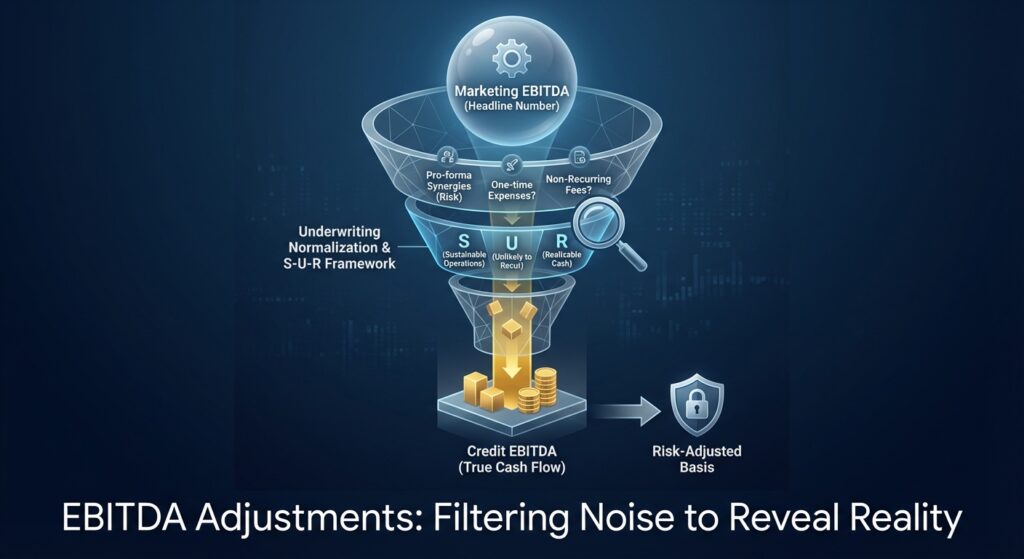
The Underwriting Challenge: Marketing EBITDA vs. Credit EBITDA
In the high-stakes environment of middle-market lending, the most contentious metric is almost always EBITDA. While borrowers and investment bankers present “Adjusted EBITDA” to showcase the maximum potential earnings capacity of a business, prudent underwriters must drill down to “Credit EBITDA”, the cash flow actually available to service debt.
As of late 2026, the divergence between marketed earnings and diligence-adjusted earnings remains a primary risk vector. A borrower presenting $15 million in Adjusted EBITDA may, upon closer inspection, only generate $10 million in reliable cash flow. For a lender engaging at 4.0x leverage based on the marketing number, the effective leverage could effectively jump to 6.0x on a credit basis, shifting the deal from a standard senior secured loan to a distressed-profile potential risk.
Effective underwriting requires a rigorous methodology for normalization. It demands differentiating between legitimate one-time expenses and the recurring costs of doing business, ensuring that capital structures are built on bedrock rather than optimistic projections.
The Framework: S-U-R Methodology
To navigate the complexity of add-backs and adjustments, credit officers often employ the S-U-R Framework: Sustainable, Unlikely to Recur, and Realizable.
- Sustainable: Are the earnings strictly derived from core operations? Gains from asset sales or FX arbitrage are stripped out.
- Unlikely to Recur (Non-Recurring): True one-time events (e.g., a lawsuit settlement or factory fire remediation) are valid add-backs. However, “restructuring charges” that appear every year in the financials are effectively operating expenses and should be treated as such.
- Realizable (Pro-Forma/Synergies): This is the highest risk bucket. Borrowers often ask for credit today on savings they hope to achieve tomorrow.
According to 2025 corporate rating criteria from Fitch Ratings, the analysis must balance historical performance with projections over a three- to five-year horizon. However, historical data remains the anchor; projections are used for comparative analysis to determine if the business risk profile matches the peer group.
The Analysis: Stress-Testing a $10M Manufacturer
Consider a hypothetical manufacturing borrower, “IndustrialCo,” seeking a $40 million term loan. The CIM presents $12 million in LTM (Last Twelve Months) Adjusted EBITDA.
The Adjustments Grid:
- Reported EBITDA: $8.5 million
- (+) Owner’s Personal Expenses: $1.0 million (Valid: Will disappear post-close)
- (+) One-time Legal Settlement: $0.5 million (Valid: Discrete event)
- (+) “Run-Rate” Synergies: $2.0 million (Risk: Projected savings from vendor consolidation)
The Underwriting calculation:
While the borrower claims $12 million, a conservative underwriter might accept the owner expenses and legal fees but haircut the synergies by 50% or exclude them entirely until proven.
If the lender accepts the full $12 million, leverage is 3.3x ($40M / $12M).
If the lender rejects the synergies entirely (Adjusted EBITDA = $10M), leverage rises to 4.0x.
This 0.7x turn in leverage changes the risk rating, pricing grid, and covenant headroom. If the “run-rate” savings rely on firing staff that operate critical machinery, those savings may never materialize, or they may degrade revenue quality.
Industry Standards and Red Flags
Institutional lenders and private credit funds have tightened standards regarding “phantom income.” According to an industry primer by Umbrex, private credit managers typically demand tighter covenants and private information rights compared to the syndicated market. This allows for active monitoring of whether those adjustments actually convert to cash.
Common Red Flags in 2025-2026:
- Recurring “Non-Recurring” Fees: Management fees or consulting costs that are added back every year.
- Inventory Revaluations: Adjustments based on changing accounting methods rather than cash generation.
- Uncapped Synergies: Market standard often caps synergy add-backs at 15-20% of EBITDA, yet aggressive aggressive borrowers may push for uncapped definitions.
The Basel Committee on Banking Supervision emphasizes that sound credit-granting processes must operate under appropriate measurement and monitoring. Relying on model-based synergies without historical evidence violates the principle of credit administration integrity.
Underwriting Checklist: Validating the Quality of Earnings
Before issuing a commitment letter, the underwriting team must validate the “Quality of Earnings” (QoE) through a systematic diligence process. This often involves third-party accounting firms, but the internal credit officer must drive the scope.
- Proof of Payment: For every “one-time” expense added back, requrie wire confirmations or bank statements. Verify the cash actually left the building.
- Causal Link: Does the “one-time” event correlate with a revenue dip? If they add back lost profit from a storm, ensure they aren’t also counting the revenue from the makeup orders in the following month (double counting).
- Synergy Verification: Request a line-item buildup of the $2M in savings. Is it headcount? Rent? Contract renegotiation? If it’s “general efficiency,” assign it zero value.
- Covenant Definitions: Ensure the credit agreement defines “EBITDA” to strictly limit how much calculation flexibility the borrower has in the future. “Covenant-lite” structures often erode this protection.
- Cash Conversion Check: compare Adjusted EBITDA to Operating Cash Flow (OCF). If Adjusted EBITDA is $12M but OCF is $2M, the adjustments are likely accounting fiction.
Key Risk Management Takeaways
- Cash is King: You cannot service debt with “synergies”; you can only service debt with cash.
- Cap the Optimism: Limit pro-forma adjustments to a percentage of total EBITDA (e.g., 15-20%) with a sunset clause (12-18 months).
- Watch the Trends: If adjustments are growing as a percentage of EBITDA year-over-year, the underlying business quality is likely degrading.
- Structure for Safety: Use “Step-Down” leverage covenants that force the borrower to grow into their capital structure.
- Trust but Verify: Underwrite to the “Bank Case,” not the “Management Case.”


