
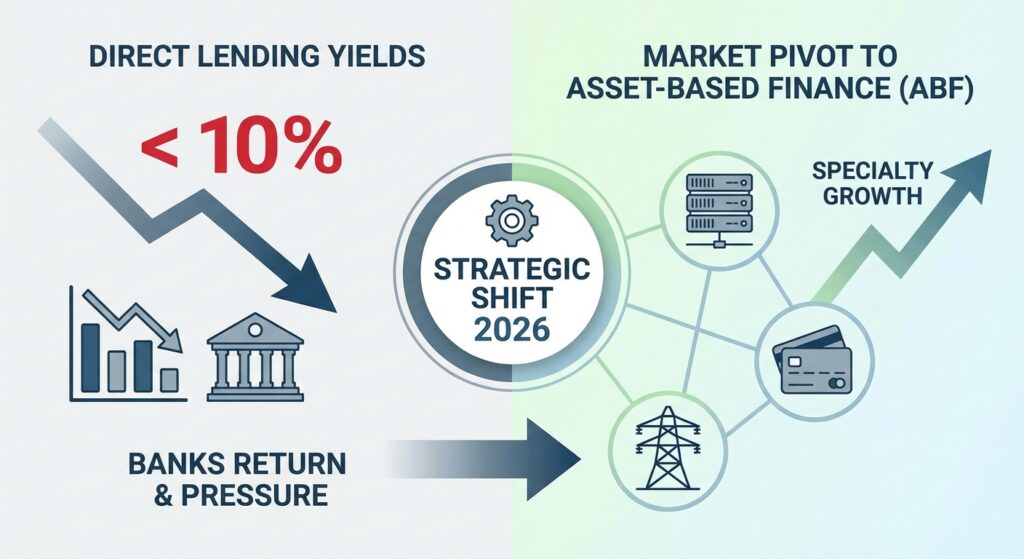
Yields Break 10% Floor as Banks Counterattack; Market Pivots to Asset-Based Finance
Feb 10, 2026 – The era of double-digit easy returns in private credit has officially paused. For the first time in three years, all-in yields for direct lending have compressed below 10%, driven by the Federal Reserve’s aggressive Q4 2025 rate cuts and a resurgence of bank competition in the broadly syndicated loan (BSL) market.
The defining narrative of early 2026 is the “Counterattack of the Banks.” Following the withdrawal of leveraged lending guidelines in December 2025, traditional banks – previously sidelined – are re-entering the market with aggressive leverage tolerances. This has sparked a fierce turf war, resulting in $48 billion in BSL takeouts of private credit deals in 2025. In response, private credit managers are rotating out of commoditized corporate lending and into complex Asset-Based Finance (ABF) and hybrid capital structures to maintain return targets.
Quantitative Market Snapshot: Q1 2026
| Metric | Current Level / Value | Trend / Comparison | Source |
|---|---|---|---|
| Fed Policy Rate | 3.75% | Down 50bps in Q4 2025 | Mondaq / McDermott Will & Emery |
| Direct Lending Yields | < 10% | First time below 10% in 3 years | CreditSights |
| Private Credit Deal Vol | ~$140 Billion (2025) | Resilient despite BSL pressure | CreditSights |
| BSL Takeouts | $48 Billion (2025) | Significant recapture of share | CreditSights |
| Fundraising (2024) | $209 Billion | +5% vs 2023 | With Intelligence |
| Est. Market AUM | > $2 Trillion | Projected 2026 milestone | Moody’s |
Sector Trends: The Great Rotation to Asset-Based Finance
As corporate lending spreads tighten due to bank competition, capital is flowing rapidly into sectors offering structural complexity premiums and inflation resilience.
- Asset-Based Finance (ABF) Takeover: With corporate direct lending saturated, Moody’s projects ABF will increasingly lead growth in 2026. Managers are aggressively funding diverse asset pools, particularly consumer loans and data infrastructure credit, where yields remain insulated from the BSL compression.
- Data Centers & Infrastructure: This sector remains a “hot” destination for capital, driven by the AI expansion cycle. However, CreditSights warns of rising concentration risks in technology and healthcare, advising LPs to scrutinize portfolio diversification.
- Banks vs. Private Credit in LBOs: The upper-middle market is seeing a convergence of terms. Banks, freed from regulatory caps, are offering higher leverage multiples to win back M&A mandates. This has forced private lenders to accept “BSL-style” documentation, eroding the covenant protections that historically distinguished private credit.
Implications for Borrowers & Lenders
For Borrowers (Corporates & Sponsors):
The borrower’s market has arguably peaked. The cost of capital is falling, and terms are loosening. Sponsors can now play clear arbitrage between a recovering BSL market and hungry private credit funds. The withdrawal of leveraged lending guidelines means banks are likely to approve higher debt-to-EBITDA multiples, offering sponsors greater purchasing power for new LBOs.
For Lenders & Investors:
The “easy money” period of riding base rate hikes is over. With yields sub-10%, managers must generate alpha through deal structuring rather than just floating rates. We are seeing a rise in Payment-in-Kind (PIK) structures to preserve liquidity for borrowers, but this increases phantom income risk for lenders. Furthermore, Liability Management Transactions (LMTs), aggressive debt restructurings like those seen at Pluralsight, are reshaping documentation, requiring lenders to be hyper-vigilant about “priming” risks.
Future Outlook: Q2-Q3 2026
Expect M&A activity to escalate significantly as the rate environment stabilizes around the 3.75% mark (Source: Mondaq). However, a potential volatility spike looms; the Fed is currently navigating a “data blackout” due to the prior government shutdown, making policy errors a non-zero risk. The path forward for private credit lies in specialty finance: litigation finance, royalties, and NAV lending, as plain-vanilla corporate lending yields continue to face downward pressure from revitalized banks.
Key Market Insights
- Yield Compression: Direct lending all-in yields have breached the psychological 10% floor; spread compression is now systemic across asset types.
- Regulatory Shift: The removal of bank leveraged lending guidelines is a game-changer, fueling a resurgence in bank appetite for high-leverage deals.
- ABF Pivot: Asset-Based Finance (consumer, infrastructure) is replacing corporate cash-flow lending as the primary growth engine for reaching $2T AUM.
- Covenant Erosion: Documentation standards are converging with public markets; expect fewer maintenance covenants in upper-middle market deals.
- Systemic Risk: Interconnectivity between banks and private credit (partnerships, synthetic risk transfers) is at an all-time high, increasing contagion risks during a downturn.


