
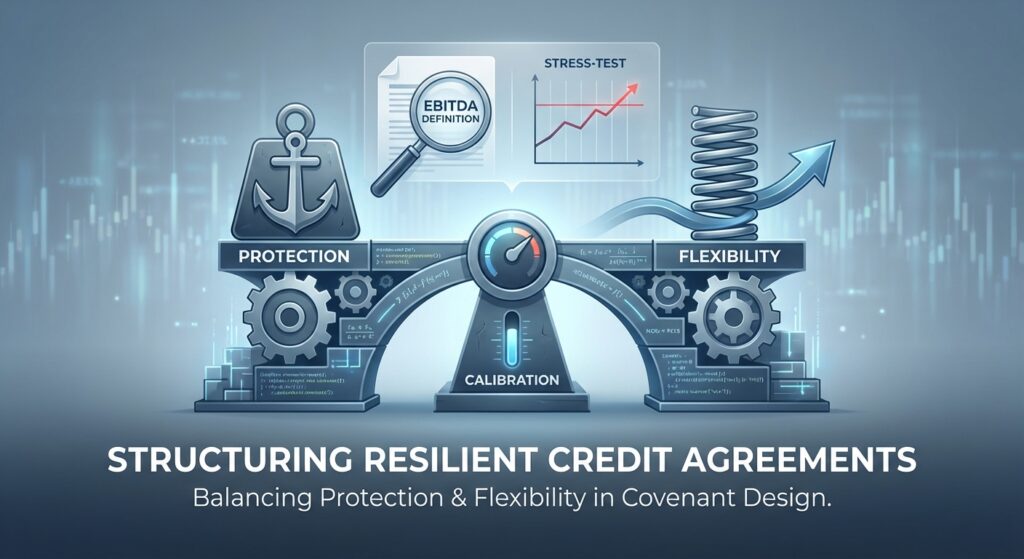
The Underwriting Challenge: Protection vs. Flexibility
In the credit underwriting ecosystem, the structuring of covenants represents one of the most critical negotiation points between borrowers and lenders. A well-designed covenant package serves as an early warning system, a “tripwire” that alerts the lender to deteriorating performance before a payment default occurs. However, the challenge lies in calibration: covenants must be tight enough to provide meaningful protection and legal recourse, yet flexible enough to allow the borrower to operate through normal business cycles without triggering technical defaults.
As we navigate the 2026 credit environment, the discipline of covenant design has moved beyond simple leverage caps. Effective risk management now requires a rigorous framework that integrates cash flow stress testing with precise legal definitions. This article breaks down the methodology for structuring resilient credit agreements, focusing on financial covenants, monitoring protocols, and the mechanics of avoiding value leakage.
The Framework: Structuring for Resilience
Sound credit risk management, as outlined in recent guidance from the Basel Committee on Banking Supervision, relies on establishing an appropriate credit administration and monitoring process. In practice, this begins with selecting the right metrics to monitor the borrower’s financial health.
1. Primary Financial Covenants
For middle-market corporate borrowers, two primary maintenance covenants form the bedrock of the credit agreement:
- Total Net Leverage Ratio: Defined as (Total Debt – Unrestricted Cash) / EBITDA. This tests the borrower’s solvency and ability to carry its debt load relative to earnings.
- Fixed Charge Coverage Ratio (FCCR): Defined as (EBITDA – Capex – Taxes) / (Interest + Principal Amortization). This tests liquidity and the ability to service debt obligations from operating cash flow.
2. The Battleground: Defining EBITDA
The strength of a covenant is only as good as the definition of its denominator. In modern underwriting, “EBITDA” is rarely just earnings before interest, taxes, depreciation, and amortization. Lenders must scrutinize “Add-Backs” regarding:
- Synergies: aggressive projections of future cost savings.
- One-time expenses: restructuring costs or legal fees.
- Owner compensation: normalizing excess salaries in private companies.
Institutional standards often cap these add-backs (e.g., at 15-20% of Adjusted EBITDA) to prevent the artificial inflation of earnings which would mask true leverage.
The Analysis: Stress Testing a Manufacturing Borrower
To illustrate the mechanics of covenant calibration, consider a hypothetical middle-market manufacturing company, “Alpha Corp,” seeking a $40 million term loan.
- LTM Adjusted EBITDA: $10 million
- Proposed Debt: $40 million
- Opening Leverage: 4.0x
Calibration Strategy
Lenders typically set financial covenants with a “cushion” of 20% to 25% to the management’s base case or the lender’s sensitivity case. This cushion absorbs normal volatility while triggering a conversation if performance deviates significantly.
Scenario Calculation
If we set the maximum leverage covenant at 5.0x (providing a 25% cushion against the opening 4.0x), we must stress test the cash flows to see what it takes to break the covenant.
Scenario: Input Cost Inflation
If raw material costs rise and compress margins, causing EBITDA to drop by 20% to $8.0 million:
$$ \text{New Leverage} = \frac{\$40\text{M}}{\$8\text{M}} = 5.0x $$
At $8 million EBITDA, Alpha Corp hits the 5.0x limit. If the covenant were set loosely at 5.5x, the lender would lose the right to intervene at this critical juncture. Conversely, if EBITDA definitions were loose and allowed for $2 million in “pro forma synergies,” the reported EBITDA might remain at $10 million despite the cash flow drop, rendering the covenant useless. This underscores the Fitch Ratings principle that quantitative factors must always be weighed against the qualitative rigors of financial structure.
Industry Standards & Monitoring
Recent updates to regulatory frameworks emphasize that underwriting does not end at closing. The FDIC’s asset quality guidelines highlight that a management team’s ability to identify and manage credit risk is a primary factor in asset quality ratings. Institutional best practices for monitoring include:
- Monthly Compliance Certificates: Requiring borrowers to calculate and certify covenants monthly rather than quarterly for tighter oversight.
- re-underwriting Triggers: Material changes in the business (e.g., loss of a major customer) should trigger an internal re-assessment of risk ratings.
- “Equity Cures”: Limiting the number of times a private equity sponsor can inject cash to “cure” a covenant breach (typically limited to 2-4 times over the life of the loan) ensures that chronic underperformance is addressed structurally.
Data from rating agencies indicates that recovery rates are significantly higher for loans with strong covenant packages because lenders can force a restructuring or seize collateral before the enterprise value evaporates entirely.
Underwriting Checklist: Due Diligence Points
When assessing a new opportunity or monitoring a portfolio company, underwriters should adhere to the following checklist:
- Verification of Add-Backs: Are one-time expenses truly non-recurring? Request a Quality of Earnings (QoE) report to validate.
- Cash Flow Waterfall: Confirm that the FCCR calculation accounts for all mandatory outflows, including unfunded capex requirements and tax distributions.
- Cross-Default Provisions: Ensure the loan defaults if the borrower defaults on other material debt (e.g., leases or vendor financing).
- Reporting Timeliness: Mandate audited financials within 120 days of year-end and interim financials within 30-45 days of quarter-end.
- Collateral Audits: For asset-heavy borrowers, require periodic field exams to verify inventory and receivable values.
Key Takeaways
- Covenants do not prevent default; they bring parties to the table before value is destroyed.
- Definitions determine the outcome: A strict definition of EBITDA is more valuable than a low leverage cap.
- Calculate the cushion carefully: Set covenants based on a downside case, typically offering 20-25% headroom.
- Monitor actively: Use monthly compliance certificates to track trends, not just breaches.
- Structure for the exit: Ensure covenants provide a pathway to repayment or restructuring in a distress scenario.


