
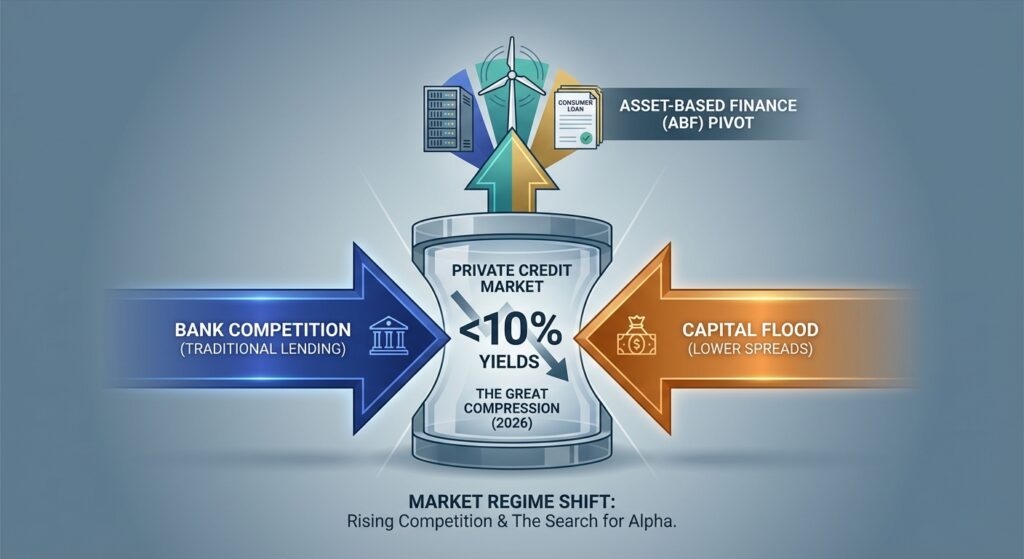
Market Headline: The Great Compression & The Resurgence of Bank Competition
As of mid-Q1 2026, the private credit market is navigating a pivotal regime shift defined by aggressive spread compression and renewed competition from traditional banks. Following the Federal Reserve’s rate cuts in Q4 2025, bringing the top rate down to 3.75%, all-in yields for direct lending have breached significant psychological floors. For the first time in three years, direct lending yields have fallen below 10%, driven by a combination of lower base rates and tightening credit spreads as capital floods the market.
The competitive landscape has been fundamentally altered by regulatory shifts. The withdrawal of leveraged lending guidelines in December 2025 has emboldened broadly syndicated loan (BSL) desks to re-enter the market with higher leverage offers, directly challenging private credit’s recent dominance. Consequently, the distinct premium that private credit once commanded is eroding, forcing managers to pivot toward complexity and asset-based finance (ABF) to generate alpha.
Quantitative Snapshot: Q1 2026 Data
| Metric | Current Level / Trend | Prior Period / Context | Source |
|---|---|---|---|
| Direct Lending Yields | < 10% | First time below double-digits in 3 years | CreditSights |
| Fed Funds Rate | 3.75% | Down from >5% (Cuts in Oct/Dec 2025) | McDermott Will & Emery |
| Private Credit AUM | > $2 Trillion | Projected to hit $4T by 2030 | Moody’s |
| BSL Takeout Volume | $48 Billion (2025) | Public markets recapturing share from private | CreditSights |
| Fundraising Volume | $209 Billion (2024) | +5% Year-over-Year | With Intelligence |
Sector Analysis: The Rotation to Asset-Based Finance
With corporate direct lending becoming saturated and spreads compressing, capital is rotating aggressively into Asset-Based Finance (ABF). Lenders are increasingly looking beyond corporate cash flows to diverse asset pools (including consumer loans, data infrastructure, and equipment finance) to secure yield. According to Moody’s, ABF is poised to lead growth in 2026 as alternative asset managers step in to fund assets where banks remain constrained, despite the broader loosening of bank regulations.
Conversely, the Technology and Healthcare sectors, long the dual engines of private credit deal flow, are facing heightened scrutiny regarding valuation and sector concentration risks. High-profile liability management transactions (LMTs) at firms like Pluralsight and First Brands have spooked lenders, leading to a tightening of documentation standards even as pricing loosens. Meanwhile, Specialty Finance and non-direct lending strategies are seeing a surge in new fund launches, as managers seek to differentiate themselves from the commoditized “vanilla” direct lending market.
Implications: The Borrower’s Market Returns
For Borrowers: This is unequivocally a borrower’s market. The fierce competition between the BSL market and private credit funds is driving down costs and increasing leverage ceilings. With the regulatory shackles removed from banks regarding leveraged lending, borrowers can now play public and private markets against each other to secure the most favorable covenants and pricing. We are seeing a surge in refinancings and repricings as issuers look to lock in these lower rates.
For Lenders & Investors: The easy money era of high base rates and wide spreads is over. To maintain target returns, investors must accept higher complexity (via structured credit and ABF) or higher leverage profiles. Consolidation is accelerating; the “buy vs. build” dynamic is dominating, exemplified by BlackRock’s acquisition of HPS, as scale becomes the primary defense against margin compression. Smaller managers without niche expertise risk being squeezed out.
Key Market Insights
- Bank Competition is Real: The removal of leveraged lending guidelines allows banks to compete aggressively on leverage, threatening private credit’s market share in large-cap deals.
- Yield Compression: With yields dipping below 10%, the “double-digit return” sales pitch for core private credit is no longer valid without adding significant leverage or structural complexity.
- ABF is the New Growth Engine: Expect capital allocation to shift significantly from corporate cash-flow lending to asset-based finance and infrastructure debt.
- Consolidation Waves: The bifurcation between “mega-managers” ($100bn+ AUM) and niche specialists will widen, with mid-sized generalists facing the most pressure.
- Systemic Risk Watch: Interconnectivity between private credit funds, insurance capital, and traditional banks is rising, creating potential contagion channels that regulators are beginning to monitor closely.


