
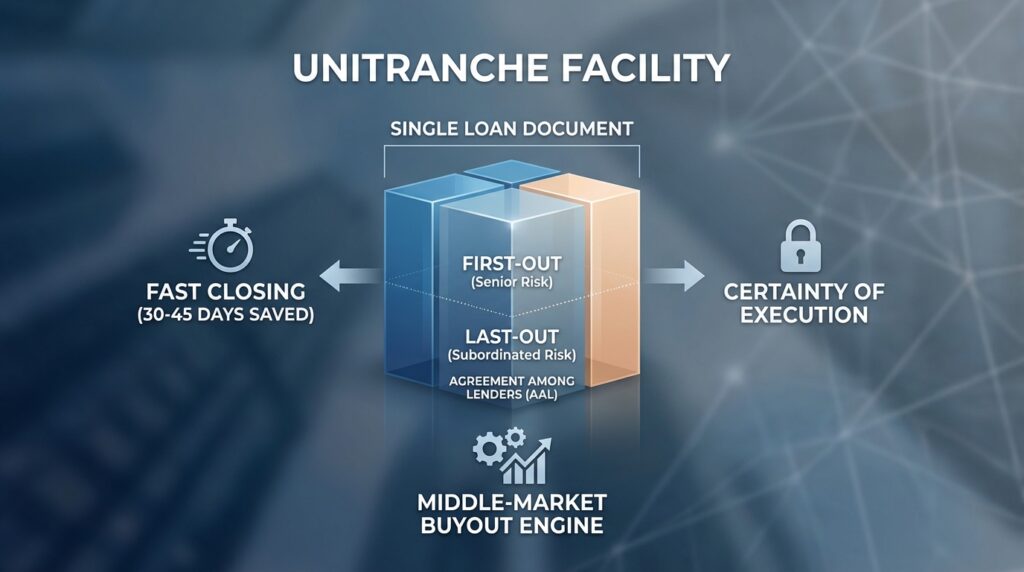
For middle-market operators and private equity sponsors, the financing landscape has shifted decisively away from complex, multi-lender syndicates toward streamlined, bilateral solutions. The unitranche facility has emerged as the dominant instrument in this space, powering roughly 80% of North American buyout financing by deal count in recent years. But what looks like a simple loan on the surface often hides complex structural engineering underneath.
The appeal is straightforward: speed and certainty. In a volatile market, the ability to close a deal 30 to 45 days faster than a syndicated process is often worth the premium price tag. However, relying on unitranche debt requires understanding exactly how the blend works, where the risks sit, and how to negotiate terms that don’t handcuff the company’s future growth.
Structure Breakdown: Anatomy of a Unitranche
A unitranche loan creates a single debt facility that blends senior and subordinated risk into one instrument with a single interest rate. Unlike traditional structures that layer a senior bank loan on top of mezzanine debt (requiring two credit agreements and a complex intercreditor agreement) the unitranche uses a single Credit Agreement.
The Mechanics: while the borrower sees one loan, the lenders often bifurcate the risk behind the scenes. This is governed by an Agreement Among Lenders (AAL). The AAL creates a "first-out" tranche (lower risk, lower return) and a "last-out" tranche (higher risk, higher return) without the borrower needing to manage multiple creditor relationships.
Deal Example: $50M Financing for a Software Platform
Consider a B2B software company with $10M EBITDA acquiring a competitor. The private equity sponsor negotiates a $50M unitranche facility to fund the buyout.
- Total Facility: $50 million (5.0x EBITDA leverage)
- Pricing: SOFR + 650 bps (floating)
- OID (Original Issue Discount): 98.0 (2% upfront fee)
- Amortization: 1% per annum
- Call Protection: 102, 101, Par (Soft call protection for 2 years)
- Covenants: Leverage ratio tests only (Maintenance covenant set at 30-35% headroom to plan)
In this structure, the "blended" rate of S+650 might conceal a backend split where a commercial bank takes the first $30M at S+450, and a private credit fund takes the remaining $20M at S+950. The borrower pays the weighted average, simplifying administration.
How It Compares: Unitranche vs. Traditional Layering
The primary alternative to unitranche is the traditional Senior/Mezzanine split. Here is how they stack up in the current market:
Closing Speed & Certainty
Unitranche wins on execution. Syndicated loans or multi-tranche structures involve "market flex" language, allowing arrangers to change pricing or terms if the market demand softens before closing. Unitranche is typically held by a small club or single lender, locking in terms early. According to industry analysis, this structure can shave over a month off the closing timeline, preventing "financing gaps" that jeopardize acquisitions.
Cost of Capital
Borrowers pay for convenience. The "illiquidity premium" or speed premium for unitranche financing typically sits 50 to 100 basis points higher than a broadly syndicated equivalent. However, when factoring in the elimination of heavy syndication fees and the administrative cost of managing two sets of lenders (and legal counsels), the all-in cost differential narrows.
Flexibility
Unitranche facilities generally offer more flexibility on "add-ons." Because the lender wants to deploy capital, they effectively provide a pre-baked acquisition line. In contrast, expanding a syndicated loan requires re-approaching a broad group of lenders, which can be difficult during market volatility.
Current Market Terms & Trends
As of late 2024 and moving into current 2025-2026 cycles, the private credit market has solidified around specific terms for best-in-class borrowers:
- Leverage: Total leverage for sponsored unitranche deals hovers around 4.75x to 5.50x EBITDA. Lenders have become more disciplined, focusing heavily on free cash flow coverage rather than just enterprise value coverage.
- Yields: All-in yields for new deals have ranged between 11% and 13% depending on the base rate environment. While spreads compress slightly in competitive auctions, the floor remains high due to the cost of lender capital.
- Mega-Unitranches: The market has seen a rise in "mega-unitranche" facilities exceeding $2 billion, proving this structure is no longer just for the lower-middle market. This allows larger platforms to bypass the public volatility of the High Yield bond market entirely.
Structuring Guidance & Negotiation
For operators and investors entering a unitranche negotiation, the devil is in the definitions.
- For Operators (Borrowers): Focus on the Accordion Feature. Ensure you have the right to increase the facility size for future acquisitions without incurring new closing fees or repricing the entire loan. Additionally, negotiate "EBITDA add-backs" aggressively. Since leverage covenants are tight, the definition of EBITDA (and what synergies you can count) is effectively your covenant breathing room.
- For Investors (Lenders): Scrutinize the AAL. In a downside scenario, understand who controls the enforcement rights. If you are in the "last-out" position, ensure you have a seat at the table if the "first-out" lender decides to liquidate collateral.
- Key Deal Point: Watch for "PIK Toggles." In high-rate environments, borrowers may request the option to pay a portion of interest in-kind (PIK) to preserve cash. Lenders may concede this in exchange for a higher overall yield (e.g., SOFR + 750 blended).
Key Takeaways
- Speed is Currency: Unitranche deals close 30-45 days faster than syndicated execution, reducing deal risk.
- Single Document Efficiency: One Credit Agreement replaces the friction of intercreditor disputes between senior and mezz lenders.
- Premium Pricing: Expect to pay 50-100 bps over syndicated markets for the certainty of close and bilateral relationship.
- Hidden Mechanics: The "Agreement Among Lenders" dictates risk; borrowers don’t sign it, but it defines lender behavior during workouts.
- Scalability: With facilities now reaching $2B+, unitranche can support companies from lower-middle market through IPO.


