
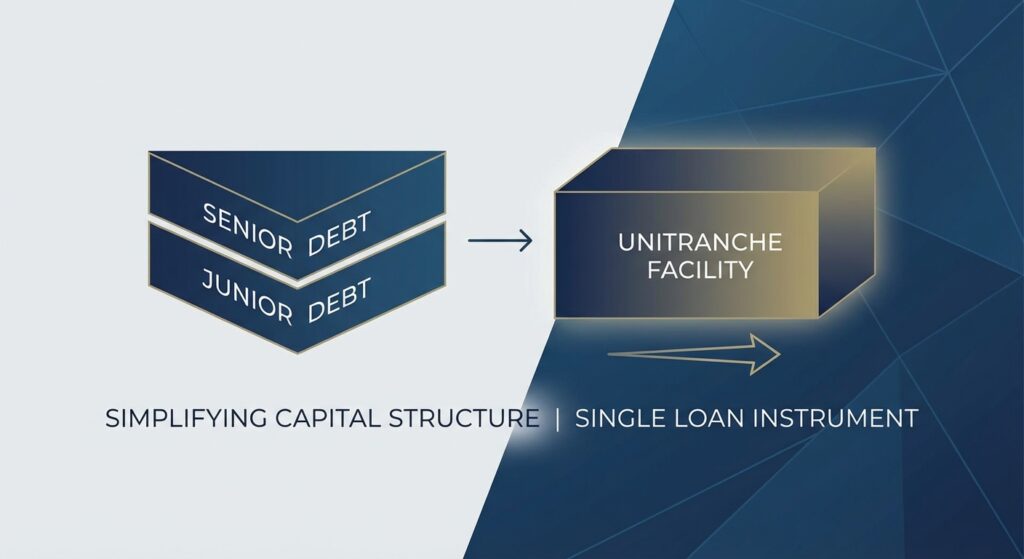
The Evolution of the Capital Stack
In traditional corporate finance, a company’s capital structure was often viewed as a layer cake. You had senior bank debt at the top (lowest risk, lowest return), followed by junior or “mezzanine” debt in the middle, and equity at the bottom. Today, the dominance of private credit has popularized a structure that fundamentally changes this geometry: the Unitranche facility.
For both institutional investors seeking yield and business operators seeking capital, understanding the mechanics of unitranche financing is no longer optional; it is the standard for middle-market leverage. This structure represents a hybrid model that combines senior and subordinated debt into a single loan, streamlining the borrowing process while altering the risk-return profile for lenders.
The Concept: Collapsing the Stack
A unitranche facility effectively collapses the distinction between senior secured debt and junior capital. Instead of a borrower negotiating with a commercial bank for a senior loan and a separate mezzanine lender for any shortfall, a private credit manager provides the entire debt package in one instrument.
Because this single facility covers higher leverage multiples than a traditional bank loan, it commands a higher blended interest rate. However, it simplifies the capital structure into a single set of loan documents with one set of covenants. For the lender, it usually maintains a “first lien” position on the assets, meaning they are first in line to be repaid in a liquidation, despite the higher risk profile inherent in the deeper leverage.
How It Works: The “Blended Rate” Math
To understand why an operator would choose a more expensive unitranche loan over a traditional bank dual-structure, we must look at the “blended cost of capital.”
Consider a hypothetical manufacturing company acquiring a competitor. They require $100 million in debt financing.
Option A: Traditional Multi-Lender Stack
- Senior Bank Loan ($70M): Priced at SOFR + 3.50%. (Approx. 8.5% total cost).
- Mezzanine Debt ($30M): Priced at 12.0% fixed + 2.0% PIK. (14% total cost).
- Intercreditor Agreement: Required between Bank and Mezzanine lender (adds legal complexity and time).
- Weighted Average Cost: ~10.15%
Option B: Private Credit Unitranche
- Single Loan ($100M): Priced at SOFR + 5.75%. (Approx. 10.75% total cost).
- Documentation: Single credit agreement. No intercreditor friction.
- Execution: Closes in weeks, not months.
While the Unitranche (Option B) is nominally more expensive (60 basis points higher in this example), the operator often selects it to remove execution risk. For the investor, the unitranche offers a yield premium over public markets while retaining senior secured status, a critical protection mechanism.
Current Market Relevance
The shift toward these streamlined structures is supported by robust data reflecting the maturation of the asset class. As of recent reporting, the structural shift is evident in the following metrics:
- Market Scale: The private credit market has scaled significantly, estimated between $1.3 trillion and $1.7 trillion, with direct lending originating roughly 40% of this volume, according to NAIC data.
- Shift from Banks: As noted by Adams Street and Pitchbook data (May 2025), borrowers increasingly prioritize “certainty of closing” and “flexible solutions” over the absolute lowest cost of capital provided by regulated banks.
- Yield Premium: Lord Abbett (Aug 2025) highlights that private credit strategies continue to offer yield premiums relative to public equivalents, compensating investors for illiquidity, a factor that unitranche structures capture effectively through their blended pricing.
- Protective Covenants: Despite the higher leverage, T. Rowe Price analysis emphasizes that direct lenders maintain “lender-friendly” documentation with significant equity cushions, often keeping these loans at the top of the capital structure.
Decision Framework: When to Utilize Unitranche
Whether you are allocating capital or seeking it, the decision to utilize a unitranche structure depends on specific criteria:
For Operators (Borrowers)
Optimize for Speed and Certainty: If you are in a competitive M&A auction where “certainty of funds” wins the deal, the unitranche is superior. The premium paid in interest is effectively an insurance premium against deal failure. However, if the company has massive, unencumbered hard assets and a slow timeline, traditional bank financing may be cheaper.
For Investors (Allocators)
Evaluate the “Last Dollar” Leverage: When analyzing a private credit fund, check the attachment point. A unitranche loan might cover leverage from 0x to 5.5x earnings. The risk is not in the structure, but in the final leverage multiple. Investors should look for Loan-to-Value (LTV) ratios that imply a significant equity cushion (typically 40-50%) beneath their debt position.
Key Takeaways
- Simplicity: Unitranche combines senior and junior debt into one instrument with one interest rate.
- Speed Premium: Borrowers pay slightly higher rates for the speed of dealing with a single counterparty rather than a syndicate.
- Senior Security: Despite higher yields, these loans generally retain first-lien priority on assets.
- Market Dominance: Direct lending (often via unitranche) now accounts for ~40% of the $1.7T private credit market.
- Diligence Focus: Investors must focus on the “equity cushion”, the amount of value that must be wiped out before the loan principal is impaired.


