
The Invisible Shock Absorber
In the world of private finance, yield often dominates the headlines. Investors are naturally drawn to the attractive interest rates that private credit offers compared to traditional fixed income. However, for sophisticated managers and institutional allocators, the primary focus is often not the return on capital, but the return of capital.
This defensive mindset relies on a fundamental structural mechanic known as the Equity Cushion. It is the single most important concept determining the safety of a private credit investment.
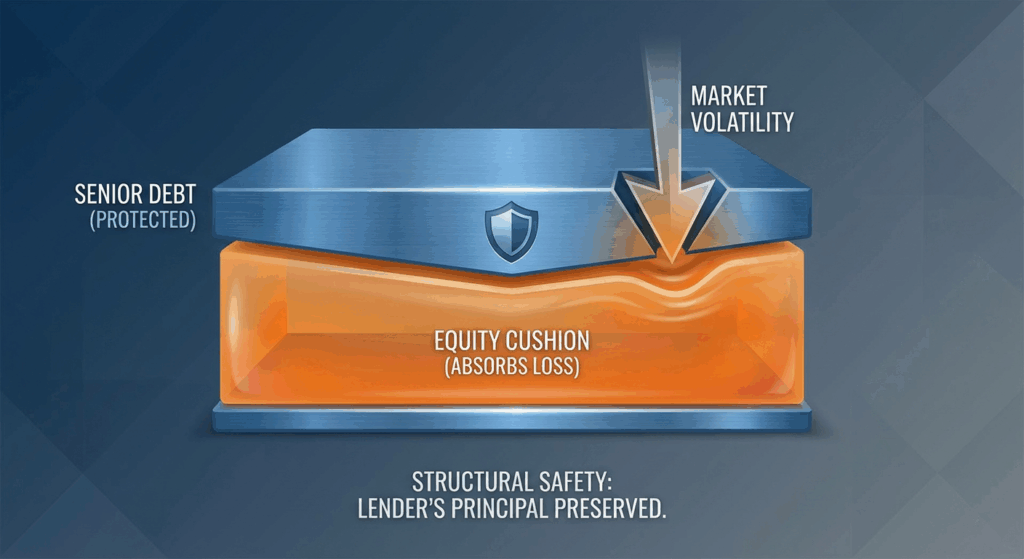
The equity cushion functions as the shock absorber of the capital stack. Just as a suspension system absorbs potholes to protect a car's chassis, the equity cushion absorbs enterprise value volatility to protect the lender's principal. Understanding this mechanic is essential for investors assessing risk and for business operators deciding between debt and equity financing.
The Concept: Capital Stack Physics
To understand the equity cushion, one must visualize the Capital Stack. This is the hierarchy of funding sources that make up a company's total Enterprise Value (EV).
In a typical leveraged buyout or growth financing, the stack is divided into two primary layers:
- Senior Secured Debt (Top): This is the loan provided by the private credit manager. It typically has the "first lien" on assets, meaning it is first in line to be repaid if the company is sold or liquidated.
- Equity (Bottom): This is the capital provided by the business owners, founders, or private equity sponsors. This layer represents the residual value of the company after debt is paid.
The "cushion" is simply the percentage of the company's total value that is funded by equity. Because debt holders have repayment priority, the equity layer must be completely wiped out before the senior debt loses a single dollar of principal. This creates a powerful asymmetry of risk.
How It Works: The $100 Million Drop
Let’s examine a concrete mathematical example to illustrate how this subordination protects lenders.
Imagine a private credit fund lends to a manufacturing business with an agreed Enterprise Value (EV) of $100 million.
The Deal Structure
- Senior Term Loan: $40 million
- Sponsor Equity: $60 million
In this scenario, the Loan-to-Value (LTV) ratio is 40% ($40M / $100M). Consequently, the Equity Cushion is 60%.
Now, assume a severe economic downturn hits. Using data from previous recessions, let's model a drastic 40% decline in the company's valuation.
The Downside Scenario
The company's Enterprise Value drops from $100 million to $60 million.
- Equity Holders: The value of their stake falls from $60 million to $20 million. They suffer a 66% loss on their investment.
- Debt Holders: The company is still worth $60 million, coverage for the $40 million loan remains robust (1.5x asset coverage). The lender's principal is 100% intact.
Even if the company's value dropped by 50%, a catastrophic decline, the lender would ideally still be "money good" because the remaining $50 million value covers the $40 million debt. This mathematical buffer explains why senior loans sit at the top of a company’s capital structure, providing significant protection against losses compared to junior debt or equity.
Current Market Relevance
As of mid-2026, the data emphasizes why this structure remains resilient.
Recent reports highlight that private credit has grown to become a dominant force in corporate finance. According to Lord Abbett (August 2025), this asset class has become a "go-to" option precisely because loans are not marked daily, offering less "noise" and utilizing structural protections like these to stabilize portfolios.
Furthermore, Adams Street (May 2025) notes that the predominant form of private credit remains senior secured direct lending. In an environment where economic forecasts can be uncertain, the seniority of these loans allows investors to prioritize capital preservation over speculative growth.
The current market discipline often demands equity cushions ranging from 40% to 60% for high-quality middle-market borrowers, ensuring that even moderate valuation corrections do not impair credit facilities.
Decision Framework
For Investors: Evaluating Risk
When reviewing a private credit opportunity, the LTV ratio is your primary metric of safety. A lower LTV means a thicker equity cushion.
- Conservative: < 40% LTV (Massive cushion, extremely safe)
- Standard: 40-55% LTV (Healthy balance of risk/yield)
- Aggressive: > 60% LTV (Thinner cushion, higher risk of impairment)
Investors should view the equity cushion as their "margin of safety." If the cushion is thin, the yield must be significantly higher to compensate for the increased risk.
For Operators: Why Accept Debt?
Business owners often ask: "Why should I take on debt instead of selling more stock?"
The answer lies in dilution protections. By utilizing senior debt, operators leverage the equity cushion to retain ownership. While debt imposes a fixed cost (interest), it allows founders to capture 100% of the upside of value creation above that debt layer. It is a tool to amplify returns on equity without selling the company incrementally to investors.
Key Takeaways
- Seniority is Safety: Senior secured loans are paid first, meaning equity absorbs all initial losses.
- The Cushion Ratio: An equity cushion of 40-50% protects lenders against significant enterprise value volatility.
- Asset Class Growth: The shift toward private credit is driven by these structural protections which offer lower volatility than public equity markets.
- LTV Matters: For investors, the Loan-to-Value ratio is the quick-check metric for downside protection.
- Non-Dilutive Capital: For operators, debt uses the company's enterprise value to fuel growth without permanently selling ownership stakes.


