
Introduction: The Hierarchy of Money
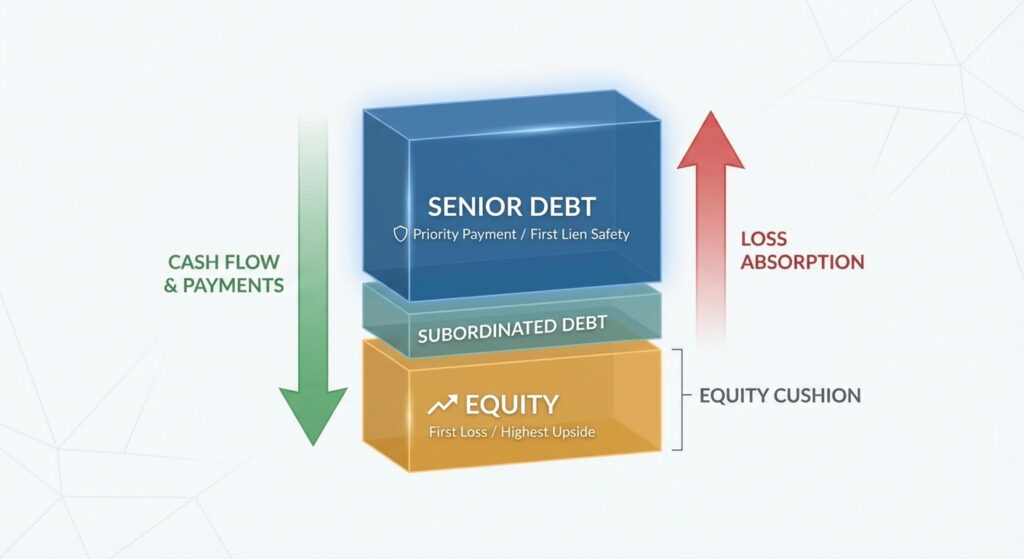
In every business transaction (whether buying a company, refinancing debt, or funding growth) money is not created equal. It is organized into a hierarchy known as the Capital Stack. This structure dictates who gets paid first when things go well, and more importantly, who gets paid (or wiped out) when they do not.
For participants in the private credit market, understanding where a specific investment sits in the capital stack is the single most critical factor in risk assessment. It defines the priority of payment and the legal rights of the lender vs. the owner.
The Concept: Seniority and Subordination
The capital stack is a layer cake of financing sources. At the top sits Senior Debt, often secured by assets. At the bottom sits Common Equity. The defining laws of this structure are priority and risk.
- Payment Priority: Cash flows from the business pay the top layers first. Only after Senior Debt obligations are met does money flow down to junior debt or equity holders.
- Loss Absorption: Losses flow upwards. If a company loses value, the Equity layer is wiped out first. The Senior Debt is the last to suffer impairment.
Private Credit funds, particularly Direct Lenders, typically operate in the Senior Secured position. This means they hold the “first lien” on company assets, placing them at the very top of the stack, ahead of other unsecured creditors and equity holders.
How It Works: The $100 Million Example
To visualize the mechanism of subordination and equity protection, consider a hypothetical theoretical acquisition of strong middle-market software company, “TechCo.”
The Deal Structure:
TechCo has an Enterprise Value (purchase price) of $100 million.
- Senior Secured Loan (Private Credit): $40 million (40% of stack)
- Sponsor Equity (Private Equity Firm): $60 million (60% of stack)
Scenario A: Success (Exit at $150M)
The company grows. The Private Equity firm sells TechCo for $150 million.
1. Lender gets: $40 million principal + accrued interest. The upside is capped at the interest rate.
2. Equity gets: $110 million (Remaining proceeds). They capture all the upside.
Scenario B: Distress (Fire Sale at $50M)
The company struggles and must be liquidated for half its original value.
1. Lender gets: $40 million (Full Repayment). Even though the company value halved, the senior claim is fully covered.
2. Equity gets: $10 million. They suffer a massive loss ($50M loss on $60M investment).
Scenario C: Disaster (Liquidated at $30M)
1. Lender gets: $30 million. They take a $10 million loss.
2. Equity gets: $0. Total write-off.
This demonstrates the concept of the Equity Cushion. In this deal, there was a $60 million cushion (60%) beneath the debt. The company’s value would have to drop by more than 60% before the senior lender lost a single dollar.
Current Market Relevance
As of 2026, the structure of the capital stack has evolved as private lenders replace traditional banks for middle-market financing.
- Dominance of Direct Lending: According to the National Association of Insurance Commissioners (NAIC), direct lending now accounts for approximately 40% of the U.S. private credit market, which is estimated between $1.7 trillion and higher.
- Defensive Income: Major managers emphasize the safety of the senior status. Blackstone notes that private loans are typically senior secured with a meaningful cushion of junior debt and equity below them, designed for principal preservation.
- Yield Premium: Investors are compensated for illiquidity. As highlighted by T. Rowe Price, the “spread” over base rates in private credit compensates for the complexity and illiquidity, offering a premium over public markets while maintaining that senior position.
Decision Framework
For Investors (allocating to private credit)
When evaluating a private credit fund, the focus should be on attachment point and loan-to-value (LTV).
- Check the LTV: If a fund lends at 40-50% LTV (like the example above), there is a massive equity cushion. If they lend at 85% LTV, the margin for error is razor-thin.
- Confirm Seniority: Ensure the strategy is truly “First Lien Senior Secured.” Some strategies labeled “credit” explore junior or mezzanine layers which carry equity-like risks without the upside.
For Operators (borrowing capital)
Business owners often debate between cheap bank debt and more expensive private credit.
- Flexibility vs. Cost: A bank might offer a lower rate but demand strict amortization and low leverage (e.g., 3x EBITDA). A private lender might charge 400-500bps more but allow 5x EBITDA leverage and require no amortization (interest-only).
- Dilution Protection: Using debt higher in the stack is cheaper than selling more equity. If you believe your business will grow, paying 10-12% interest for senior debt is mathematically better than selling 20% of your company permanently.
Key Takeaways
- Seniority is Safety: In a liquidation scenario, senior lenders are paid first, fully, before anyone else sees a dime.
- Equity Cushion Matters: The thickness of the equity layer below the debt acts as a shock absorber for the lender.
- Asymmetric Risk: Lenders have capped upside (interest) but substantial downside protection; Equity has uncapped upside but first-loss risk.
- Private Credit Role: Direct lenders have largely taken over the senior secured position for middle-market companies, filling the void left by regional banks.
- Trade-offs: For borrowers, moving down the stack (taking on more debt) increases leverage and risk, but preserves ownership dilution.


