
The Situation: The Liquidity Dilemma in a Tight Exit Market
By April 2026, the dialogue in boardrooms has shifted. The IPO window remains selective, and while private equity firms are deploying capital, their terms have tightened. For founders of profitable, growing companies (roughly $20M–$50M EBITDA), the traditional “exit” binaries (sell the company or keep grinding with illiquid equity) feel increasingly restrictive.
This creates a friction point known well to capital allocators: usage of the “Dividend Recapitalization.” While historically associated with private equity sponsors juicing returns, the strategy has been democratized for founders, driven by an aggressive private credit market that began pitching higher leverage to win deals in mid-2025.
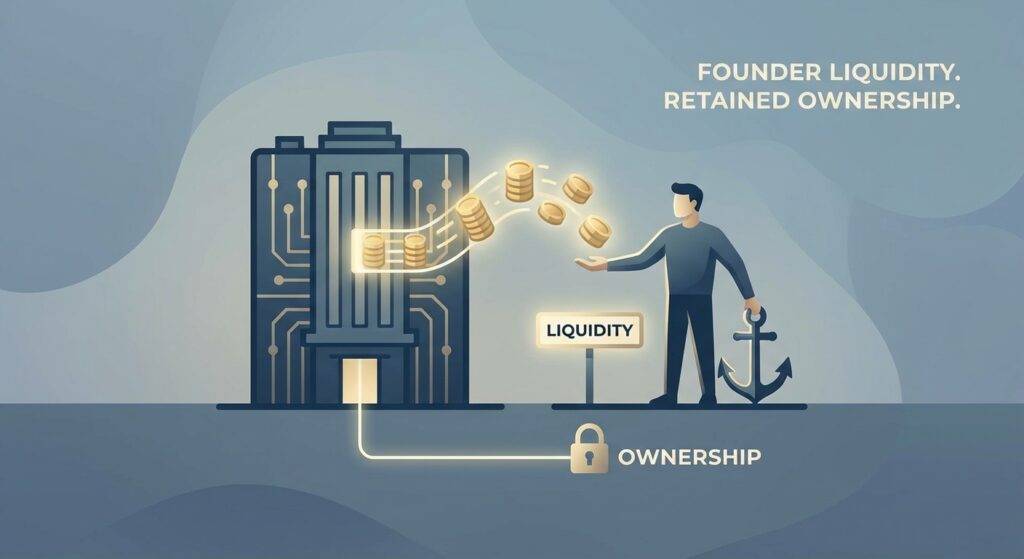
To illustrate the mechanics and potential of this approach, we examine the “No-Exit Exit”, a strategy allowing founders to take chips off the table while retaining ownership of the asset.
Case Study (Hypothetical): Apex Logistics
Note: This scenario is a composite based on deal structures observed in the 2024-2026 credit cycle.
The Company: Apex Logistics, a tech-enabled 3PL (third-party logistics) provider.
- Founder Ownership: 80% (Bootstrapped with minor angel equity).
- Financials: $30M EBITDA, growing 15% YoY. Debt-free.
The Decision Point (Q1 2026):
The founder, “David,” has been running Apex for 12 years. He is asset-rich but cash-poor. He wants to buy a home, diversify his net worth, and reduce personal risk, but he believes Apex is only halfway through its growth curve. He receives two competing term sheets.
Option A: The Private Equity Buyout
A mid-market PE firm offers a standard majority buyout.
- Valuation: 10x EBITDA ($300M Enterprise Value).
- Structure: PE acquires 80% of the business.
- Founder Proceeds: David sells his 80% stake for $240M, maintains 20% rollover equity.
- Result: Massive immediate liquidity ($240M pre-tax), but he loses control. He is now an employee reporting to a board. If Apex doubles in value to $600M, his remaining upside is limited to his 20% stake.
Option B: The Leveraged Recap (Private Credit)
A direct lender, competing against the syndicated market, offers a credit facility to fund a dividend. Following trends from late 2024 where sponsors turned to loan markets to cut checks to investors, lenders are now extending similar terms to operator-owned firms.
- Structure: Senior Term Loan at 5.0x Leverage.
- Debt Raised: $150M.
- Use of Funds: $140M one-time special dividend to shareholders; $10M to balance sheet.
- Founder Proceeds: David receives 80% of the dividend ($112M pre-tax).
- Result: David secures generational wealth ($112M) but retains 80% ownership and operational control. The company now services debt, but retains all future equity upside.
The Outcome: Comparing the Economics
David chose Option B. Here is why the math works, provided the business is durable.
Three years later (hypothetically projecting to 2029), assuming Apex grows EBITDA to $45M and pays down $30M of debt from cash flow:
Scenario A (Sold to PE):
The company exits at $450M. David owns 20%.
Second Exit Proceeds: $90M.
Total Lifetime Liquidity: $240M (initial) + $90M (secondary) = $330M.
Scenario B (Leveraged Recap):
The company is valued at $450M. Debt is now $120M ($150M original – $30M paydown).
Equity Value: $330M.
David owns 80% of that equity.
Second Exit Proceeds: $264M.
Total Lifetime Liquidity: $112M (initial dividend) + $264M (exit) = $376M.
The Delta: By using debt instead of selling equity, David generated an additional $46 million in wealth. More importantly, he maintained autonomy over strategy, culture, and hiring during those three years.
The Lessons: Debt as a Non-Dilutive Partner
The Apex case highlights a principle often discussed by firms like Ares and other private credit giants: Debt is cheaper than equity.
When a founder sells equity (Option A), they are selling a perpetual claim on all future cash flows. When a founder “sells” a debt claim (Option B), they are renting capital for a fixed period. Once the debt is paid, the claim vanishes. The equity persistence remains.
However, this strategy is not risk-free. It requires:
- Stable Cash Flows: The business must comfortably service interest. In the Apex example, a $150M loan at 10% interest costs $15M/year. With $30M EBITDA, coverage is 2.0x, healthy, but leaves less margin for error than a debt-free balance sheet.
- Discipline: Recent reports indicate some firms use leverage to mask slow growth. A recap should bridge to future growth, not solely cash out past success.
- Lender Alignment: Unlike a bank, private credit funds can offer flexibility (PIK interest, covenant-lite structures) that allow businesses to navigate choppy quarters without technical default.
Framework for Decision Making
Founders facing this choice in 2026 should ask three questions:
- Is my growth rate higher than the cost of debt? If your business equity compounds at 20% and debt costs 11%, you are arbitraging the spread. Keep the equity.
- Do I want to run this for 5 more years? Recaps lock you in. You are now working for the bank until leverage decreases. If you are burned out, sell (Option A).
- Can the balance sheet handle a shock? 5.5x leverage is aggressive. Ensure your “cushion” can absorb a 20% revenue draw-down without breaching covenants.


