
The Underwriting Challenge: Protection vs. Flexibility
In the discipline of private credit and commercial lending, the true test of an underwriter is not the successful closing of a transaction, but the resilience of that credit through an economic cycle. Covenants act as the structural skeleton of risk management; they are the primary mechanism for monitoring borrower health and triggering intervention before a permanent capital loss occurs.
A critical error in modern underwriting is viewing covenants solely as legal boilerplate. Instead, they must be architected as precise early warning systems. If set too loosely, they fail to alert the lender to deteriorating performance until it is too late. If set too tightly, they may trigger technical defaults that erode the borrower-lender relationship without indicating true credit weakness. The art of covenant design lies in balancing the borrower’s need for operational flexibility with the lender’s non-negotiable requirement for capital preservation.
The Framework: Designing Maintenance Covenants
Effective covenant design begins with a clear distinction between maintenance covenants (tested periodically, usually quarterly) and incurrence covenants (tested only upon a specific action, like raising debt). For middle-market underwriting, maintenance covenants are the industry standard for risk control.
Key financial covenants typically fall into two categories:
- Leverage Ratios: Measure balance sheet risk (e.g., Total Net Debt / TTM Adjusted EBITDA).
- Coverage Ratios: Measure cash flow adequacy (e.g., Fixed Charge Coverage Ratio or FCCR).
The methodology for setting these covenants requires a “cushion” analysis. A standard underwriting guideline is to set financial covenants with a 20% to 25% cushion (headroom) to the borrower’s base case financial model. This allowance accommodates normal business cyclicality while ensuring that material underperformance triggers a conversation.
The Analysis: Stress Testing the Fixed Charge Coverage Ratio
Let us analyze a manufacturing company with \$10 million in TTM EBITDA to illustrate the precision required coverage analysis. The Fixed Charge Coverage Ratio (FCCR) is often the most critical metric for assessing immediate default risk.
Step 1: Calculate Unlevered Free Cash Flow
Start with EBITDA and deduct “Non-Financing” cash outflows.
- EBITDA: \$10,000,000
- Less: Unfinanced CAPEX: (\$1,500,000)
- Less: Cash Taxes: (\$2,000,000)
- Less: Distributions/Dividends: (\$500,000)
- = A: Cash Flow Available for Debt Service: \$6,000,000
Step 2: Calculate Fixed Charges
Sum all required debt payments.
- Cash Interest Expense: \$3,500,000
- Scheduled Principal Amortization: \$1,000,000
- = B: Total Fixed Charges: \$4,500,000
Step 3: Determine the Ratio and Set the Covenant
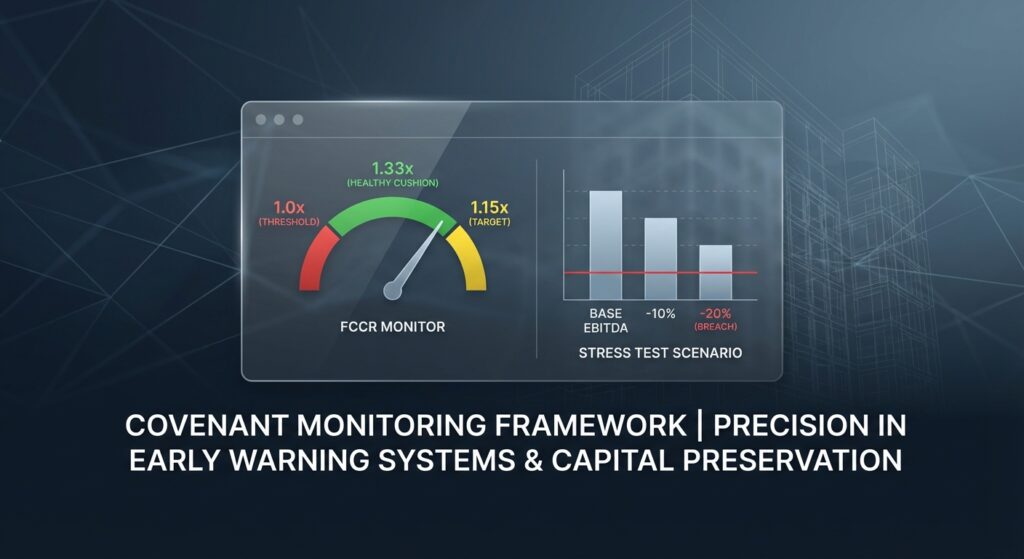
Actual FCCR = A / B = \$6.0M / \$4.5M = 1.33x.
In this scenario, setting a covenant at 1.0x provides a 33% cushion, which may be too loose for a volatile industry. A covenant of 1.10x or 1.15x is tighter, signaling a breach if EBITDA drops by roughly 15-20% (holding other variables constant). Underwriters must stress test the EBITDA line: “At what EBITDA level does FCCR break 1.0x?” In this case, if EBITDA falls to \$8.0M (assuming taxes/capex remain constant), the ratio hits 1.0x. This breakeven analysis informs the final covenant level.
Industry Standards and Red Flags
Institutional guidelines emphasize that credit risk management extends well beyond the initial approval. According to the Basel Committee on Banking Supervision’s 2025 principles, a sound credit risk environment requires an “appropriate credit administration, measurement and monitoring process” that functions independently of the origination process [bis.org].
Similarly, Fitch Ratings notes in their corporate criteria that an issuer’s “financial flexibility”, defined by their ability to meet obligations from internal cash flow relative to their debt load, is a primary driver of credit ratings. Weak covenant packages that allow for significant “add-backs” to EBITDA can artificially inflate compliance ratios, obscuring the true financial structure [fitchratings.com].
Common Red Flags in Covenant Documentation:
- Excessive EBITDA Add-Backs: “Capped” add-backs (e.g., max 5% of EBITDA) are standard; uncapped subjective adjustments are a major risk.
- Cure Rights: Borrowers often request equity cure rights. Lenders should limit these to 1-2 times per year and require that the cure amount be applied to pay down debt, not just retained as cash to “fix” the ratio.
- “Holidays”: Step-downs or covenant holidays during difficult quarters should be scrutinized heavily during the initial underwriting.
Underwriting Checklist: Due Diligence & Monitoring
When structuring or monitoring a credit facility, use the following checklist to ensure rigor:
- Definition Check: Does “Consolidated EBITDA” in the credit agreement match the underwriting model? Ensure non-recurring items are clearly defined.
- Testing Frequency: Is the covenant tested quarterly on a trailing 12-month basis? Avoid “annual only” testing for leverage.
- Reporting Requirements: Does the compliance certificate require a detailed bridge of adjustments, or just a final number? Demand granularity.
- Cross-Default Provisions: Ensure that a default on other material indebtedness triggers a default on your facility.
- Collateral Linkage: For asset-based scenarios, ensure covenants align with borrowing base reporting cycles (as noted in FDIC asset quality manuals [fdic.gov]).
Key Takeaways
- Structure for Safety: Covenants are the “tripwires” of credit; they must be set tight enough to catch falls but loose enough to allow movement.
- Focus on Cash Flow: Earnings can be manipulated; cash flow (FCCR) is the ultimate arbiter of repayment ability.
- Define “EBITDA” Carefully: The legal definition of EBITDA often deviates from the accounting definition; limit add-backs strictly.
- Monitor Actively: A covenant breach is an opportunity to re-underwrite and potentially re-price the risk, not just a box to check.
- Stress Test Breakevens: Always know exactly how much revenue or margin can degrade before a covenant triggers.


