
The Foundation of Risk Mitigation
In the world of private credit, the interest rate (or yield) often garners the most headlines. However, for sophisticated market participants, the true “DNA” of a deal lies not in its coupon, but in its position within the Capital Stack. This hierarchy determines who gets paid first, who controls the collateral, and who absorbs losses when a business faces turbulence.
For investors, understanding seniority is the difference between a recoverable investment and a total write-off. For business operators and sponsors, understanding this structure is critical to optimizing the weighted average cost of capital (WACC) while maintaining control.
The Concept: Absolute Priority
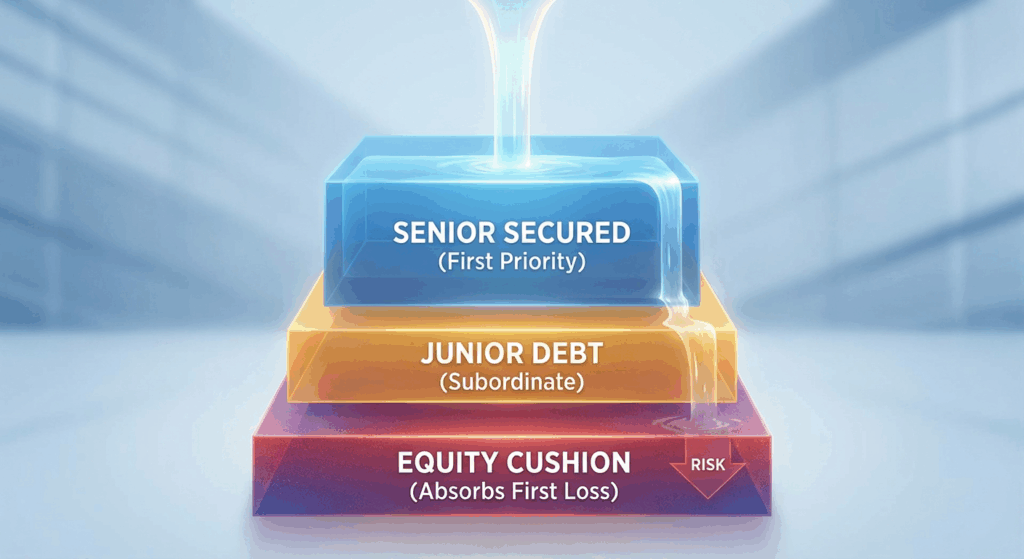
The Capital Stack is the total structure of all capital invested in a company. It functions like a tower of blocks, governed by the “Absolute Priority Rule.” This legal and financial principle dictates that cash flows and liquidation proceeds must fill the “buckets” from the top down.
- Senior Secured Debt (First Lien): Sits at the very top. It has the first claim on assets and cash flow. It offers the lowest risk and, consequently, the lowest cost of capital.
- Junior/Mezzanine Debt: Sits in the middle. It is subordinate to senior debt but senior to equity. It takes higher risk for higher return.
- Equity (Common & Preferred): Sits at the bottom. It absorbs the first dollar of loss but enjoys unlimited upside potential.
In private credit, the vast majority of direct lending activity focuses on the Senior Secured position. As noted in Blackstone’s 2025 Essentials of Private Credit, these loans typically possess a “meaningful cushion below in the form of junior debt and equity,” designed to provide principal preservation.
How It Works: The “Equity Cushion” Calculation
To understand the protective mechanism of seniority, we look at the Equity Cushion and Loan-to-Value (LTV) ratios. Let’s analyze a concrete hypothetical scenario of a Middle Market buyout.
The Structure:
- Enterprise Value (EV): $100 Million
- Senior Term Loan (Private Credit): $40 Million (40% LTV)
- Sponsor Equity: $60 Million (60% Cushion)
The Downside Scenario:
Suppose the company faces severe headwinds: recession, loss of a major client, or operational failure. The company is forced to liquidate or sell at a distressed price of $50 Million (a massive 50% destruction of enterprise value).
The Payout Waterfall:
- Senior Lender: Owed $40M.
Outcome: 100% Repaid ($40M). Because the sale price ($50M) covers the senior claim entirely. - Equity Holder: Residual value ($50M proceeds – $40M debt).
Outcome: 83% Loss. They invested $60M but recovered only $10M.
In this example, the lender was protected by the “Equity Cushion.” The business value had to fall by more than 60% before the senior lender lost a single dollar of principal. This highlights why attachment points (where debt starts) and detachment points (where debt ends) are more vital metrics than yield alone.
Current Market Relevance (2026 Context)
As of early 2026, the distinction between capital stack layers has become increasingly relevant due to the shifting banking landscape. Following the bank retrenchment that began earlier in the decade, private credit has stepped in to fill the “financing gap” for middle-market companies.
According to NEPC’s December 2025 Guide to Private Debt, banks have materially prioritized return-on-equity, often exiting direct lending to hold fewer assets on their balance sheets. This has left private credit managers as the primary providers of senior secured financing.
Key market observations include:
- Shift to Seniority: In the current high-rate environment, the “Defensive Income” properties of senior loans act as a hedge. As T. Rowe Price notes in their 2024 Introduction to Private Credit, senior loans sit at the top of the structure, meaning they are repaid before any junior tranches, offering a buffer against volatility.
- Floating Rate Protection: Most private credit senior loans utilize floating rates (base rate + spread). This structural feature mitigates interest rate risk compared to fixed-rate bonds, a critical factor cited by Lord Abbett (Aug 2025) regarding income generation.
Decision Framework
For Investors: Evaluating Attachment Points
When assessing a private credit fund or direct deal, the “yield” is often a distraction. The primary question should be: “How much equity sits beneath me?”
- The Metric: Look for Last Dollar Leverage. If a company generates $10M in EBITDA and the loan is $40M, the leverage is 4.0x. If comparable companies sell for 10.0x EBITDA, the implied equity cushion is substantial (60%).
- The Risk: If a Senior Loan stretches to 6.5x leverage in a sector trading at 7.0x, the “Senior” label is cosmetic. You are effectively taking equity risk for reliable debt returns, an asymmetry to avoid.
For Operators: Minimizing Dilution
For business owners, using senior debt is a tool to preserve ownership.
- The Trade-off: Equity is the most expensive form of capital (long-term cost of ~15-25%+ in expected returns and loss of control). Senior debt, while requiring cash interest payments, is non-dilutive.
- The Strategy: Operators often utilize “Unitranche” facilities (blending senior and junior risk into a single instrument) to maximize leverage without giving up shares. This increases the immediate interest burden but preserves the “upside” of the exit for the founders.
Key Takeaways
- Hierarchy Matters: Senior Secured debt must be repaid fully before junior debt or equity receives any proceeds.
- Equity as Shield: The “Equity Cushion” absorbs the first losses, protecting the lender’s principal in downside scenarios.
- Asset Backing: Private credit is largely “asset-based” or cash-flow supported, differing from venture debt which relies on future enterprise value.
- Ownership Preservation: Operators utilize senior debt to fund growth without diluting their ownership stake.
- Current Trend: As banks retreat (NEPC, 2025), private lenders are increasingly setting the terms for senior secured protections in the middle market.


