
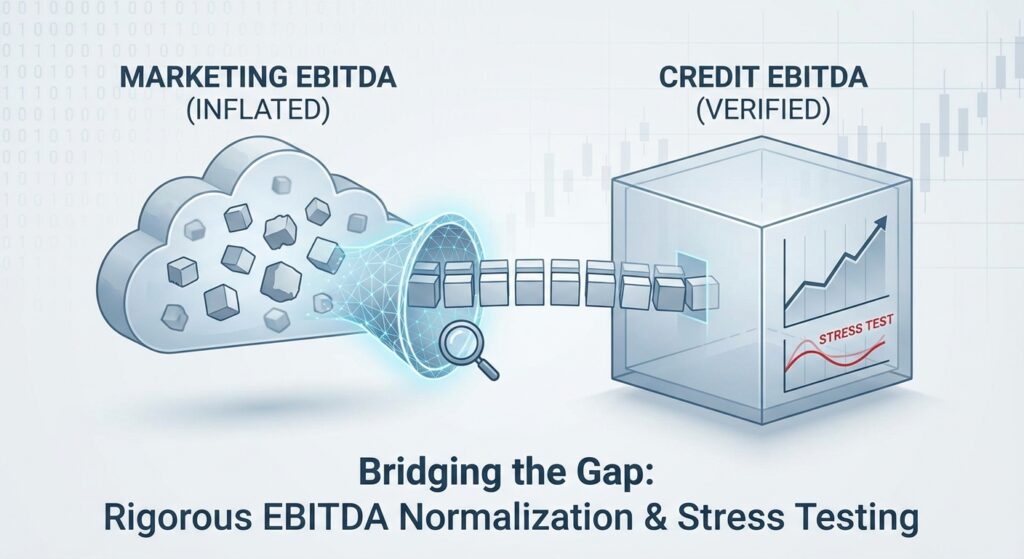
The Underwriting Challenge: Marketing vs. Credit Reality
In the high-stakes environment of credit origination, the most dangerous number in a Confidential Information Memorandum (CIM) is often the “Pro Forma Adjusted EBITDA.” For underwriters and portfolio managers, the widening gap between a borrower’s “Marketing EBITDA” and their actual debt-servicing capacity represents a primary source of risk. As aggressive add-backs and synergy estimates become standard in deal structuring, the discipline of credit underwriting hinges on a rigorous normalization process.
As of early 2026, the divergence between public and private market credit standards highlights the need for independent validation. Institutional guidance emphasizes that relying solely on sponsor-provided metrics can lead to “optical leverage” being significantly lower than “effective leverage.” This article outlines a rigorous framework for EBITDA normalization and cash flow stress testing, drawing on methodologies from global rating agencies and institutional risk principles.
The Framework: Normalization and Projection
Effective underwriting moves beyond historical financial statements to construct a forward-looking view of verifyable cash flow. According to the Corporate Rating Criteria (2025) used by major agencies, a robust financial profile analysis must encompass a three-to-five-year time horizon. This typically includes the last three years of operating history combined with projections to capture a full economic cycle.
The core methodology involves three phases:
- Quantitative Normalization: Stripping out non-recurring items to determine the steady-state “run-rate” earnings.
- Qualitative Weighting: Assessing the business risk profile. As noted in Fitch Ratings’ criteria, where one factor (such as leverage or liquidity) is significantly weaker than others, it often attracts greater weight in the final credit assessment [fitchratings.com].
- Stress Testing: Applying downside scenarios to the normalized number to test covenant compliance.
The Analysis: Bridging to “Credit EBITDA”
To illustrate the underwriting rigor required, consider a hypothetical middle-market manufacturing borrower presenting a $15 million Adjusted EBITDA.
The CIM includes $4 million in adjustments: $1.5 million in “realized synergies” from a recent acquisition, $1.5 million in “one-time” consulting fees, and $1.0 million in “pro forma” cost savings from a future plant closure. A prudent underwriter performs the following bridge:
- curing Period: TTM Reported EBITDA: $11.0 million
- (+) One-Time Fees: $1.5 million (Accepted, verified by Quality of Earnings report)
- (+) Realized Synergies: $0.5 million (Capped at verifiable, executed savings only; $1.0M rejected as speculative)
- (+) Pro Forma Savings: $0.0 million (Rejected as future execution risk)
- (=) Underwritten EBITDA: $13.0 million
The Leverage Impact:
If the total debt ask is $60 million, the borrower claims leverage is 4.0x ($60M / $15M). However, the underwritten leverage is 4.6x ($60M / $13M). If the accepted market tolerance for this sector is 4.5x, this deal moves from “approved” to “declined” or requires structural changes based on normalization alone.
Industry Standards and Risk Monitoring
Institutional lenders are increasingly wary of “complacency” in private credit origination, where total capital deployment sometimes overrides relative value analysis. Recent insights from PIMCO highlight that evaluating private investment grade credit requires understanding structural nuances rather than trusting a single credit rating or metric [pimco.com].
Furthermore, the Basel Committee’s Principles for the Management of Credit Risk (2025) emphasizes that banks must operate under a “sound credit-granting process” that continuously assesses the borrower’s ability to repay under changing economic conditions [bis.org].
Key Red Flags in EBITDA Analysis:
- “Poorly Defined” Add-backs: Adjustments labeled purely as “management consulting” or “business optimization” without billable evidence.
- Capped Pro Formas: Synergies that exceed 15-20% of the base EBITDA are statistically unlikely to be fully realized within 12 months.
- Capitalization of Opex: Treating software development or maintenance capex as an add-back to cash flow.
Underwriting Checklist: The Diligence Process
To ensure portfolio resilience, risk managers should enforce the following diligence checklist prior to committee approval:
- Verify “One-Time” Nature: Review the General Ledger (GL) to ensure “one-time” costs haven’t appeared in 3 consecutive years.
- Stress Test Margins: Apply a 10% reduction in Gross Margin. Does Fixed Charge Coverage Ratio (FCCR) remain above 1.1x?
- Analyze Conversion: Calculate Free Cash Flow (FCF) conversion (EBITDA minus Capex / EBITDA). If EBITDA is high but FCF is low, the add-backs are likely artificial.
- Benchmark Covenants: Ensure leverage covenants are set off Underwritten EBITDA, not Marketing EBITDA, providing a tighter leash on performance.
Key Takeaways
- Distrust the Headline: Never accept CIM EBITDA; build a ground-up bridge based on verifiable historicals.
- Stress the Structure: Leverage calculations must use the “Credit EBITDA” to determine true risk exposure.
- Watch the Horizon: Use a 3-5 year analysis period to capture full economic cycles, per rating agency criteria.
- Monitor Drift: Post-closing, track whether “add-back” costs actually disappear from the P&L.
- Prioritize Cash: Ultimately, debt is serviced by cash flow, not accounting adjustments.


