
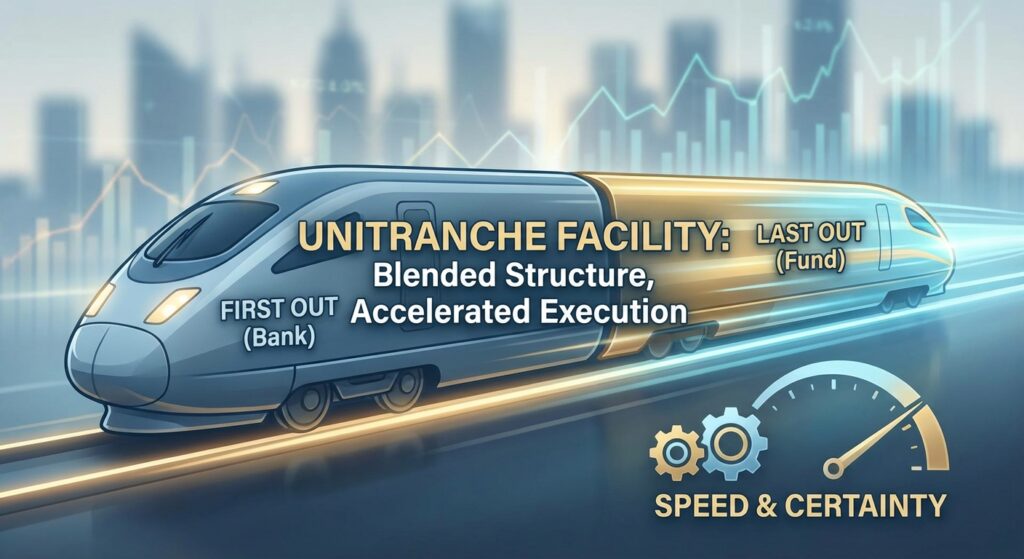
For middle-market operators and sponsors in 2026, the question of acquisition financing often comes down to a trade-off: speed and certainty versus the lowest possible cost of capital. While the broadly syndicated loan (BSL) market offers scale, the unitranche facility has cemented itself as the dominant structure for buyouts, particularly for software and high-growth sectors. By blending senior and junior debt risk into a single instrument, the unitranche offers a streamlined solution, but its simplicity on the surface hides complex internal mechanics that borrowers must understand to negotiate effectively.
Structure Breakdown: The Mechanics of Bifurcation
A unitranche facility is a single debt instrument with a blended interest rate and one set of loan documents. Unlike a traditional capital stack, which stacks a senior bank loan on top of mezzanine debt with an intercreditor agreement, the unitranche presents a unified face to the borrower. However, behind the scenes, the structure is often “bifurcated” via an Agreement Among Lenders (AAL).
The AAL splits the loan into:
- First Out (FO) Tranche: Typically held by a commercial bank or the low-cost capital arm of a credit fund. It has a lower yield and priority in repayment.
- Last Out (LO) Tranche: Held by the direct lender or credit fund. It carries higher risk (junior to the FO) and commands a higher return, often acting as the “mezzanine” component.
Hypothetical Deal Structure: Project Skyward
Consider a $100M Enterprise Value (EV) B2B software company seeking $50M in acquisition financing (5.0x leverage). A unitranche provider offers a single facility at SOFR + 650 bps. Internally, the deal is structured as follows:
| Component | Amount | Pricing (Spread) | Calculated Return |
|---|---|---|---|
| First Out (Bank) | $30M (60%) | SOFR + 450 bps | Lower risk, lower yield |
| Last Out (Fund) | $20M (40%) | Implied: SOFR + 950 bps | Leveraged return via arbitrage |
| Total / Blended | $50M | SOFR + 650 bps | Client pays single rate |
In this structure, the direct lender (Last Out) achieves a “mezzanine-like” return (SOFR + 950) while the borrower only manages one credit agreement and one agent. The lender achieves this yield enhancement through the AAL arbitrage, without the borrower needing to negotiate a separate second-lien facility.
How It Compares: Unitranche vs. Senior/Mezzanine
The primary alternative to unitranche is the traditional Senior/Mezzanine (or First/Second Lien) split. Each has distinct optimal use cases:
- Execution Certainty (Unitranche Wins): With no public intercreditor agreement to negotiate, unitranche deals can close 30–45 days faster than syndicated structures. As noted by privateequitybro.com, sponsors are often willing to pay a premium of 50–100 basis points for this certainty, avoiding the distinct execution risk of syndicating a second-lien bond in volatile markets.
- Cost of Capital (Senior/Mezz Wins): If a borrower has ample time and a pristine credit profile, a traditional bank-led senior facility (e.g., SOFR + 350) coupled with a smaller slice of mezzanine debt might result in a lower weighted average cost of capital (WACC). However, this introduces “friction costs”, distinct covenants for each lender and potential intercreditor disputes during a workout.
- Documentation (Unitranche Wins): A single credit agreement simplifies ongoing administration. Historically, AALs (private agreements) have held up well, though some experts note they are less tested in bankruptcy courts than standard public Intercreditor Agreements (ICAs) [fe.training].
Current Market Terms (2025-2026 Context)
Following the surge in private credit to over $2.1 trillion in assets under management in 2025, market terms have stabilized around clearer norms:
- Yields: New unitranche deals in the core middle market are pricing with all-in yields between 12% and 13% for average credits [privateequitybro.com].
- Leverage: Total leverage ratios for sponsored deals are hovering around 5.0x EBITDA, with lenders remaining disciplined regarding free cash flow coverage.
- Jumbo Unitranches: The market has seen a rise in “mega-unitranche” facilities executing above $2 billion, proving this structure effectively competes with the broadly syndicated loan market and high-yield bonds for larger corporate borrowers.
Structuring Guidance & Negotiation
For operators evaluating a unitranche proposal, leverage comes not just from the rate, but from the structural flexibility:
- The “Accordion” Feature: Negotiate a robust incremental facility (accordion) that allows you to draw additional capital for acquisitions at pre-agreed terms. This locks in the “blended” simplicity for future growth without restriking the entire credit doc.
- Covenant Headroom: Unlike the rigid maintenance covenants of a bank loan, unitranche lenders often set covenants with 25-30% headroom to EBITDA plans. Ensure the definition of “EBITDA” includes credit for pro-forma synergies, often uncapped or capped at 20-25% of EBITDA.
- Call Protection: Unitranche lenders typically demand stricter call protection (e.g., 102, 101, par) than banks to protect their yield. Negotiate for “soft call” protection (only triggered by refinancing) vs. “hard call” (triggered by any repayment) to maintain exit optionality.
Ultimately, the unitranche is a product of convenience and speed. The premium paid in spread is effectively an insurance policy against execution risk and complex stakeholder management.


