
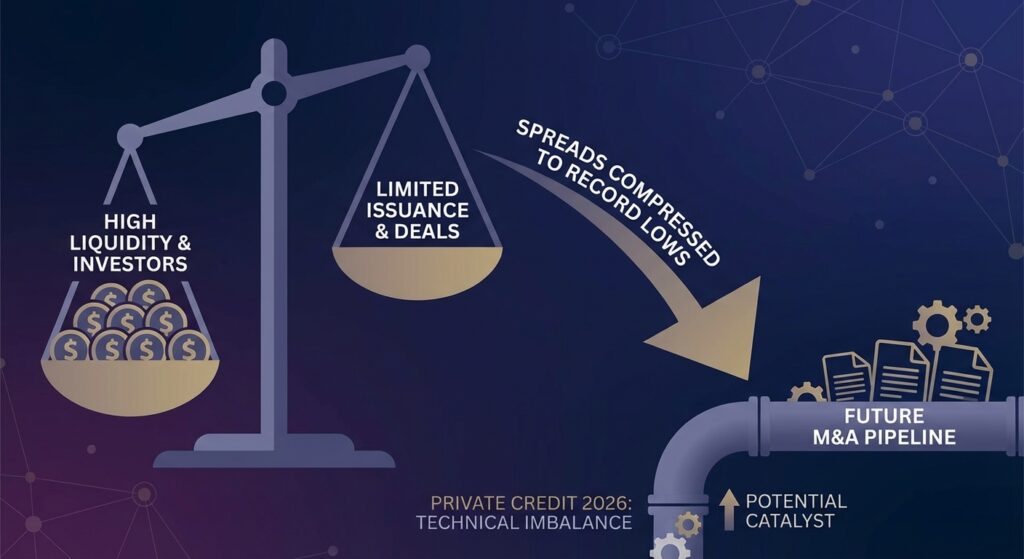
Market Headline: Technical Imbalance Drives Spreads to Record Lows as 2026 Begins
As of late January 2026, the private credit market is defined by a distinct “technical imbalance”: robust institutional liquidity is chasing limited net issuance, creating a fiercely competitive environment that has compressed spreads to near-historic lows. While capital formation remains strong, with private credit assets under management (AUM) projected to exceed $2 trillion this year, the deployment landscape has shifted. The market is currently dominated by opportunistic refinancing and repricings rather than new-money M&A, forcing lenders to offer increasingly flexible terms to win deals.
The boundary between syndicated loans and private credit continues to blur. Following a record-breaking, tariff-disrupted third quarter of 2025 which saw $404 billion in primary syndicated loan activity, competition between the two markets has intensified. This dynamic is benefiting borrowers, who are leveraging the abundance of capital to optimize balance sheets, while lenders pivot toward Asset-Backed Finance (ABF) and infrastructure debt to maintain yield targets in a crowded corporate lending market.
Quantitative Snapshot: Key Market Metrics
The following data points reflect the most recent verified market activity from Q3/Q4 2025 and early 2026 outlooks.
| Metric | Current Level / Trend | Context & Comparison | Source |
|---|---|---|---|
| Syndicated Loan Activity | $404 Billion (Record High) | Q3 ’25 volumes surged; dominated by refi/repricing, not M&A. | Portage Point |
| Asset-Backed Spreads | Tightening 10–30 bps | Spreads compressing in ABF sectors; stable investor appetite. | MetLife IM |
| M&A Deal Share | $36 Billion (Low) | LBO/M&A financing accounted for <10% of issuance in Q3 '25. | Portage Point |
| Market Size (AUM) | >$2 Trillion (2026 proj.) | Growth accelerating; approaching $4T by 2030. | Moody’s |
Sector Analysis: The Rotation to Asset-Based Finance
With traditional corporate direct lending facing yield compression, capital is aggressively rotating into specialized niches. Asset-Backed Finance (ABF) and Infrastructure have emerged as the primary growth engines for 2026.
- Asset-Backed Finance (ABF): As traditional banks remain constrained by capital requirements, alternative asset managers are filling the void. Moody’s reports that investing is shifting from a corporate lending focus to the ABF market, particularly in consumer loans and data infrastructure credit. This sector is leading growth as managers form new partnerships to spur origination.
- Infrastructure & Data Centers: Flows into digital infrastructure remain robust. MetLife Investment Management reported $3.3 billion in infrastructure debt origination in Q3 2025 alone, driven by “lower rates and rising demand from renewable and data center projects.”
- Corporate Lending: Traditional middle-market lending is seeing the tightest competition. The “lack of M&A financing opportunities” coupled with high lender support has created a borrower-friendly environment, pushing spreads on direct lending transactions tighter to compete with the syndicated market.
Implications for Market Participants
For Borrowers:
The current window is exceptionally favorable. The “technical imbalance”, high demand met with limited new deal supply, puts borrowers in the driver’s seat. Companies with strong operational performance should prioritize repricing existing debt, extending maturities, or seeking dividend recapitalizations. Cross-market competition is allowing borrowers to secure flexible terms previously reserved for the most liquid large-cap issuers.
For Lenders & Investors:
The “easy beta” of plain-vanilla direct lending is fading. To generate alpha in 2026, managers must embrace complexity. This means increasing exposure to structured credit, NAV lending, and asset-based strategies where yields compensate for complexity risk. As noted by Moody’s, “financial innovation is playing a critical role,” and lenders failing to diversify beyond corporate leverage risk significant margin erosion.
Forward Outlook (Next 3-6 Months):
While refinancing dominates today, the M&A drought is expected to break. Moody’s forecasts that M&A and LBO activity will “escalate” throughout 2026 as mounting pressure for sponsor exits meets a stabilizing rate environment. Until that volume materializes, spread compression will likely persist.
Key Market Insights
- Spread Compression: High liquidity relative to deal flow is driving spreads to near-record lows across both syndicated and private markets.
- The “ABF” Pivot: Growth is shifting from corporate cash-flow lending to Asset-Based Finance and infrastructure debt.
- Refinancing Wave: Borrowers are prioritizing liability management (repricings/extensions) over new debt issuance.
- Convergence: Competition is forcing private credit terms and pricing to converge closer to the syndicated loan market.
- M&A Catalyst: A sustained widening of spreads will likely require the anticipated rebound in LBO activity to absorb available capital.


