
Introduction: The Architecture of Risk
In the world of private finance, yield often dominates the headlines. However, for sophisticated investors and prudent operators, the true story lies in the structural protections of the deal. The most fundamental of these concepts is the Capital Stack: the hierarchical order of capital within a company that dictates who gets paid first, who gets paid last, and who absorbs losses when things go wrong.
Understanding the capital stack is not just an academic exercise; it is the primary method for evaluating risk in the $1.7 trillion private credit market. Whether you are an allocator seeking “defensive income” or a business owner calculating the cost of dilution, your position in the stack determines your financial destiny.
The Concept: Seniority and The Equity Cushion
The capital stack manages the priority of claims on a company’s assets and cash flows. At its simplest, it is divided into three layers: Senior Debt, Subordinated (Junior) Debt, and Equity.
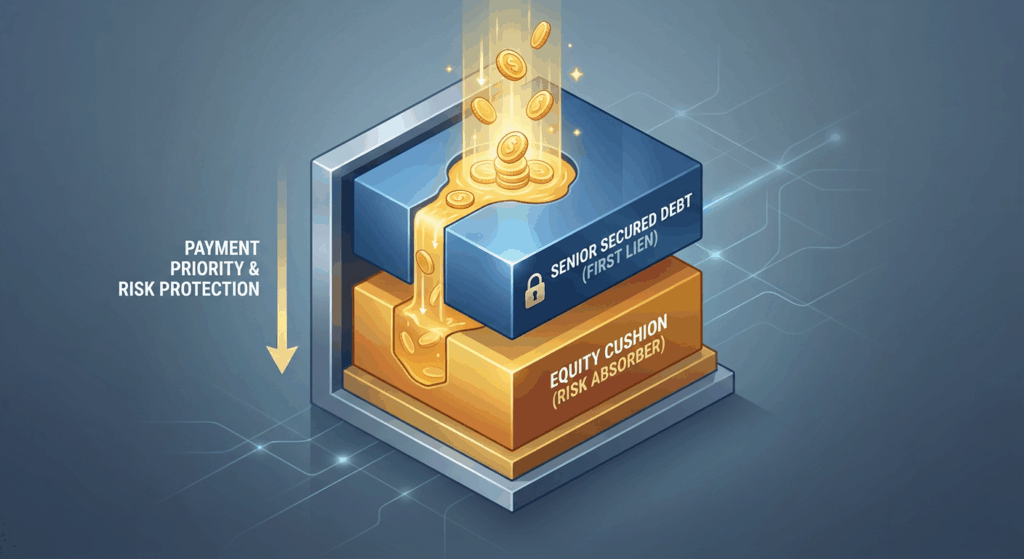
Senior Secured Debt sits at the very top of the stack. It is characterized by two key features:
- Priority of Payment: In the event of a sale, liquidation, or bankruptcy, senior lenders must be repaid in full before any other stakeholder receives a cent.
- Security: These loans are typically backed by the specific assets of the borrower (receivables, inventory, intellectual property), technically known as a “first lien.”
Below the debt sits the Equity Cushion. This is the value of the company that exceeds the debt load. For a lender, the equity cushion acts as a shock absorber. It represents the amount of value that can be eroded from the enterprise before the lender’s principal is at risk.
How It Works: The Waterfall Mechanism
To understand the power of seniority, let’s look at a concrete repayment “waterfall” scenario.
Imagine a mid-sized software company, TechCo, with an Enterprise Value (EV) of $100 million. The company finances its growth with a capital structure composed of 40% debt and 60% equity.
The Structure:
- Senior Loan: $40 million (First Lien)
- Equity: $60 million (Sponsor/Owner Capital)
Scenario A: Success
If TechCo is sold for $120 million, the waterfall flows as follows:
1. Senior Lender receives $40 million (plus accrued interest).
2. Equity holders receive the remaining $80 million.
Result: Lender gets 100% principal back; Equity holders enjoy the upside.
Scenario B: Distress (The Downside Protection)
Suppose TechCo loses a major client and forced liquidation brings in only $50 million (a 50% drop in value).
1. Senior Lender receives $40 million.
2. Equity holders receive the remaining $10 million.
Result: Despite the company losing half its value, the Senior Lender sustains zero loss. The equity cushion absorbed the entire blow.
Scenario C: Deep Distress
If the company is sold for just $30 million:
1. Senior Lender receives $30 million (recovering 75% of principal).
2. Equity holders receive $0.
Result: The equity is wiped out first. The lender only takes a loss after the equity cushion is fully evaporated.
Current Market Relevance
The mechanics of seniority are driving the current boom in private credit, as institutional investors seek safety amidst economic uncertainty. According to major asset managers, the shift from public to private markets is largely structural.
- Market Scale: The private credit market has grown to approximately $1.7 trillion, with Direct Lending accounting for roughly 40% of the U.S. market, according to the NAIC.
- The “Defensive” Shift: Blackstone notes that private loans are typically senior secured with “meaningful cushion below in the form of junior debt and equity,” positioning them as a tool for principal preservation.
- Deal Size Evolution: While banks retreat due to regulatory pressure, private lenders are stepping in to finance larger borrowers. NEPC reports that average U.S. high-yield deal sizes now exceed $700 million, leaving a significant financing gap for mid-sized firms that private credit is uniquely positioned to fill.
- Resilience: As noted by Lord Abbett, private credit values tend to “fluctuate less dramatically” than public equivalents, partly because the seniority ensures repayment stability even when enterprise valuations wobble.
Decision Framework
For Investors: Evaluating Attachment Points
When reviewing a private credit opportunity, the yield is secondary to the Attachment Point and Detachment Point.
Ask: what Loan-to-Value (LTV) percentage does this debt represent?
If a loan represents the first 40% of a company’s value (0% to 40% LTV), the company’s value must drop by 60% before you lose a dollar. This is a conservative, defensive play. If a loan is “Unitranche” or mezzanine stretching to 70% LTV, the risk is significantly higher, and the yield should compensate for that thinner equity cushion.
For Operators: Cost of Capital vs. Control
Business owners often recoil at the interest rates of private credit (often higher than bank loans). However, the decision should be viewed through the lens of Dilution.
The Trade-off: Senior debt is cheaper than equity. Raising $10 million in debt at 12% interest costs $1.2 million a year. Raising $10 million in equity by selling 10% of a growing company could cost tens of millions in lost future value upon exit. Utilizing senior debt preserves your ownership upside, provided the cash flows can support the service payments.
Key Takeaways
- Position is Power: Senior secured debt is “first money out,” meaning it is the last to suffer a loss in a downturn.
- The Cushion Matters: The safety of a private credit investment is mathematically defined by the size of the equity cushion beneath it.
- Defensive Income: Current market allocations are driven by the desire for yield with structural protection, unlike pure equity bets.
- Non-Bank Liquidity: With banks retreating from middle-market lending, private credit has become the primary provider of senior secured financing for mid-sized firms.
- Dilution Math: For operators, the higher coupon of private credit is often the price paid to prevent expensive equity dilution.


