
The Underwriting Challenge: Viability vs. Bankability
In modern private credit and project finance, a viable project does not automatically equate to a bankable loan. While commercial viability rests on market demand and operational margins, bankability is a function of structural rigidity and risk allocation. For underwriters, this necessitates a shift from analyzing pure historical cash flows to scrutinizing the future certainty of those cash flows through contractual frameworks.
The core underwriting challenge today, particularly in non-recourse financing and private investment-grade credit, is dissecting the "network of contracts" that surrounds a borrower. Whether underwriting a $250 million infrastructure asset or a structured credit pool, the lender must look past the parent balance sheet to the specific covenant structures and credit enhancements that ring-fence the cash flow.
The Framework: The Three-Pillar Contract Structure
When underwriting non-recourse or limited-recourse debt, the methodology moves from corporate credit analysis to Special Purpose Vehicle (SPV) isolation. The creditworthiness of the deal depends on three pillars that replace the traditional collateral coverage ratio:
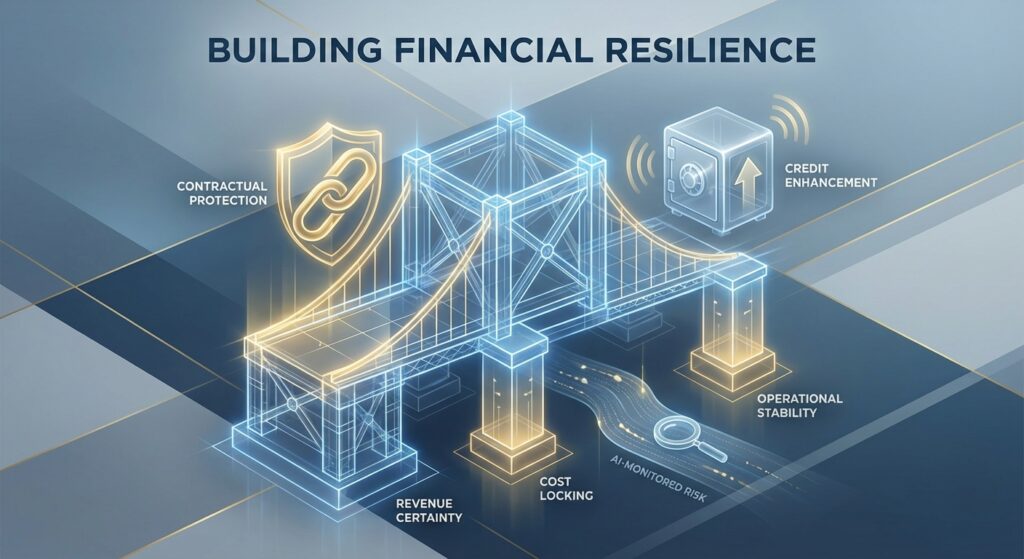
- Revenue Certainty (The Offtake): Unlike corporate loans where revenue is market-dependent, project finance relies on long-term Power Purchase Agreements (PPAs) or take-or-pay contracts. The analysis focuses on the counterparty credit risk of the offtaker rather than the borrower itself.
- Cost Locking (The EPC): Construction risk is mitigated through fixed-price, date-certain Engineering, Procurement, and Construction (EPC) contracts.
- Operational Stability (The O&M): Long-term Operation and Maintenance agreements with indexed fee formulas cap operating expenses (OPEX).
For example, analyzing a $50 million terminal asset requires verifying that the ten-year take-or-pay storage contract creates a revenue floor that comfortably exceeds debt service requirements, regardless of market volatility.
The Analysis: Credit Enhancement and Recovery Mechanics
Once the base cash flows are established, the underwriter must stress-test the "what ifs": delays, defaults, or political instability. This is where Credit Enhancement mechanisms become the primary underwriting variable.
1. Guarantees and Wraps
Lenders should quantify the value of third-party commitments. A guarantee from an investment-grade parent or a sovereign entity can elevate a sub-investment-grade project to a bankable status. These enhancements often lower interest rates and extend tenors from 5-7 years to 15-25 year horizons.
2. Liquidated Damages (LDs)
In the construction phase, the analysis must calculate the "LD Bucket." If the contractor delays the project, are the delay damages sufficient to cover the debt service during the overrun period? Best practices suggest aggressive stress testing: does the security package (letters of credit or surety bonds) cover a 6-month delay scenario?
3. Technology-Driven Portfolio Monitoring
For structured credit pools (receivables, leases), manual analysis of collateral value is obsolete. Lenders now employ AI and machine learning to monitor performance. Using interpretable models (like gradient-boosted trees), underwriters can identify specific drivers of delinquency (such as LTV ratios or regional economic stress) before they trigger a covenant breach.
Industry Standards: Private vs. Public Credit
Institutional lenders distinguish heavily between public and private investment grade (IG) profiles. In the public market, liquidity allows investors to exit deteriorating credits. In Private IG, assets are often non-transactable without borrower consent. Therefore, the underwriting standard is higher: investors must demand a "illiquidity premium" and structural protections that public bonds often lack.
According to PIMCO, avoiding impairment risk in private credit requires analyzing bespoke terms rather than relying solely on credit ratings. Common red flags in this sector include:
- Weak Step-In Rights: Lenders lacking the legal ability to replace an underperforming operator.
- Uncapped OPEX Pass-Throughs: O&M contracts that allow inflation costs to erode Debt Service Coverage Ratios (DSCR).
- Opaque Data: Pools where loan-level data is inconsistent, masking vintage risk.
Underwriting Checklist: The Structural Defense
Before issuing a term sheet, the risk management desk should clear the following structural hurdles:
- Contract Tightness: Is the EPC "turnkey" with a single point of responsibility, or is the borrower managing multiple interfaces?
- Counterparty Strength: Has the offtaker’s credit rating been stress-tested against the loan tenor?
- Enhancement Validation: Are guarantees joint and several? Are insurance wraps voidable under specific conditions?
- Data Governance: For structured pools, is there an audit trail for model outputs and algorithm parameters?
Key Takeaways
- Structure over Spread: In private credit, a higher yield rarely compensates for weak covenant structures or lack of recourse.
- Isolate the Risk: Effective underwriting isolates the asset via an SPV, ensuring the parent’s unrelated liabilities do not contaminate the project.
- Enhancement is Key: Use credit enhancements (guarantees, insurance) to bridge the gap between project risk and lender appetite.
- Monitor with Tech: Utilize AI to separate signal from noise in large credit pools, but ensure models remain interpretable.
- Liquidity Premium: Demand structural rigidity to compensate for the inability to trade out of private positions.


