
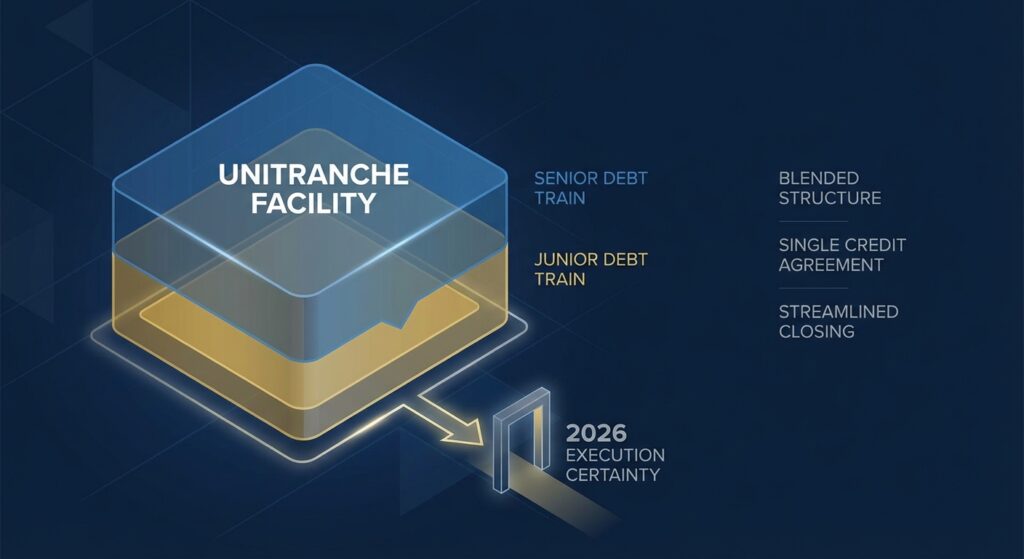
The Financing Challenge: Certainty vs. Cost
In the current middle-market buyout landscape, the primary friction point for sponsors and operators is the trade-off between execution speed and cost of capital. While broadly syndicated loans (BSLs) traditionally offered lower headline interest rates, they introduce execution risk via strict flex terms and intercreditor complexities. Entering 2026, the market has decisively shifted toward certainty, with private credit providing roughly 80% of North American buyout financing by deal count.
The solution of choice remains the Unitranche Facility. By blending senior and subordinated debt into a single instrument, this structure removes the friction of syndication, offering a streamlined path to closing. However, this convenience carries a “speed premium” that deal teams must model carefully to ensure returns hold up against a higher all-in cost of debt.
Structure Breakdown: Mechanics and Example
A unitranche facility combines senior and junior risk tranches into a single loan document with one blended interest rate and one set of covenants. Unlike a traditional Senior/Mezzanine split, the borrower interfaces with a single administrative agent.
Behind the Scenes: The AAL
While the borrower signs one credit agreement, the lenders often execute a private “Agreement Among Lenders” (AAL). This creates a waterfall structure where “first-out” lenders (often banks or safe-money funds) get paid first at a lower rate, and “last-out” lenders (higher-risk credit funds) take the junior position for a higher return. The borrower simply pays the blended coupon.
Deal Example
Consider a Software-as-a-Service (SaaS) company with $20M EBITDA and a $100M Enterprise Value (5.0x entry multiple). A typical unitranche package in today's market might look like this:
- Facility Size: $50M (5.0x Total Leverage)
- Pricing: SOFR + 650 bps (Floating)
- OID (Original Issue Discount): 2.0%
- Amortization: 1% per annum (minimal required principal contracting)
- Call Protection: 103/102/101 (3-year non-call or soft call premium)
- Covenants: Single leverage maintenance covenant (e.g., Net Leverage not to exceed 6.5x)
In this structure, the sponsor avoids negotiating a separate intercreditor agreement between a bank and a mezzanine fund, saving legal fees and, crucially, 30 to 45 days of closing time.
How It Compares: Unitranche vs. Senior/Mezz
The unitranche structure competes primarily with the traditional bifurcated capital stack (Senior Term Loan A + Mezzanine/Junior Capital). Here is how the trade-offs stack up:
- Execution & Speed: Unitranche is superior. With no need to syndicate the debt to a broad group of institutional investors, there is no “market flex” risk (where terms change just before closing). Market analysis suggests sponsors pay a premium of 50–100 basis points for this certainty.
- Cost of Capital: Traditional bank senior debt is cheaper. If a borrower can secure a bank loan at SOFR + 350 and layer on mezzanine debt, the weighted average cost might be lower than the unitranche blend. However, this requires managing two lender groups with competing interests during a workout.
- Scalability: Unitranche facilities are easier to expand. “Add-on” acquisitions can often be funded by the existing lender group under the same documentation, whereas expanding a syndicated deal requires returning to the broader market.
Current Market Terms (2025-2026 Context)
Following the surge in private credit assets to over $2.1 trillion, the market has stabilized around specific terms for sponsored middle-market deals. According to recent data, lenders are focusing heavily on cash flow visibility:
- All-in Yields: New direct lending deals in late 2024 and 2025 have seen average all-in yields hover between 12% and 13%.
- Leverage Profiles: Total leverage for unitranche deals is averaging around 5.0x EBITDA. Lenders are disciplined, rarely exceeding 6.0x without significant equity cushions or recurring revenue structuring adjustments.
- Deal Sizes: The ceiling has lifted. “Mega-unitranches” exceeding $2 billion are now feasible, as large asset managers club together to take down entire buyouts, displacing the public high-yield bond market.
Structuring Guidance & Negotiation
For Operators and Borrowers:
Focus negotiations on the “Net Leverage” definition. Ensure it allows you to net 100% of balance sheet cash against debt. Additionally, fight for “accordion features” that allow you to increase the facility size for acquisitions without a full refinancing fee. While the rate (spread) is often fixed by the market, the flexibility to define “EBITDA” (add-backs for synergies and transaction costs) is where value is created or lost.
For Investors:
Scrutinize the AAL (Agreement Among Lenders) if participating in a club deal. If you are in the “last-out” position, ensure you have sufficient consent rights regarding amendments to the credit agreement. You are effectively the mezzanine risk holder; do not get stripped of your voting power by the “first-out” senior tranch holders during a restructuring scenario.


