
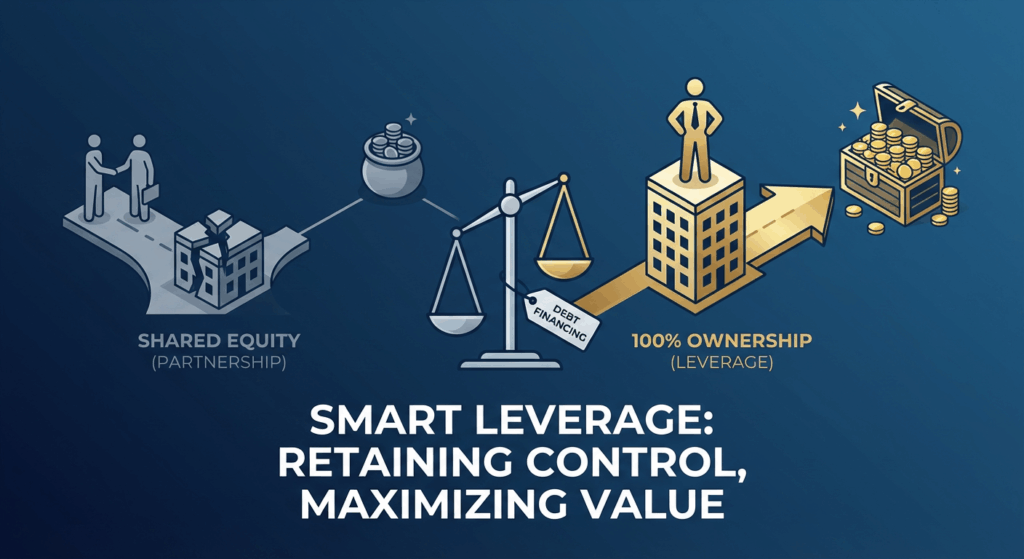
The Dilemma: To Sell or To Borow?
In the high-stakes world of middle-market dealmaking, the most expensive words a founder can hear are often “strategic partnership.”
Consider the scenario of “Apex Industrial” (a hypothetical manufacturer modeled after recent industrial rollups). By late 2025, Apex had quietly grown to $50 million in EBITDA. The founder, Sarah, faced a classic “good problem”: she had 90% of her net worth tied up in the business and wanted liquidity. However, she wasn’t ready to retire, nor was she interested in answering to a private equity board that would demand an exit in 3-5 years.
The offers on her desk were standard for the 2025 market:
- The PE Buyout: A sale of 60% of the company at a 10x multiple ($500M EV). Sarah pockets $300M pre-tax but becomes an employee in her own company.
- The Growth Equity Deal: Sell 20% for $100M. She gets liquidity, but introduces a minority partner with blocking rights and an IPO clock.
Then came the third option: The Leveraged Recapitalization.
The Decision: Renting Capital vs. Selling the House
In July 2025, Bloomberg reported that private credit firms were aggressively pitching higher leverage and dividend recaps to win deals from banks. For founders like Sarah, this shifted the calculus.
Instead of selling equity, Sarah explored “renting” the capital. The proposal looked like this:
- Loan Amount: $225 million (4.5x EBITDA).
- Structure: Unitranche facility from a direct lender.
- Use of Proceeds: $175 million dividend to shareholders; $50 million to the balance sheet for acquisitions.
- Cost: SOFR + 550 basis points (expensive, but non-dilutive).
The math was stark. Selling 20% equity meant giving away 20% of all future upside forever. Borrowing $225M meant paying interest, roughly $25M annually at current rates, but retaining 100% of the equity appreciation.
Sarah chose the debt. “I can pay off the loan,” she reasoned. “I can never buy back the equity at the price I sold it.”
The Outcome: Speed and Control
In this scenario, Apex Industrial used the debt not just for liquidity, but for offense. Because private credit lenders in 2025/2026 focused on cash flow rather than rigid governance, Sarah maintained operational autonomy. She didn’t have a board meeting to approve her next acquisition; she just had to stay within her leverage covenants.
This mirrors real-world strategies seen at the top of the market. For instance, in April 2025, Clearlake Capital utilized a $5.75 billion bridge loan to acquire Dun & Bradstreet rapidly. While that was a massive take-private deal, the principle holds: debt offers speed and certainty that equity financing (with its roadshows and diligence) often cannot match.
By 2030, assuming Apex grows EBITDA to $100M (a conservative 15% CAGR):
- Equity Path outcome: Sarah owns 80%. Value: $800M (at 10x). Net Worth: $640M.
- Debt Path outcome: Sarah owns 100%. Value: $1.0B. Less remaining debt (~$150M after paydown). Net Worth: $850M.
By keeping the equity, she captured the “compounding premium.” The cost of debt was high, but the cost of equity would have been $210 million higher.
The Lessons: When Leverage Works
The “First Brands” model, referencing the secretive automotive group that scaled to billions in debt to fund acquisitions while staying private, demonstrates that for cash-generative businesses, debt is often the superior fuel for growth.
However, this strategy is not risk-free. It requires:
- Predictable Margins: High leverage kills cyclical businesses. Apex worked because industrial parts have sticky demand.
- Disciplined Capital Allocation: The cash flow must service debt first. There is no room for vanity projects.
- Interest Rate Hedging: In a volatile rate environment, floating rate debt can suffocate a company if not properly hedged.
Framework for Founders
If you are facing a capital decision today, ask three questions:
- Is the need for capital permanent or temporary? If you need liquidity now but expect growth later, debt is temporary; equity release is permanent.
- What is your “Return on Control”? If you believe you can outperform the market, keeping 100% control is valuable. If you need a partner to fix the business, sell the equity.
- Can the balance sheet handle the stress? Look at your worst-case EBITDA coverage ratio. If it drops below 1.5x, the debt is too risky.


