
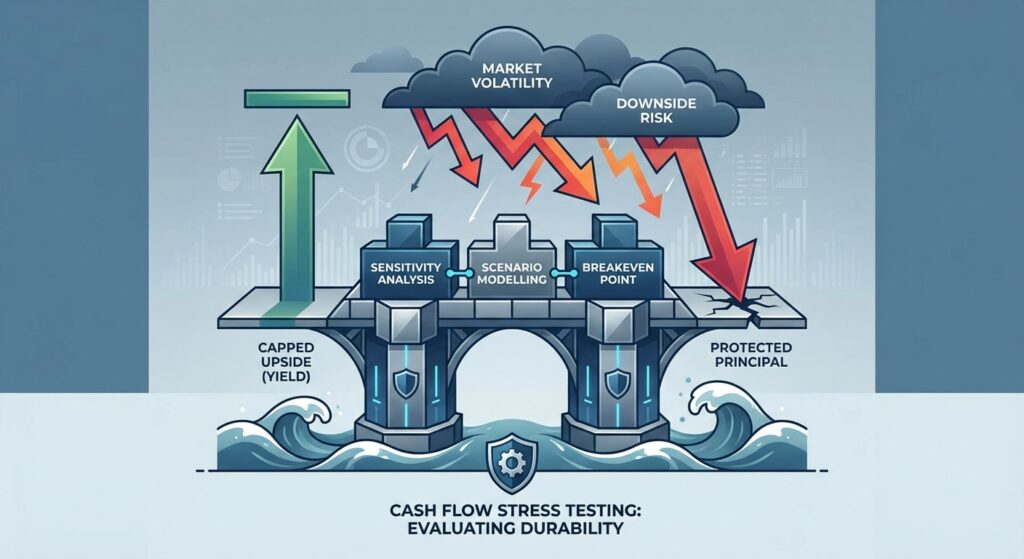
The Underwriting Challenge: Survival, Not Growth
In equity investing, the upside is theoretically infinite. In credit investing, the upside is capped at the yield, but the downside is 100% of the principal. Consequently, the primary job of a credit underwriter is not to identify growth, but to identify durability. The central tool for measuring durability is cash flow stress testing.
Static financial models (those that project a steady “up and to the right” growth trajectory) fail to capture the reality of economic cycles. Experienced underwriters know that the borrower’s ability to service debt is rarely tested in the base case; it is tested when a major customer leaves, when raw material prices spike, or when a recession contracts demand. This article outlines the rigour required to stress test a middle-market credit opportunity effectively.
The Framework: Operating Leverage and Sensitivity
Effective stress testing requires moving beyond simple revenue haircuts. It demands an understanding of a company’s operating leverage: the ratio of fixed costs to variable costs. A company with high fixed costs will see margins compress significantly faster than revenue during a downturn.
A robust stress test framework evaluates three distinct layers:
- Sensitivity Analysis: Changing one variable (e.g., SOFR +200bps) to isolate specific risks.
- Scenario Analysis: Combining multiple adverse events (e.g., recession scenario: Revenue -10%, COGS +5%, Interest Rates +2%).
- Breakeven Analysis: Solving for the maximum decline in revenue or margin before the Fixed Charge Coverage Ratio (FCCR) breaches 1.0x (default level).
According to the Basel Committee on Banking Supervision’s 2025 Principles for the Management of Credit Risk, banks must operate under a sound credit-granting process that specifically assesses profits under “evolving economic environments.” This means underwriters must model the correlation between risks, not just the risks in isolation.
The Analysis: Stressing a $10M EBITDA Manufacturer
Consider a hypothetical manufacturing borrower, “AlphaCorp,” with the following profile:
- Revenue: $50 Million
- EBITDA: $10 Million (20% Margin)
- Debt Service: $5 Million (Principal + Interest)
- Base Case FCCR: 2.0x
A novice underwriter might apply a 10% revenue haircut and assume margins stay flat. However, a rigorous analysis accounts for sticky fixed costs.
Step 1: Determine Cost Structure
Assume AlphaCorp’s COGS are 60% variable, but SG&A is 90% fixed.
Base Case: Revenue $50M – COGS $30M – SG&A $10M = $10M EBITDA.
Step 2: Apply the Stress (The “Downside Case”)
Let’s model a 15% revenue decline due to a lost contract.
- New Revenue: $42.5 Million
- New COGS: Variable portion drops, fixed portion stays. Adjusted COGS = $27M (approx).
- New SG&A: Remains largely static at $10M.
- Resulting EBITDA: $5.5 Million.
Step 3: Impact on Covenants
The EBITDA dropped by 45% ($10M to $5.5M) despite revenue only dropping 15%. This is the danger of operating leverage.
New FCCR: $5.5M EBITDA / $5.0M Debt Service = 1.1x.
In this scenario, AlphaCorp survives but barely. If the stress test included a simultaneous rise in interest rates (increasing debt service to $5.6M), the company would default (FCCR < 1.0x). This analysis reveals that AlphaCorp is highly sensitive to volume declines.
Industry Standards and Red Flags
Institutional lenders and regulators, including the OCC (Office of the Comptroller of the Currency), emphasize that stress testing should drive the loan structure, not just be a checking-the-box exercise. In their Loan Portfolio Management handbook, the OCC highlights that concentration management and stress testing are vital for identifying risks embedded in the portfolio.
Common Red Flags in Models:
- Variable Cost Optimism: Assuming SG&A will decrease linearly with revenue. In reality, you cannot fire the accounting department just because sales dropped 10%.
- Capex Flexibility Fallacy: Assuming Maintenance Capex can be cut to zero. Machinery breaks regardless of the economy; deferring maintenance usually accelerates long-term failure.
- Working Capital Ignorance: Failing to model the cash trap of inventory build-up when sales slow down.
Data Context
When structuring syndicated loans, lenders often look for a “cushion” of 25-30% in the breakeven analysis. For example, if a business breaks even at a 15% revenue decline, it is often considered too risky for senior secured lending unless it has significant asset coverage.
Underwriting Checklist: The Stress Test
Before issuing a Term Sheet or Commitment Letter, the underwriting team should validate the following:
- Variable vs. Fixed Validation: Have we reviewed the General Ledger to confirm which line items are truly variable?
- Customer Concentration: If the top customer (20% of sales) leaves, does the FCCR stay above 1.1x?
- Interest Rate Shock: Can the borrower service debt if SOFR rises by 200 basis points? (See Syndicated Loans Demystified regarding interest rate cycles).
- Contractual Pass-Throughs: If raw material costs rise 10%, how many days does it take to pass price increases to customers? A 90-day lag can drain liquidity.
- Liquidity Bridge: Does the Revolver availability cover the cash burn operationally during the first 6 months of the stress scenario?
Key Takeaways
- Upside pays yield, downside takes principal: Focus 90% of analysis on the downside case.
- Operating leverage magnifies risk: Small revenue dips can cause massive EBITDA contractions in high-fixed-cost businesses.
- Correlation matters: Recessions often bring simultaneous revenue drops and margin compression.
- Cash is king: FCCR is an accounting metric; ensure actual liquidity (cash on hand + revolver) is sufficient to weather the storm.
- Structure for safety: Use the stress test results to set financial covenants (e.g., minimum EBITDA) that trip before the company runs out of cash.


