
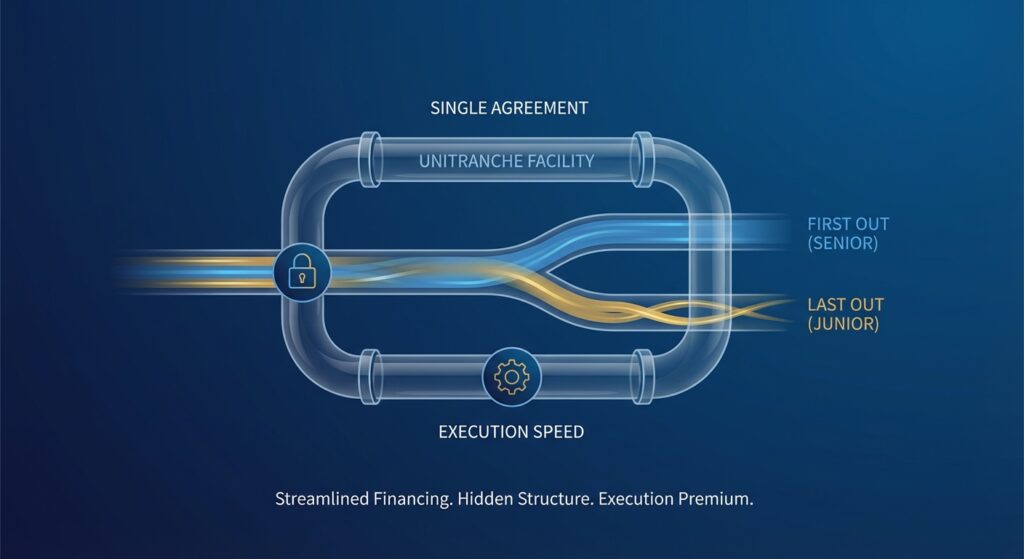
The Execution Premium: Deconstructing the Unitranche Mechanism
In the high-velocity world of middle-market buyouts, speed often trumps price. This preference for certainty has fueled the dominance of unitranche financing, a structure that now underpins approximately 80% of North American buyout financing by deal count. While the headline rate may appear higher than syndicated solutions, the unitranche offers a strategic trade-off: a streamlined, single-document facility that eliminates syndication risk and accelerates closing timelines.
For operators and sponsors, understanding the internal mechanics of a unitranche, specifically the hidden “First Out/Last Out” waterfall, is critical to negotiating leverage, pricing, and covenants effectively in 2026.
Structure Breakdown: Components and Mechanics
At its core, a unitranche facility combines senior and subordinated debt risk into a single instrument with one blended interest rate and one set of loan documents. Unlike a traditional first/second lien structure, there is no intercreditor agreement between public lenders. Instead, the complexity is handled privately behind the scenes.
The “Invisible” Bifurcation
While the borrower sees a single loan, lenders often bifurcate the facility via an Agreement Among Lenders (AAL). This agreement splits the loan into two synthetic tranches:
- First Out (Senior): Lower risk, lower yield. Often held by banks or conservative BDCs.
- Last Out (Junior): Higher risk, higher yield. Held by credit funds seeking enhanced returns.
Example: The $50M Software Buyout
Consider a hypothetical acquisition of a B2B software company with $10M EBITDA at a $100M Enterprise Value. The sponsor requires $50M in debt financing (5.0x leverage).
The Borrower’s View (Unitranche Term Sheet):
- Facility Size: $50M Term Loan
- Pricing: SOFR + 675 bps (Blended)
- Amortization: 1.0% per annum
- Documents: Single Credit Agreement
The Lenders’ View (Back-End Bifurcation):
- Tranche A (First Out): $30M allocated at SOFR + 475 bps. Priority claim on cash flow.
- Tranche B (Last Out): $20M allocated at SOFR + 975 bps. Subordinated claim.
The lender generates a blended return that matches the borrower’s rate, while custom-fitting risk profiles for different capital providers.
How It Compares: Unitranche vs. Traditional Stack
The primary alternative to unitranche is a traditional Senior/Mezzanine split or a Broadly Syndicated Loan (BSL). The choice depends largely on the premium a borrower is willing to pay for execution speed.
| Feature | Unitranche | Traditional Senior/Mezz |
|---|---|---|
| Execution | Single counterparty, fast close (30-45 days) | Multiple lenders, slower (60-90 days), syndication risk |
| Cost | Higher (Illiquidity premium included) | Lower weighted average cost of capital (WACC) |
| Documentation | Single Credit Agreement + AAL | Separate Credit Agreements + Intercreditor Agreement |
| Covenants | Typically 1-2 financial covenants (e.g., Net Leverage) | Mixed: Maintenance (Senior) + Incurrence (Mezz) |
Sponsors frequently justify paying 50 to 100 basis points of extra spread for unitranche facilities to avoid “flex” terms, where banks can change pricing if the loan is hard to syndicate, and to eliminate the friction of managing two distinct lender groups.
Current Market Terms (2025-2026)
Following a robust 2024, the private credit market has stabilized with specific standards for middle-market borrowers.
- Pricing & Yields: New private credit deals in the core middle market are seeing all-in yields in the 12-13% range. Competition among direct lenders has kept spreads from blowing out, despite base rate fluctuations.
- Leverage Profiles: Total leverage for sponsored deals is hovering around 5.0x EBITDA. Lenders remain disciplined, focusing heavily on free cash flow conversion and covenant headroom rather than purely maximizing debt multiples.
- Deal Size: The “Jumbo Unitranche” consists of facilities exceeding $2 billion, proving this structure is no longer limited to the lower middle market. Large asset managers are clubbing together to take down massive tranches that previously required public bond markets.
Structuring Guidance & Negotiation
For Operators (Borrowers):
- Define “EBITDA” Carefully: Since leverage covenants are tight (often set with 25-30% headroom), the definition of EBITDA (specifically add-backs for synergies and transaction costs) is the most critical negotiation point.
- Portability: Negotiate for portability provisions, allowing the debt to stay in place if the company is sold again. This adds value to the next buyer in a high-rate environment.
For Investors (Lenders):
- Scrutinize the AAL: In a workout scenario, the Agreement Among Lenders dictates voting rights. “Last Out” lenders must ensure they have standstill protections and purchase options to buy out the “First Out” lender if the company underperforms.
Key Takeaways
- Speed Premium: Borrowers pay ~50-100 bps more for unitranche to gain execution certainty and speed (closing 30+ days faster than syndicated deals).
- Synthetic Structure: The “single” loan is often chemically separated into First Out/Last Out tranches via a private Agreement Among Lenders (AAL).
- Market Dominance: Unitranche structures now support ~80% of private equity buyouts, scaling from $50M deals to $2B+ jumbo facilities.
- Simplicity: A single credit agreement reduces legal costs and administrative burden compared to managing separate senior and junior creditor classes.
- Leverage Limits: Current market tolerance sits near 5.0x EBITDA, with lenders prioritizing cash flow coverage over asset value.


