
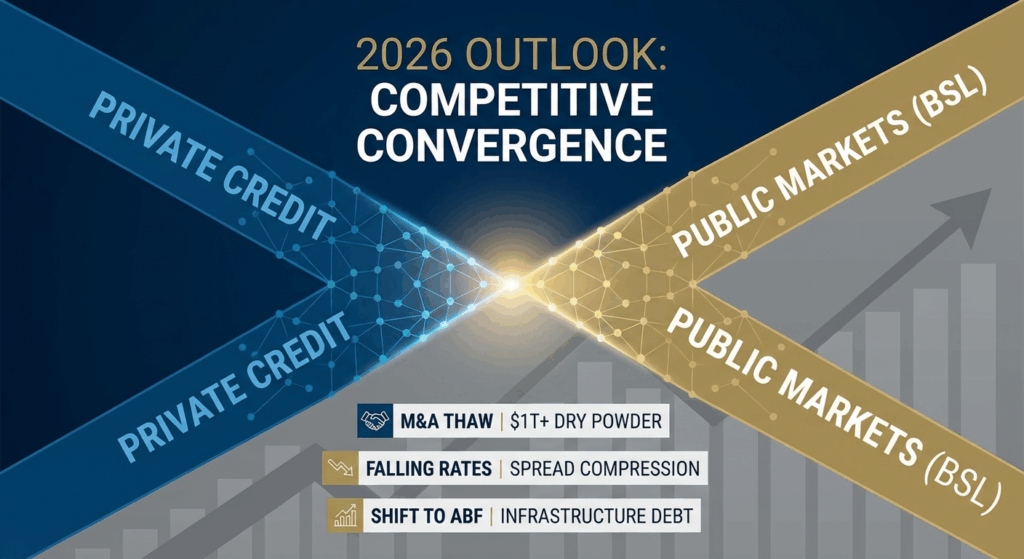
Market Headline: Private Credit Enters Era of “Competitive Convergence” as M&A Thaws
As markets settle into 2026, the private credit landscape is pivoting from a defensive “higher-for-longer” stance to an aggressive deployment phase driven by falling rates and pent-up demand. The prevailing theme for Q1 2026 is competitive convergence: the broadly syndicated loan (BSL) market has roared back to record activity levels, putting immense pressure on private credit spreads and forcing direct lenders to seek yield in complex Asset-Based Finance (ABF) and infrastructure debt.
Following a 2025 defined by opportunistic refinancing and repricings, the industry is bracing for a release of the M&A valve. With global private equity buyout dry powder exceeding $1 trillion and the Federal Reserve deep into its easing cycle, sponsors are finally preparing to exit vintage investments. However, the easy returns of the post-2022 liquidity crunch are over. Private credit managers now face a borrower-friendly environment characterized by tightening spreads, looser documentation, and fierce competition from traditional banks re-entering the fray.
Quantitative Snapshot: Key Market Metrics
The data signal a market awash in liquidity with improved risk appetite. Deal volumes in the public markets have surged, forcing private credit lenders to compress spreads to remain competitive. Below is the current market state as of early 2026.
| Metric | Current Level / Trend | Prior Period / Context | Source |
|---|---|---|---|
| Syndicated Loan Volume | $404 Billion (Q3 ’25 Record) | Highest quarterly total on record; significant rebound from 2024 lows. | Portage Point |
| ABF Spreads | Tightening 10–30 bps | Compression observed in Q3-Q4 2025 due to stable investor appetite. | MetLife |
| Private Credit AUM | >$2 Trillion (Est. 2026) | Projected to approach $4T by 2030 as growth accelerates. | Moody’s |
| PE Dry Powder | >$1 Trillion | Near historic highs, fueling anticipated 2026 M&A surge. | Northleaf |
| Primary Use of Proceeds | Refinancing / Repricing | New money M&A lagged in 2025 (~18% of issuance); expected to flip in 2026. | Portage Point |
Sector Analysis: The Pivot to Asset-Based Finance
With corporate direct lending spreads compressing due to BSL competition, capital is rotating into sectors offering complexity premia and structural protections.
1. Asset-Based Finance (Hot):
ABF is emerging as the primary growth engine for 2026. Moody’s reports that financial innovation is driving allocators toward “diverse pools of assets,” specifically consumer loans and data infrastructure. Recent data indicates spread tightening of 10–30 basis points in bilateral club transactions, yet yields remain accretive compared to corporate vanilla debt. Non-bank lenders are filling voids where bank capital regulation remains restrictive.
2. Digital Infrastructure & Power (Hot):
Infrastructure debt is seeing robust activity driven by the AI/data center boom. MetLife reported continued strong demand for renewable and data center projects in late 2025, supporting long-dated issuance. The recurring revenue nature of these assets provides a hedge against potential economic softness, even as rates decline.
3. Corporate Lending / LBOs (Recovering / Competitive):
The traditional bread-and-butter of private credit, corporate LBO financing, is becoming a battleground. While M&A volumes were “disappointing” in 2025, expectations for 2026 are bullish. However, lenders face a “technical imbalance” where robust demand for assets outstrips supply, leading to spread compression. The middle market continues to offer a healthy return premium relative to public debt, but the gap is narrowing.
Implications for Market Participants
For Borrowers (Sponsors & Corporates):
This is unequivocally a borrower’s market. Options are plentiful as the syndicated loan market offers a viable, lower-cost alternative to private credit for large caps. Sponsors can drive aggressive terms, demanding tighter spreads, greater portability, and looser covenants. The 2026 vintage aimed at optimizing capital structures, refinancing expensive 2023-2024 paper, will likely yield significant interest expense savings.
For Lenders & Investors:
The “Golden Age” of easy 12% yields on senior secured paper has passed. To maintain returns, managers must embrace complexity. This means increasing allocation to ABF, exploring NAV lending, and utilizing structured credit tools. Lenders staying strictly in the plain-vanilla corporate lane will face margin erosion and heightened repayment risk as borrowers refinance into cheaper public markets. Relationship banking and speed of execution will once again become key differentiators over pure pricing.
Forward Outlook (6 Months):
Expect a surge in “Jumbo” unitranche deals being taken out by the BSL market or repriced aggressively. As the Fed continues easing, the floating-rate advantage will diminish, prompting a potential rotation of retail capital. Watch for increased contagion risk between private funds and traditional banks as partnerships deepen to fund large-scale origination.
Key Market Insights
- M&A Thaw Imminent: $1T+ in dry powder combined with stable rate outlooks will unlock deal flow in H1 2026.
- Spread Compression: BSL resurgence is capping pricing power in the upper-middle market; spreads are at multi-year lows.
- The Alpha is in ABF: Allocations are shifting from corporate cash-flow lending to asset-based finance (consumer, data infra) to find yield.
- Refi Wave Continues: Opportunistic refinancing will dominate Q1/Q2 activity before new money LBOs take over.
- Hybrid Convergence: The line between private credit and syndicated loans is blurring, with banks and funds partnering on massive originations.


