
Introduction: Risk, Return, and the Priority of Payment
In the world of private credit, the interest rate (or yield) is often the headline number that attracts attention. However, for sophisticated credit investors and prospective borrowers, the most critical metric is not the return on capital, but the return of capital.
The mechanism that determines who gets paid back first during a default or liquidity event is known as value placement within the Capital Stack. This structural hierarchy dictates the order of payment and, by extension, the risk profile of the investment.
Understanding where a loan sits in this stack is the fundamental starting point for evaluating private credit deals. For business owners, it clarifies why different lenders charge vastly different rates. For investors, it explains how “senior secured” loans can remain resilient even when the underlying company loses value.
The Concept: The Capital Stack Hierarchy
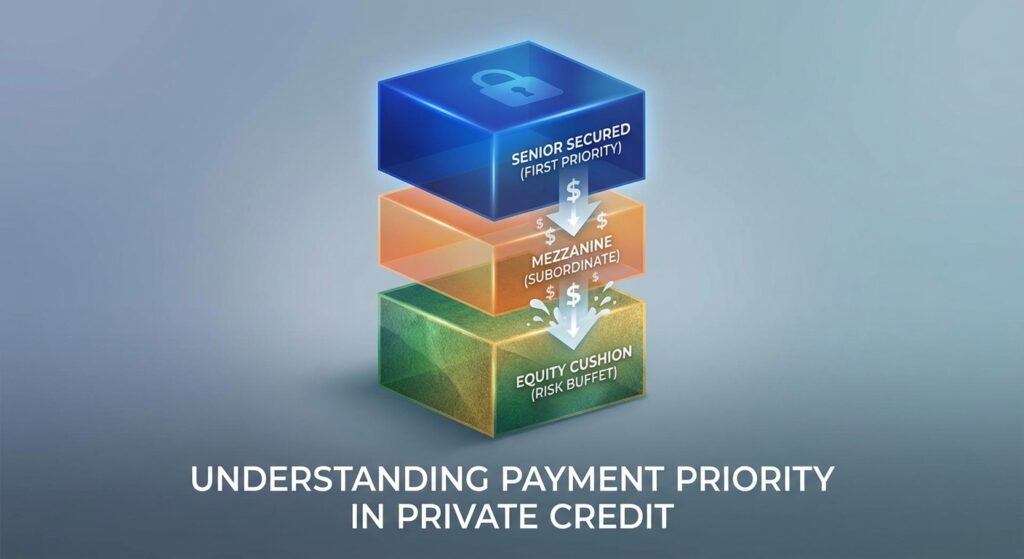
Think of a company’s capital structure as a layer cake of funding sources. Every layer has a specific priority (seniority) regarding claims on the company’s assets and cash flows.
- Senior Secured Debt: Sits at the very top. This is typically the “First Lien” debt. It has the first claim on assets and cash flow. Because it is the safest spot, it yields the lowest return in the stack (though often higher than public market equivalents).
- Junior / Mezzanine Debt: Sits in the middle. It is “subordinate” to senior debt. Lenders here only get paid after the senior lenders are satisfied. To compensate for this higher risk, they charge higher interest rates and may ask for equity warrants.
- Equity: Sits at the bottom. This includes Common and Preferred Stock. Equity holders take the most risk, they are the first to lose money if the company’s value drops, but they also enjoy uncapped upside potential if the company grows.
The distance between the loan amount and the total enterprise value is called the Equity Cushion. This cushion acts as a shock absorber for lenders.
How It Works: The “Waterfall” of Repayment
To visualize the protective power of seniority, let’s look at a concrete, hypothetical acquisition scenario involving a mid-sized software company.
The Setup:
A Private Equity firm buys “TechCo” for an Enterprise Value (EV) of $100 million.
The deal is financed (the “Sources of Capital”) as follows:
- $50 Million Equity: Cash put in by the PE sponsor (The Cushion).
- $50 Million Senior Secured Loan: Provided by a private credit fund (The Debt).
Scenario A: Success
TechCo grows and sells for $150 million. The debt is repaid ($50M + interest), and the equity holders keep the remaining $100M, doubling their money.
Scenario B: Distress (The Downside Protection)
TechCo struggles. The market turns, and the company is forced to liquidate or sell for just $60 million (a 40% loss of enterprise value).
Here is the repayment “waterfall”:
- Senior Lender: Owed $50M. Since $60M is available, they are repaid in full (100% recovery).
- Equity Holder: Owed theoretically unlimited upside, but they have a claim only on the residual value. $60M proceeds – $50M debt = $10M remaining. They lose $40M of their initial investment.
The Insight: Even though the business lost 40% of its value, the senior lender lost $0. This is because the structurally subordinated equity layer absorbed the entire blow. This structural reality is why managers like T. Rowe Price emphasize that senior loans “sit at the top of a company’s capital structure,” providing significant insulation against losses.
Current Market Relevance
As we move through 2026, the data from the past 24 months underscores why capital stack positioning remains a primary focus for allocators.
- Market Scale: According to PitchBook, the private debt market surpassed $2 trillion in assets under management by recent estimates. As the market grows via non-bank lending, the differentiation between senior and junior tranches has become sharper.
- Flight to Quality: Institutional reports from managers like Blackstone highlight that private loans are typically structured as senior secured with a “meaningful cushion” of junior debt and equity below them. This “defensive income” strategy has driven the bulk of recent inflows.
- Sponsor Equity Levels: In the current vintage of buyouts, private equity sponsors are often contributing 40% to 50% of the purchase price in equity. This historically high equity contribution thickens the “cushion” for lenders, making the senior debt tranche structurally safer than in highly leveraged eras of the past.
- Rising Rates & Floating Coupons: With most private credit structured as floating-rate debt (as noted by Golub Capital), the cost of debt has risen. This increases the burden on borrowers, making the senior position even more vital for lenders, as cash flows are first diverted to service senior interest before any residual cash can support junior tranches or equity distributions.
Decision Framework
Whether you are allocating capital or seeking it, understanding the stack dictates your strategy.
For Investors (Lenders)
When evaluating a private credit fund or specific deal, look beyond the yield:
- Check the Attachment Point: At what valuation does your principal risk begin? If a loan is 50% Loan-to-Value (LTV), the company value must drop by half before you lose a dollar.
- Analyze the Cushion: Who is below you? A large equity check from a reputable PE sponsor suggests they will fight hard (and inject more capital) to save the company, indirectly protecting the lender.
For Operators (Borrowers)
When raising capital, the stack represents a trade-off between Cost and Control:
- Senior Debt is Cheaper: It costs less (lower interest rate) because it is safer. However, it comes with stricter covenants and liens on assets.
- Equity is Expensive: Selling equity avoids monthly interest payments, but you dilute your ownership forever.
- The Balance: Operators often use senior debt to minimize dilution, but must ensure their cash flows are robust enough to service that debt first, because the senior lender gets paid before the owner takes a profit.
Key Takeaways
- Seniority Equals Priority: In a liquidation, Senior Secured lenders are paid first. Junior lenders and Equity holders only get what is left.
- The Equity Cushion is Key: The thicker the layer of equity usage below the debt, the safer the loan. A 50% LTV loan can survive a 40% drop in company value without realizing a loss.
- Risk/Return Trade-off: Senior debt offers lower yields than mezzanine or equity but offers capital preservation. It is designed for “Defensive Income.”
- Floating Rate Protection: Most private credit loans are floating rate, protecting the lender’s real return in inflationary environments, but increasing pressure on the borrower’s cash flow.
- Sponsor Support: In private credit, the presence of a strong equity sponsor often provides an implicit safety net, as sponsors are incentivized to inject cash rather than lose their position in the stack.


