
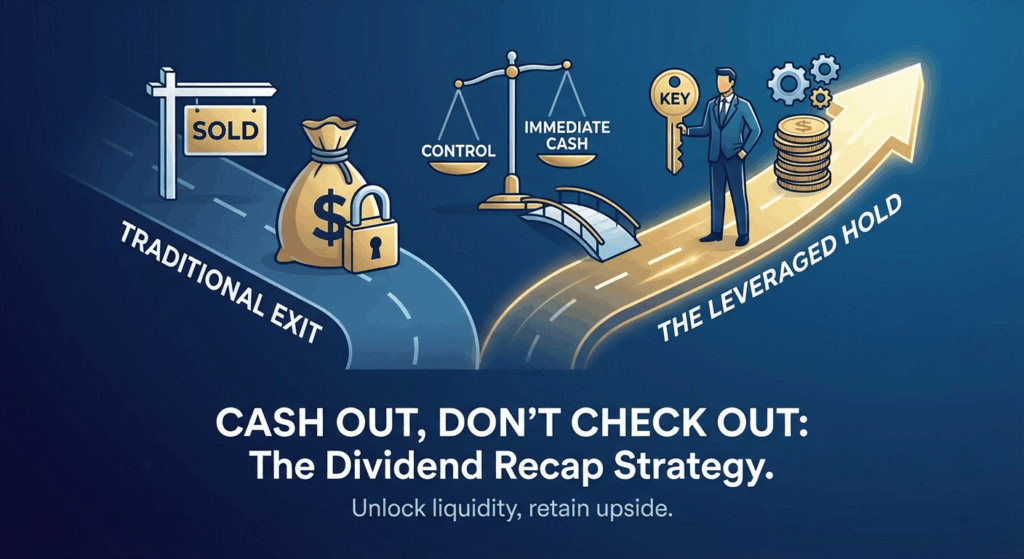
The Dilemma
For decades, the founder’s journey had a binary destination: IPO or M&A. If you built a company to meaningful scale, your liquidity was tied to your exit. To get the cash, you had to give up the keys.
But a quiet shift in the capital markets has created a third door. As private credit matures and competition among lenders intensifies, founders are increasingly utilizing dividend recapitalizations to unlock massive liquidity while retaining operational control and future equity upside.
This isn’t just a strategy for private equity titans anymore. By late 2025, it became a cornerstone playbook for bootstrapped founders and family-owned operators.
Case Study: The $25M EBITDA Crossroads
Note: The following is a hypothetical scenario illustrating structure and outcomes based on current market lending terms.
Consider "Apex Logistics," a bootstrapped supply chain software provider. By Q4 2025, Apex hit $25 million in EBITDA. The founder, "James," owned 100% of the business but had nearly all his net worth tied up in the company. He wanted to buy a house, secure his family’s future, and diversify.
James faced two distinct offers:
Option A: The Strategic Sale (The Exit)
A strategic acquirer offered a 12x multiple.
Valuation: $300 Million
Outcome: James walks away with ~$240 million (after taxes and fees) but becomes an employee with an earn-out. The "Apex" brand is absorbed, and he loses control of the culture he built.
Option B: The Dividend Recap (The Leveraged Hold)
Instead of selling, James explored the private credit market. With lenders "pitching higher leverage ratios as a sweetener," as reported by Bloomberg in July 2025, Apex was an attractive borrower. High margins, recurring revenue, and low churn allowed the company to support 4.5x leverage.
The Transaction:
Apex raises a $112.5 million Unitranche facility.
Use of Proceeds: $100 million distributed to James as a special dividend; $12.5 million stays on balance sheet/transaction fees.
Ownership: James retains 100% equity.
The Outcome: Liquidity Without Departure
James chose Option B. Here is why the math worked in his favor:
- Immediate Cash: He secured $100 million in liquidity, enough to solve all personal financial anxieties forever.
- Retained Upside: Fast forward three years. If Apex grows EBITDA to $35 million and pays down $30 million of debt, the enterprise value (at the same 12x multiple) grows to $420 million.
- The Second Bite: James’s equity value in three years would be ~$337 million ($420M EV minus ~$82M remaining debt).
Total value captured in Option B (Dividend + Future Equity) = $437 million.
Total value in Option A (Sale) = $300 million.
By renting capital instead of selling equity, James effectively arbitraged the cost of debt against his company’s growth rate.
The Market Shift
Apex’s story aligns with broader market data. In the first half of 2024 alone, dividend recapitalizations successfully funded $30.2 billion in payouts, matching 2021 records, according to Bloomberg. By mid-2025, this trend accelerated as private credit firms, facing stiff competition from syndicated markets, began offering more flexible terms to win deals.
Private equity firms have long used this tool to return capital to LPs while extending hold periods. Now, sophisticated individual operators are realizing they can access the same toolkit. As noted by Fortune, the dominance of players like Ares Management has deepened the pool of capital available for these non-dilutive structures.
Lessons for Founders
The "Leveraged Hold" isn’t for everyone. It requires a business with predictable cash flows capable of servicing debt. However, for the right company, it offers a superior risk-adjusted path.
Key Takeaways:
- Debt is Cheaper Than Equity: Selling 100% of your business ends your compounding journey. Borrowing against cash flow allows you to compound tax-efficiently.
- Control Have Value: A recap allows you to act as Chairman/Owner rather than an employee of an acquirer.
- Timing Matters: These deals rely on credit market liquidity. As seen in 2024-2025, when huge inflows of capital chase deals, terms loosen, favoring the borrower.
- Incentives Align: Unlike venture capital, debt providers don’t need 10x returns; they need stability. This often aligns better with cash-flowing mature businesses than VC expectations.
In a world where "Exits" are celebrated, the savviest move in 2026 might just be the decision to stay.


