
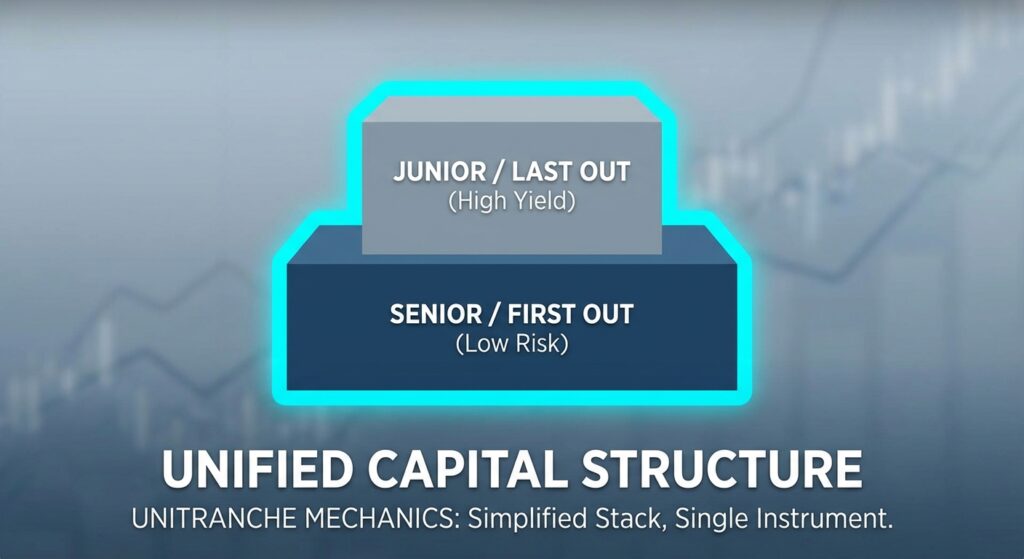
The Financing Challenge: Certainty vs. Cost
In the current middle-market landscape, financial sponsors and operators face a persistent trade-off: pursue the lower cost of capital available in the syndicated loan market, or optimize for the speed and certainty of private credit. While broadly syndicated loans (BSLs) often offer lower headline rates, they introduce “market flex” risk and execution uncertainty. The structural solution that has come to dominate North American buyouts, accounting for roughly 80% of financings by deal count, is the unitranche facility.
A unitranche loan combines senior and subordinated risk into a single debt instrument with one blended interest rate and one set of loan documents. For borrowers, this means administrative simplicity. For lenders, it allows for creative risk-sharing behind the scenes. This article breaks down the mechanics of the unitranche structure, typically defined by an Agreement Among Lenders (AAL), and analyzes why it has displaced traditional senior-subordinated stacks.
Structure Breakdown: Mechanics & AAL
To the borrower, a unitranche facility appears as a single term loan. However, the internal engineering often involves a bifurcated risk structure known as “First Out / Last Out” (FOLO).
The Agreement Among Lenders (AAL)
Unlike a public Intercreditor Agreement used in senior/mezzanine deals, the AAL is a private contract between lenders. It establishes two distinct tranches within the single facility:
- First Out Tranche: Often held by a bank or low-cost lender. They get paid first in a waterfall and carry lower risk (lower return).
- Last Out Tranche: Held by a direct lender or credit fund. They take the “junior” risk attachment point and receive a higher yield.
Detailed Term Sheet Example
Consider a hypothetical acquisition of a $100M Enterprise Value (EV) software company by a private equity sponsor. The financing need is $50M (50% LTV).
Headline Terms (Borrower View):
- Facility Size: $50,000,000
- Interest Rate: SOFR + 650 bps (Blended)
- Amortization: 1.0% per annum
- Maturity: 5 Years
- Covenants: Max Total Net Leverage of 5.50x, stepping down to 5.00x after 24 months.
Behind the Scenes (Lender Structure):
- Tranche A (First Out): $30M provided by a commercial bank.
- Risk Pricing: SOFR + 400 bps
- Attachment: 0.0x to 3.0x Leverage
- Tranche B (Last Out): $20M provided by a private credit fund.
- Risk Pricing: SOFR + 1025 bps
- Attachment: 3.0x to 5.5x Leverage
- Blended Rate Calculation: (($30M * 400) + ($20M * 1025)) / $50M = ~650 bps spread.
The borrower pays the single invoice at S+650, and the administrative agent splits the proceeds according to the AAL.
How It Compares: Unitranche vs. Senior/Mezzanine
The primary alternative to unitranche is a traditional stacked capital structure involving a senior term loan and separate subordinated debt (mezzanine).
Trade-offs
- Execution Speed: Unitranche deals can close in 4–5 weeks compared to 8–10 weeks for syndicated structures. There is no need to syndicate the debt to a broad group of institutional investors, eliminating “flex” terms where arrangers can change pricing last minute.
- Cost: Unitranche borrowers typically pay a “illiquidity premium” of 50–100 bps over syndicated markets. However, when factoring in the legal costs of negotiating two separate credit agreements (senior and mezz) and an intercreditor deed, the total cost of execution often narrows.
- Control: In a unitranche structure, the borrower deals with one agent. In a restructuring scenario, this prevents the “blocking” rights that junior creditors might hold in a traditional structure.
Current Market Terms & Trends
As of late 2025 and early 2026, the unitranche market has matured significantly, moving up-market to finance multi-billion dollar buyouts (“Mega-Unitranches”). Recent data highlights several key benchmarks:
- Leverage Profiles: Total leverage in sponsored middle-market deals spans 4.5x to 5.5x EBITDA, with lenders focusing heavily on loan-to-value (LTV) ratios, generally capping lending at 50-60% LTV.
- Yields: All-in yields stabilized in the 10-12% range for most of 2025, down slightly from the 12-13% peaks seen in 2024.
- Call Protection: Lenders continue to enforce strict call protection to lock in yields. Standard terms are 102/101/Par (2% penalty in Year 1, 1% in Year 2, Par thereafter) or Non-Call 1 (NC-1) provisions.
- Asset Management: With global private credit AUM exceeding $2.1 trillion, funds have ample dry powder, driving competition on terms like “covenant-lite” documentation for larger credits ($100M+ EBITDA), though smaller deals retain maintenance covenants.
Structuring Guidance & Negotiation
For Operators and Sponsors:
- Accordion Features: Negotiate pre-baked “incremental facilities” (accordions) that allow you to borrow additional capital for acquisitions up to a certain leverage cap (e.g., maintain 5.0x) without renegotiating the whole document.
- EBITDA Definitions: The battleground is not the headline rate, but the EBITDA definition. Ensure “Add-backs” for synergies and one-time costs are well-defined to prevent technical defaults on leverage covenants.
- Holiday Clauses: Ask for “Equity Cure” rights, allowing sponsors to inject equity to cure a financial covenant breach, which keeps the loan performing.
For Investors:
- Documentation Risk: In a unitranche, the AAL is your primary protection. Ensure clear voting rights on material amendments (e.g., releasing collateral, extending maturity) are not solely controlled by the majority lender if you hold the minority “Last Out” position.
- Bankruptcy Mechanics: Verify that the AAL includes a “purchase option” allowing the Last Out lender to buy out the First Out lender at par in a distress scenario to take control of the workout process.
Key Takeaways
- Integration: Unitranche simplifies the capital stack into one instrument, removing intercreditor friction and accelerating closing timelines by 30-45 weeks.
- Invisible Mechanics: The “First Out / Last Out” split allows lenders to bifurcate risk and return without complicating the borrower’s interface.
- Premium Pricing: Borrowers pay ~50-100 bps more for certainty, but save on syndication risk and duplicate legal fees.
- Covenant Flexibility: While costly, this structure often offers greater flexibility on leverage definitions and incrementally drawing capital (accordions) compared to banks.
- Market Dominance: With private credit funding ~80% of buyouts, this is now the standard for deal execution over $50M EBITDA.


